Showing posts with label Great Powers. Show all posts

Friday, June 8, 2012

Nuclear talks fail between UN and Iran

The UN nuclear watchdog and Iran failed at talks Friday to unblock a probe into suspected atom bomb research by the Islamic state, a setback dimming any chances for success in higher-level negotiations between Tehran and major powers later this month.

Using unusually pointed language, the International Atomic Energy Agency said no progress had been made in the meeting aimed at sealing a deal on resuming the IAEA’s long-stalled investigation. It described the outcome as “disappointing.”

A few weeks ago, UN nuclear chief Yukiya Amano said he had won assurances from senior Iranian officials in Tehran an agreement would be struck soon.

Herman Nackaerts, the IAEA’s global head of inspections, said after the eight-hour meeting at its headquarters in Vienna no date for further discussions had been set.

The nuclear agency had been pressing Tehran for an accord that would give its inspectors immediate access to the Parchin military complex, where it believes explosives tests relevant for the development of nuclear arms have taken place and suspects Iran is cleaning the site of any incriminating evidence.

The United States, European powers and Israel want to curb Iranian atomic activities they fear are intended to produce nuclear bombs. The Islamic Republic says its nuclear program is meant purely to produce energy for civilian uses.

Six world powers were scrutinizing the IAEA-Iran meeting to judge whether the Iranians were ready to make concessions before a resumption of wider-ranging negotiations with them in Moscow June 18-19 on the decade-old nuclear dispute.

The lack of result may heighten Western suspicions Iran is seeking to drag out the two sets of talks to buy time for continuing uranium enrichment, without backing down in the face of international demands it suspend its sensitive work.

“It should by now be clear to everyone that Iran is not negotiating in good faith,” a senior Western diplomat said.

A European envoy also accredited to the IAEA said, “This is a dismal outcome … Iran is simply wasting time with its evasions and refusal to engage.”

Mark Fitzpatrick, a former senior U.S. State Department official, now a director at the International Institute for Strategic Studies think-tank in London, said, “This situation is reminiscent of the Peanuts cartoon of Charlie Brown repeatedly believing Lucy this time will hold the football for him to kick, with her always snatching it away at the last minute, leaving him to fall flat.”

Ali Asghar Soltanieh, Iran’s IAEA ambassador, said after Friday’s talks work on a “structured approach” document, setting the overall terms for the IAEA investigation, would continue and there would be more meetings.

“This is a very complicated issue,” he said.

Asked about the Iranian envoy he replied, “That is in fact one of the problems. The more you politicize an issue which was purely technical it creates an obstacle and damages the environment.”

And so the debate over baubles that will never be used goes on, while the world that created them crumbles.

Spanish banks need $46 billion, IMF says in audit

The International Monetary Fund said late Friday that Spain’s banks would need to raise at least 37 billion euros, or about $46 billion, in additional capital to guard against further economic deterioration in the country. That number will guide European policy makers as they seek to stabilize the Spanish financial system and prevent contagion to the rest of the euro zone.

The I.M.F. released its banking audit as Spain contemplates making a formal bailout request to Europe to help recapitalize its fragile banking system.

Spanish banks are struggling with significant losses on their housing portfolios, and they have been hurt by the country’s broader economic malaise. Last month, the Spanish government seized Bankia, the country’s biggest mortgage lender. And Spain’s borrowing costs have soared to close to record highs.

Spanish officials have said they would not request a bailout until they had reviewed audits by the I.M.F. and two independent consulting firms.

In a statement accompanying the audit, the fund said that the “core” of Spain’s financial sector is “well managed and appears resilient to further shocks.” But the report said that significant vulnerabilities remain, particularly among smaller banks and those with bigger exposure to the Spanish housing sector.

In the adverse scenario used in the stress tests, the Spanish economy would shrink 4.1 percent in 2012 and 1.6 percent in 2013. In that case, Spanish banks in aggregate would need to raise about 37 billion euros in cash to maintain their capital ratios at international standards.

But Spanish banks would likely need to raise far more than that to satisfy skittish international investors. The I.M.F. estimate did not include costs associated with restructuring, or losses on loans. Including such costs, the Spanish banking system would require as much as 100 billion euros, or about $125 billion, according to estimates by private firms.

“Going forward, it will be critical to communicate clearly the strategy for providing a credible backstop for capital shortfalls — a backstop that experience shows it is better to overestimate than underestimate,” Ms. Pazarbasioglu said.

The fund called on Spain to form a plan to recapitalize its banking sector and restructure its ailing banks immediately. It also recommended that Madrid introduce new instruments to resolve faltering financial institutions, and to bolster regulatory oversight.

“In recent years a gradual approach to taking corrective action allowed weak banks to continue to operate to the detriment of financial stability,” the report said. “The processes and the accountability framework for effective enforcement and bank resolution powers therefore need to be improved.”

The I.M.F. report comes as European countries — and leaders around the world — are pushing Spain to resolve its financial crisis. On Friday, President Obama urged European leaders to stabilize their financial sector and end their long-simmering sovereign debt crisis.

“These decisions are fundamentally in the hands of Europe’s leaders, and fortunately, they understand the seriousness of the situation and the urgent need to act,” Mr. Obama said at a news conference. “They’ve got to stabilize their financial system. And part of that is taking clear action as soon as possible to inject capital into weak banks.”

European finance ministers were expected to hold calls to hash out a bailout plan for Spain as soon as Saturday.

Thursday, June 7, 2012

Corruption seen as fueling Europe's debt crisis

The failure of some European governments to tackle corruption has helped fuel the euro-zone’s debt crisis, according to a new report released Wednesday.

Transparency International, an anticorruption watchdog, points to a strong correlation between graft and fiscal deficits, with crisis-hit countries Greece, Portugal and Spain suffering the most from corruption in Western Europe.

“The reasons for the crisis differ from country to country, but countries that are worst hit by the crisis are also those where corruption is most pervasive and where there’s a lack of integrity in the public system,” says Finn Heinrich, TI’s research director.

The report, “Money, Politics and Power: Corruption Risks in Europe,” is to be presented to the media in Brussels later Wednesday and investigates more than 300 national institutions across 25 states to assess their capacity to fight corruption. Political parties, business and the civil service performed the worst in the fight against graft and wrongdoing, the report says, and “too many governments are not accountable enough for public finances and public contracts,” the latter worth €1.8 trillion in the European Union each year.

Greece, which triggered the euro-zone’s debt crisis and is under pressure from its international lenders to reform its institutions and economy, received top billing in terms of the prevalence of bribery, feeding into broader fiscal problems such as tax-evasion.

There was a widespread practice in Greece of paying officials “to knock a zero off someone’s tax bill or to speed up health care,” Mr. Heinrich said in an interview. “But as well as front-line bribery there’s also bribery on a grand scale, such as with public procurement, and the oversight of public spending is too weak.”

Greece, Portugal and Spain also performed well below average when it came to the strength of their auditing institution, seen as key to overseeing public spending and promoting transparent financial reporting by governments. TI called into question the independence of Greece’s Court of Audit, citing the fact that it was accountable to the executive and not to the parliament — unlike most European systems — and its head was appointed by the government.

The report’s findings are in line with a recent pan-European poll in which 98% of Greeks considered corruption a major problem, while only 19% of Danes worried about the issue. “When it comes to Western Europe, there is clearly a North-South divide here,” said Mr. Heinrich.

Another risk area singled out in the study is public procurement. Despite EU rules seeking to root out waste and fraud, “high-profile scandals involving public procurement continue to occur,” the report said. Here however, it is mainly among the EU’s newcomers — Bulgaria, the Czech Republic, Slovakia and Romania — where the problem is most acute. One in three managers of small and medium sized enterprises in the Czech Republic believes it is impossible to clinch a public contract without having recourse to bribery, kickbacks or other incentives, the report said.

The Berlin watchdog also sounds the alarm over the lack of transparency in the funding of political groups and in the area of lobbying. It says that 19 of the 25 countries surveyed have yet to regulate lobbying, while many of the rules in place are too weak and not binding.

“Across Europe, many of the institutions that define a democracy and enable a country to stop corruption are weaker than often assumed. This report raises troubling issues at a time when transparent leadership is needed as Europe tries to resolve its economic crisis,” said Cobus de Swardt, TI’s managing director, in a statement.

Three quarters of Europeans view corruption as a growing problem in their country, according to recent EU surveys, showing that Europeans are no longer looking at corruption as something which can be used to their advantage or embracing its potential benefits.

Wednesday, June 6, 2012

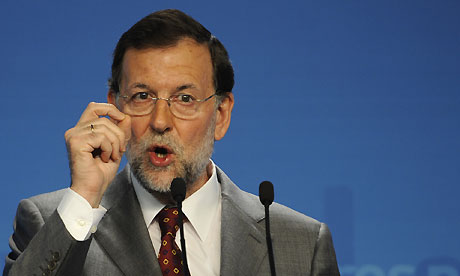
"Give up sovereignty to save the euro," says Spanish PM

Mariano Rajoy, the Spanish prime minister, has called for the eurozone to have "centralised control" over the budgets of all the countries using the euro.

Mr Rajoy has become the latest European politician to call for countries to, in effect, abandon their sovereignty in a last ditch attempt to save the beleaguered currency.

Mr Rajoy said a new central authority would go a long way to alleviating Spain's economic crisis as it would send a clear signal to investors that the single currency is an irreversible project.

Speaking in Madrid yesterday, he said: "The European Union needs to reinforce its architecture. This entails moving towards more integration, transferring more sovereignty, especially in the fiscal field.

"And this means a compromise to create a new European fiscal authority which would guide the fiscal policy in the eurozone, harmonise the fiscal policy of member states and enable a centralised control of public finances."

Mr Rajoy is not the first to propose creating such an authority but the fact that Spain -- a country deemed too big to fail -- is backing the move may now accelerate talks.

Its set-up would require a change in the European Union treaties, a usually lengthy process which requires ratification in the 27 member states of the bloc, including those such as the UK which do not use the euro.

Germany, the de facto guarantor of the euro, has said further integration in Europe was required, including additional controls on national public finances.

Angela Merkel, the German chancellor, said there should be no taboos when discussing such issues.

Last week Mario Draghi, the president of the European Central Bank, said that the ECB could not "fill the vacuum of the lack of action by national governments on the structural problem" and that countries needed to give up some of their sovereignty.

The ultimate outcome of this consensus will be the widening of the divide between Europe's rulers and its people, leading eventually to the disintegration of the European Union and even the nation-states that formed it.  Self-determination and harmony cannot coexist.

Tuesday, June 5, 2012

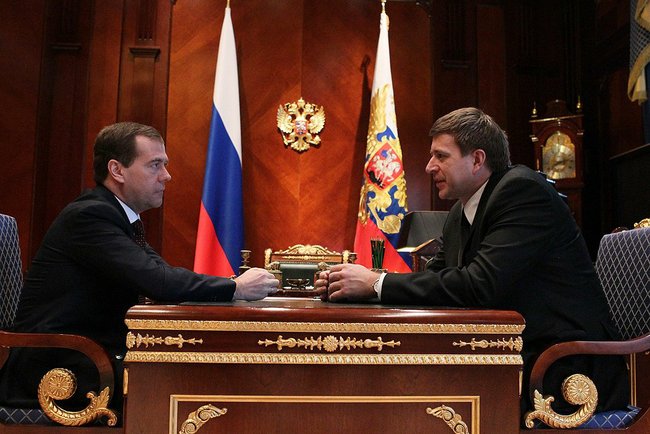
Russia proposes bilateral extradition treaty with US

Russia proposes that the United States sign a bilateral extradition treaty or join existing international conventions, Russian Justice Minister Alexander Konovalov said on Friday.

"The Justice Ministry proposes either signing bilateral treaties on the extradition of criminals and repatriation of convicts. The second variant for the U.S. is to join the existing convention mechanisms, we will try to persuade our U.S. partners to do this too,” Konovalov told journalists during his working visit to Washington.

"We raised these issues more than two years ago, during the first visit of a justice ministry’s delegation to the U.S. So far, frankly speaking, the U.S. side remains reluctant to accept our proposals,” the minister said. “But, on the whole, we hope to persuade them and we aim to do our best.”

Russia and the U.S. have no extradition deal and Russian citizens convicted by U.S. court serve their sentences in the United States.

Relations between the two countries have been strained by legal proceedings against Russian nationals in the U.S., including the trial of Viktor Bout, a Russian national arrested in Thailand in March 2008 in an operation led by U.S. agents and extradited in November 2010, and the case of Vladimir Zdorovenin, a Russian cybercrimes suspect extradited in mid-January from Switzerland to the U.S. without Russia receiving timely notification.

"Such practices are absolutely unacceptable to us. We, of course, think that it is understandable… But people should not be abducted on the territory of third states, they should not be extradited illegally. Legal instruments and mechanisms should be used, and we are going to further discuss the issue with the Americans,” Konovalov said.

His statement overlooked a growing body of opinion that regards extradition as a crime in its own right, albeit one committed by the state against its citizens.