The Falsane nuclear submarine base on the Clyde could remain under UK control in an independent Scotland, according to a senior defence minister.
Armed forces minister Nick Harvey said the future of Trident would be the biggest issue in negotiations that would follow a vote for Scottish separation.
Mr Harvey told MPs at the Commons Scottish affairs committee: “I would have thought that relocation would be about the least favourite option possible.”
With the SNP set on removing “weapons of mass destruction” from Scottish territory, the Liberal Democrat minister warned the “costs of moving the base would be absolutely immense”.
His Tory colleague, Peter Luff, said relocation would be “a seismic shock” to the UK budget.
But the suggestion Faslane could remain part of the UK was last night dismissed by the SNP, which wants to turn it into a conventional naval base.
Mr Harvey said the most recent upgrade of Faslane was £3.5 billion “in today’s money” but added that this figure would be “dwarfed” by relocation costs.
It was also suggested that removing Trident could take as long as 20 years.
Under questioning from Tory MP David Mowatt, Mr Harvey raised the prospect that the base could remain UK territory. The move would create a military enclave north of the Border, comparable with US-controlled Guantanamo Bay in the Caribbean.
Another parallel is the Baltic port of Kaliningrad, which remained Russian after Lithuania broke away from the old Soviet Union in the 1990s.
Mr Mowatt asked what terms the UK government would insist on if the SNP reversed its policy on Trident and permitted UK submarines to remain on the Clyde.
Mr Harvey said: “I think the critical one would be complete freedom of action, complete control and complete sovereignty over the facility.”
However, both ministers said there were currently no contingency plans being drawn up for Faslane or defence if Scotland votes for independence, because they do not envisage the scenario happening.
They said the Ministry of Defence needed to hear from the SNP about its plans, but there had been no discussions with the Scottish Government.
They also said the MoD didnot have the resources to look at all the options.
On who would meet the cost of dismantling Faslane, Mr Harvey said a “huge negotiation” would be required.
He added: “If the residual UK taxpayer had to pick up that bill, their ability to pick up any other bills would be proportionately diminished.”
Labour MP Iain McKenzie suggested decommissioning would be included in negotiations after a vote for independence, alongside the division of the national debt.
“A compromise would be made as to who pays for what so both sets of taxpayers would end up paying,” he said.
Mr Harvey replied: “That sounds to me like a sensible characterisation of what I think will probably happen.”
But last night the SNP said Faslane would be Scotland’s conventional naval base, with warships, post-independence.
SNP defence spokesman Angus Robertson said: “Faslane has a tremendous future as a conventional naval base in Scotland after independence.
“For decades arrogant Westminster politicians have foisted nuclear submarines on Scotland,” he added.
“There is no reason to decommission Faslane; it will change its use to something altogether more constructive.”
He said there was a lack of conventional capability in Scotland, which he described as a “total disgrace”.
He said: “The advantage of making better decisions in Scotland is that we can prioritise a non-nuclear defence posture and protect jobs in the conventional military.
“This stands in stark contrast to the UK government, which has been running down conventional defence in Scotland.
“Majority Scottish opinion, our churches, the STUC and civic society all oppose Trident – and the Scottish Parliament has voted against its replacement – yet the UK government wants to use Scottish taxpayers’ money to pay for these weapons of mass destruction, while cutting conventional defence.”
Charting islands of stability in a stormy sea. Advice & articles on going offshore, investing, weak governments, food sovereignty, personal security, and private banking.
Showing posts with label Revolutions. Show all posts
Wednesday, June 13, 2012
Call to criminalise Australians who support Fiji regime
There has been a call for Australia and New Zealand to make it illegal for its citizens to work overseas in support of undemocratic regimes.
The call comes from prominent Fiji academic, Professor Wadan Narsey, who says several Australians and and New Zealanders are working in prominent positions in the coup installed military government in Fiji.
Professor Narsey told Radio Australia's Pacific Beat program that both countries already criminalise their citizens who travel offshore to engage in paedophilia or terrorist activities, and supporting what he says are illegal governments should be treated the same way.
"I mean I have no problems with those people who are trying to do positive and constructive things, you know, to try and get the country back to a lawful and democratic government," he said.
"But where I have a problem is where quite a few people have gone there and justified illegal things such as the overthrow of a lawful government, or they have taken part in processes which have compromised the judiciary or have compromised the ministerial portfolios."
"If somebody goes and engages in paedophilia or engages in activities which encourage terrorism, such as what happened in September 11, you have laws over here which allows the Australian and New Zealand Governments to prosecute them," said Professor Narsey.
"There is no laws which they can use to discredit this unlawful behaviour abroad, and to me this strikes me as double standards."
He says the lack of legislation available to prosecute such actions is a double standard, made more glaring by the fact that Australia has imposed travel bans on not only those taking part in the coup in Fiji, but their relatives as well.
"That infringes on their basic human rights," he said.
"I mean you are not responsible for your relatives, you are responsible for your own actions."
Professor Narsey says that with huge financial interests at play in areas like PNG and East Timor, there is the very real danger that the assistance of well-trained New Zealanders and Australians can be used to further weaken the fragile political and judicial institutions in these places.
The call comes from prominent Fiji academic, Professor Wadan Narsey, who says several Australians and and New Zealanders are working in prominent positions in the coup installed military government in Fiji.
Professor Narsey told Radio Australia's Pacific Beat program that both countries already criminalise their citizens who travel offshore to engage in paedophilia or terrorist activities, and supporting what he says are illegal governments should be treated the same way.
"I mean I have no problems with those people who are trying to do positive and constructive things, you know, to try and get the country back to a lawful and democratic government," he said.
"But where I have a problem is where quite a few people have gone there and justified illegal things such as the overthrow of a lawful government, or they have taken part in processes which have compromised the judiciary or have compromised the ministerial portfolios."
"If somebody goes and engages in paedophilia or engages in activities which encourage terrorism, such as what happened in September 11, you have laws over here which allows the Australian and New Zealand Governments to prosecute them," said Professor Narsey.
"There is no laws which they can use to discredit this unlawful behaviour abroad, and to me this strikes me as double standards."
He says the lack of legislation available to prosecute such actions is a double standard, made more glaring by the fact that Australia has imposed travel bans on not only those taking part in the coup in Fiji, but their relatives as well.
"That infringes on their basic human rights," he said.
"I mean you are not responsible for your relatives, you are responsible for your own actions."
Professor Narsey says that with huge financial interests at play in areas like PNG and East Timor, there is the very real danger that the assistance of well-trained New Zealanders and Australians can be used to further weaken the fragile political and judicial institutions in these places.
Tuesday, June 12, 2012
Occupying farmland for organic food and fairness exposes university elitism
On Earth Day—April 22, 2012—about 200 people, accompanied by children in strollers, dogs, rabbits, chickens, and carrying hundreds of pounds of compost and at least 10,000 seedlings entered a 14-acre piece of land containing the last Class I agricultural soil in the East Bay. Located on the Albany-Berkeley border in the Bay Area, the plot is owned by the University of California Berkeley. By the end of the day, they had weeded, tilled, and successfully cultivated about an acre of the land. By May 14, when 100 University of California riot police surrounded the tract and began arresting the farmers, Occupy the Farm had cultivated around five acres of the plot known as the Gill Tract.
The Occupy farmers have laid out footpaths around cultivated plots, created wildlife corridors, riparian zones, and protected areas for native grasses and a wild turkey nest, and set up a library and a kitchen. They have planted thousands of seedlings of corn, tomatoes, squash, beans, broccoli, herbs, and strawberries, including heirloom varieties from a local seed bank. Other plots have been reserved for agro-ecological research. There’s also a permaculture garden for kids on the other side of a gazebo of woven branches where wind chimes tinkle in the breeze.
Gopal Dayaneni of Movement Generation, says that the vision for the farm is the “practice and promotion of sustainable urban agriculture with a commitment to food justice and food sovereignty.” He is a father, activist, and member of what he calls the “new urban peasantry.” Food grown on the farm will be distributed—for free—through existing food justice networks in the San Francisco Bay Area.
On April 24, the University shut off the water supply and threatened the farmers with eviction. University administration has gone on a media offensive, attempting to pit researchers against the Occupy farmers and according to some reports, preventing them from negotiating with the farmers. Some faculty members have published statements in support of the farmers, arguing that the goals of the farm are aligned with the public policy goals of the state and the U.C. mission. If transforming a student’s life is part of that mission, U.C. Berkeley student Lesley Haddock has certainly experienced it working on the farm. “Before our project began, I had never planted a seed,” she admits. “But in the past two weeks, I have become a farmer!”
One of the Occupy farmers, Ashoka Finley is a program assistant with Urban Tilth and runs an organic farm in collaboration with students at Richmond High School, in Richmond, California. A political economy graduate of U.C. Berkeley, Finley believes that the farm is redefining and reclaiming the role of the public university, just as the Occupy movement is redefining and reclaiming public space.
“The history of the Gill Tract is [about] public subsidization of private research that [profits] the corporate industrial complex; not research for the public good,” he says.
It was not always this way. The 104-acre plot was sold to the University in 1928 by the Gill family with the condition that it be used as an agricultural research station. Under the Smith-Lever Act of 1914, part of the University’s mission as a land grant institution is to promote community involvement and initiatives in agriculture.
From the 1940s through the 1990s, research conducted at the Gill Tract laid the groundwork for successful, non-chemical and non-petroleum-based methods for controlling numerous major insect pests on several California crops, and for the integration of biological, chemical, and cultural methods of pest control.5 The innovative methods developed, shared, and refined at the International Center for Biological Control included intercropping6 and using bugs to control pests in addition to or in place of pesticides, and means to reduce overall chemical dependency and prevent the development of superbugs in industrial and community agriculture worldwide.
The turning point came in 1998, when Novartis gave $25 million to the Plant and Microbial Biology department to conduct genetic research on the land. “They kicked off the local organic pest management project to do gene research,” says Ulan McKnight of the Albany Farm Alliance. “What was here before directly benefitted the people of California; now what they do here directly benefits biotechnology companies. Instead of doing things that can help people, they are doing things that benefit the one percent.”
Among the projects closed down at the time was a seed bank of rare heirloom varieties of many important food crops, and a state-of-the-art drip irrigation system from a student-run urban sustainable agriculture demonstration plot. Until the water was cut off at the Tract, the Occupy farmers were planning to start using those irrigation tubes again.
The trend of privatizing the research and knowledge produced at public institutions is systemic, according to Julie Sze, associate professor of American Cultures at U.C. Davis. A long-time supporter of social justice and student movements, Sze attributes her activism to her student days at U.C. Berkeley, where she took courses with the likes of RP&E founder Carl Anthony. She credits the university with being the “social justice innovation lab” that produced so many of the environmental justice leaders of today and argues that corporatization is an impoverishment of the U.C. system and a betrayal of the system’s legacy for California.
It is worth noting that the number of people graduating from UCLA annually exceeds the total number of people graduating from all private colleges in the state. It is no exaggeration, therefore, to say that whatever happens with the U.C. system affects the future of California.
Universities have a special role to encourage ways of thinking that go beyond the corporate workplace, says Sze. People who have fought to work with communities on the side of racial and economic justice are an important legacy of the university. People like Paul Taylor, who in the 1930s, promoted the idea of the agricultural job ladder (where farm workers could eventually become family farmers) over the agribusiness model, which depended on seasonal workers. The university is a place to explore and imagine different possibilities and different futures, which is why student activism is a global force and so deeply threatening to the existing order.
Sze believes that the move towards corporate funding of research, coupled with increasing student debt, has curtailed the ability and desire of students to participate in the creative and innovative social justice thinking and activity that is so important to the common good.
David Naguib Pellow, another movement scholar-activist and a professor of sociology at the University of Minnesota, observes, “Every [public] university I’ve worked at, professors are encouraged to secure external funding for their research to alleviate state budget constraints. This often involves seeking resources from corporations and foundations that have little or no accountability to the public, which amounts to the privatization of ideas, knowledge, and the commons, and is a dangerous trend if we desire to live in a democratic society.”
The tuition hikes and the cuts in programs that do not have a corporate/profit bent are a direct result of the bias towards education in the service of corporations, according to Finley, and needs to be countered by the training of people in the service of people.
In an email sent out in early May, Adbusters urges recipients to “occupy the future;” that is, “to describe, build and sustain the post-capitalist future we want to live in.”
Dayaneni concurs with that sentiment. “People ask me what they can do to support. I say, take more land. Occupy a library, a clinic, whatever, plan it right and [re-launch] it appropriately and at scale. We need to prove that we have the ability to self govern. This is the new moment of occupy, not tit for tat, not cat-and-mouse games with cops, but full-scale intervention. Occupy the Farm is one of the first to-scale interventions.”
Projects like Occupy the Farm also create a sort of sovereignty and allow a space for larger political expression where people can articulate their demand for a more egalitarian, just society through work done with their own hands, argues Finley.
“In the first world, we have been fed a false sense of security that is imploding,” says Michelle Mascarenhas-Swan, recounting her family’s experience with the militant experiment in collective governance and self-sufficiency. “On Earth Day, our families were a part of manifesting a collective vision for a better way forward—that the land be a community educational center. We have planted strawberries in the children’s garden and feed the chickens with snails that we collect from our own garden. My partner, a cook, brings us food regularly. We are making that vision real.”
Not everybody, however, sees Occupy the Farm in the same light and on the same terms, Finley points out. For many communities of color, farmwork is both a practice of material and cultural survival and self-sufficiency, and, at the same time, deeply tied to racialized exploitation in the United States. For African Americans, farming is related to slavery and sharecropping. For recent immigrants from Latin America, farming is about the bankruptcy brought on by the dumping of subsidized monoculture products in their countries. And for Southeast Asian immigrants, farming is associated with a bloody countryside strewn with unexploded ordnance and other detritus from U.S. wars. At the same time, like other forced immigrants before them, these people have also brought with them a knowledge and identity that is wrapped up in the cultivation and ceremony of working the land.
Subsistence through the production of one’s own food is one of the most effective forms of resistance. But the action at Gill Tract also points toward the broader challenges at the University.
The arena of struggle revealed by Occupy the Farm is not just organic farming, food justice, and food sovereignty. The classrooms, the libraries, and the research agenda of the university are being shaped to meet the needs of corporate sponsors. Groundbreaking areas in scholarship that were pioneered in the University of California, such as Ethnic Studies, Women and Gender Studies, Peace and Conflict Studies, were won by student-led protest and strikes (and occupations) in the early 1970s. They now face devastating cuts against which students are mobilizing. Battles against tuition hikes, student debt, and democratizing University governance will be key to shifting the overall direction of the university and the society.
Amilcar Cabral, the African revolutionary and agricultural engineer once said: “Culture contains the seed of resistance, which blossoms into the flower of liberation.” At the Gill Tract we can see seeds of resistance that have been planted—but it is clear that in order to blossom, they will need watering.
The Occupy farmers have laid out footpaths around cultivated plots, created wildlife corridors, riparian zones, and protected areas for native grasses and a wild turkey nest, and set up a library and a kitchen. They have planted thousands of seedlings of corn, tomatoes, squash, beans, broccoli, herbs, and strawberries, including heirloom varieties from a local seed bank. Other plots have been reserved for agro-ecological research. There’s also a permaculture garden for kids on the other side of a gazebo of woven branches where wind chimes tinkle in the breeze.
Gopal Dayaneni of Movement Generation, says that the vision for the farm is the “practice and promotion of sustainable urban agriculture with a commitment to food justice and food sovereignty.” He is a father, activist, and member of what he calls the “new urban peasantry.” Food grown on the farm will be distributed—for free—through existing food justice networks in the San Francisco Bay Area.
On April 24, the University shut off the water supply and threatened the farmers with eviction. University administration has gone on a media offensive, attempting to pit researchers against the Occupy farmers and according to some reports, preventing them from negotiating with the farmers. Some faculty members have published statements in support of the farmers, arguing that the goals of the farm are aligned with the public policy goals of the state and the U.C. mission. If transforming a student’s life is part of that mission, U.C. Berkeley student Lesley Haddock has certainly experienced it working on the farm. “Before our project began, I had never planted a seed,” she admits. “But in the past two weeks, I have become a farmer!”
One of the Occupy farmers, Ashoka Finley is a program assistant with Urban Tilth and runs an organic farm in collaboration with students at Richmond High School, in Richmond, California. A political economy graduate of U.C. Berkeley, Finley believes that the farm is redefining and reclaiming the role of the public university, just as the Occupy movement is redefining and reclaiming public space.
“The history of the Gill Tract is [about] public subsidization of private research that [profits] the corporate industrial complex; not research for the public good,” he says.
It was not always this way. The 104-acre plot was sold to the University in 1928 by the Gill family with the condition that it be used as an agricultural research station. Under the Smith-Lever Act of 1914, part of the University’s mission as a land grant institution is to promote community involvement and initiatives in agriculture.
From the 1940s through the 1990s, research conducted at the Gill Tract laid the groundwork for successful, non-chemical and non-petroleum-based methods for controlling numerous major insect pests on several California crops, and for the integration of biological, chemical, and cultural methods of pest control.5 The innovative methods developed, shared, and refined at the International Center for Biological Control included intercropping6 and using bugs to control pests in addition to or in place of pesticides, and means to reduce overall chemical dependency and prevent the development of superbugs in industrial and community agriculture worldwide.
The turning point came in 1998, when Novartis gave $25 million to the Plant and Microbial Biology department to conduct genetic research on the land. “They kicked off the local organic pest management project to do gene research,” says Ulan McKnight of the Albany Farm Alliance. “What was here before directly benefitted the people of California; now what they do here directly benefits biotechnology companies. Instead of doing things that can help people, they are doing things that benefit the one percent.”
Among the projects closed down at the time was a seed bank of rare heirloom varieties of many important food crops, and a state-of-the-art drip irrigation system from a student-run urban sustainable agriculture demonstration plot. Until the water was cut off at the Tract, the Occupy farmers were planning to start using those irrigation tubes again.
The trend of privatizing the research and knowledge produced at public institutions is systemic, according to Julie Sze, associate professor of American Cultures at U.C. Davis. A long-time supporter of social justice and student movements, Sze attributes her activism to her student days at U.C. Berkeley, where she took courses with the likes of RP&E founder Carl Anthony. She credits the university with being the “social justice innovation lab” that produced so many of the environmental justice leaders of today and argues that corporatization is an impoverishment of the U.C. system and a betrayal of the system’s legacy for California.
It is worth noting that the number of people graduating from UCLA annually exceeds the total number of people graduating from all private colleges in the state. It is no exaggeration, therefore, to say that whatever happens with the U.C. system affects the future of California.
Universities have a special role to encourage ways of thinking that go beyond the corporate workplace, says Sze. People who have fought to work with communities on the side of racial and economic justice are an important legacy of the university. People like Paul Taylor, who in the 1930s, promoted the idea of the agricultural job ladder (where farm workers could eventually become family farmers) over the agribusiness model, which depended on seasonal workers. The university is a place to explore and imagine different possibilities and different futures, which is why student activism is a global force and so deeply threatening to the existing order.
Sze believes that the move towards corporate funding of research, coupled with increasing student debt, has curtailed the ability and desire of students to participate in the creative and innovative social justice thinking and activity that is so important to the common good.
David Naguib Pellow, another movement scholar-activist and a professor of sociology at the University of Minnesota, observes, “Every [public] university I’ve worked at, professors are encouraged to secure external funding for their research to alleviate state budget constraints. This often involves seeking resources from corporations and foundations that have little or no accountability to the public, which amounts to the privatization of ideas, knowledge, and the commons, and is a dangerous trend if we desire to live in a democratic society.”
The tuition hikes and the cuts in programs that do not have a corporate/profit bent are a direct result of the bias towards education in the service of corporations, according to Finley, and needs to be countered by the training of people in the service of people.
In an email sent out in early May, Adbusters urges recipients to “occupy the future;” that is, “to describe, build and sustain the post-capitalist future we want to live in.”
Dayaneni concurs with that sentiment. “People ask me what they can do to support. I say, take more land. Occupy a library, a clinic, whatever, plan it right and [re-launch] it appropriately and at scale. We need to prove that we have the ability to self govern. This is the new moment of occupy, not tit for tat, not cat-and-mouse games with cops, but full-scale intervention. Occupy the Farm is one of the first to-scale interventions.”
Projects like Occupy the Farm also create a sort of sovereignty and allow a space for larger political expression where people can articulate their demand for a more egalitarian, just society through work done with their own hands, argues Finley.
“In the first world, we have been fed a false sense of security that is imploding,” says Michelle Mascarenhas-Swan, recounting her family’s experience with the militant experiment in collective governance and self-sufficiency. “On Earth Day, our families were a part of manifesting a collective vision for a better way forward—that the land be a community educational center. We have planted strawberries in the children’s garden and feed the chickens with snails that we collect from our own garden. My partner, a cook, brings us food regularly. We are making that vision real.”
Not everybody, however, sees Occupy the Farm in the same light and on the same terms, Finley points out. For many communities of color, farmwork is both a practice of material and cultural survival and self-sufficiency, and, at the same time, deeply tied to racialized exploitation in the United States. For African Americans, farming is related to slavery and sharecropping. For recent immigrants from Latin America, farming is about the bankruptcy brought on by the dumping of subsidized monoculture products in their countries. And for Southeast Asian immigrants, farming is associated with a bloody countryside strewn with unexploded ordnance and other detritus from U.S. wars. At the same time, like other forced immigrants before them, these people have also brought with them a knowledge and identity that is wrapped up in the cultivation and ceremony of working the land.
Subsistence through the production of one’s own food is one of the most effective forms of resistance. But the action at Gill Tract also points toward the broader challenges at the University.
The arena of struggle revealed by Occupy the Farm is not just organic farming, food justice, and food sovereignty. The classrooms, the libraries, and the research agenda of the university are being shaped to meet the needs of corporate sponsors. Groundbreaking areas in scholarship that were pioneered in the University of California, such as Ethnic Studies, Women and Gender Studies, Peace and Conflict Studies, were won by student-led protest and strikes (and occupations) in the early 1970s. They now face devastating cuts against which students are mobilizing. Battles against tuition hikes, student debt, and democratizing University governance will be key to shifting the overall direction of the university and the society.
Amilcar Cabral, the African revolutionary and agricultural engineer once said: “Culture contains the seed of resistance, which blossoms into the flower of liberation.” At the Gill Tract we can see seeds of resistance that have been planted—but it is clear that in order to blossom, they will need watering.
Sunday, June 10, 2012
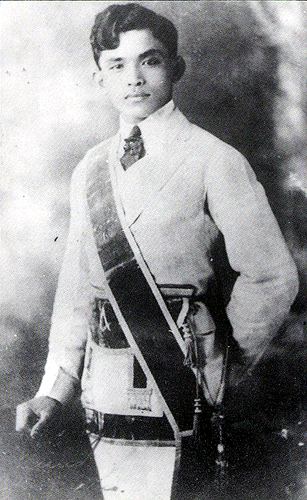
Filipino revolutionary heroes were young
“The Youth is the fair hope of the Motherland.” That is José Rizal’s most famous quotation. As it did in his time, the reflection holds true today, when 53 percent of Filipinos are below 20 years old and only three percent are above 65. Rizal himself started young in inspiring Filipinos about nationhood. He was only 26 when he published Noli Me Tangere in 1887. Going by the World Health Organization’s definition of “youth” as age 15 to 34, Rizal was barely out of his youth when executed at age 35. The Filipino life expectancy then was 66.1 years.
Many heroes of the Revolutionary Period — from the Propaganda Movement in the 1880s to the setting up of a national government in 1907 — were as young. A partial listing:
• Graciano Lopez Jaena was 32 when he founded the newspaper La Solidaridad in Madrid. He endured hunger and disease to expose to the Spanish people the aspiration of indios in their colony, Las Islas Filipinas.
• Marcelo H. del Pilar was probably the oldest of our young heroes. He was 39 when he took over editorship of La Solidaridad. Yet he started writing against friar rule in his native Bulacan as a lawyer aged 30. So stinging were his articles that he had to flee to Spain from persecution.
• Isabelo de los Reyes was 25 when he started writing in Ilocano and Spanish against abuses of the colonizers. He was barely 30 when thrown to the dungeons in Madrid for inciting fellow-Ilocanos to speak out against the abusers.
• At age eight Rizal wrote a poetic tribute to the mother tongue, “Sa Aking Mga Kabata (To My Fellow Youth)”. He finished his second novel, El Filibusterismo in 1891, when he was 30. His writings caused his exile to Dapitan the following year. He was blamed for the spark of the Revolution in 1896 and so was martyred that same year.
• Andres Bonifacio founded the Katipunan when he was but 29.
• When the Revolution began, his faithful comrade-in-arms Emilio Jacinto was only 21. Youth did not deter Jacinto, after the Supremo’s death, from carrying on the struggle in the mountains of Laguna.
• Gregoria de Jesus was only 22 when she became Bonifacio’s widow. She courageously fought on for independence.
• Emilio Aguinaldo was the victorious general of the Revolution at age 27. He founded the first Republic in Asia three months after turning 29.
• Maestro Artemio Ricarte was 32 when he taught the Katipunan trench warfare. His invaluable field tactics prevented Spanish troops from capturing Cavite.
• Marcela Agoncillo was 37 when she sewed the first Philippine flag for unfurling on June 12, 1898.
• Gregorio del Pilar became a general of the Katipunan at age 21. He had just turned 24 when he fought his last battle as Aguinaldo’s rear guard at Tirad Pass in 1899.
• Apolinario Mabini was 34 when he took on the intellectual leadership of the Malolos Republic and drafted its Constitution.
• Miguel Malvar was 36 when, after Aguinaldo’s capture, he took over the Revolutionary government in 1901.
• Macario Sakay was 31 when he continued the War of Liberation against the new U.S. colonizers in 1901 to 1904.
• And Sergio Osmeña and Manuel Quezon were both only 29 when they boldly became the Speaker and Majority Leader, respectively, of the first Philippine Assembly under American rule in 1907.
There surely were thousands of other young Filipino heroes during the countless revolts against 333 years of Spanish rule. Diego Silang was 32 when he led the Ilocano uprising against abuses and taxation in 1762. At age 33 he was assassinated the following year. His wife Gabriela, only a year younger, carried on the fight for four months until captured and executed. The Dagohoy Revolt in Bohol could not have lasted almost 85 years, 1744 to 1829, without the participation of youthful fighters.
The Filipino soldiers at Bataan and Corregidor were also young. A good number of them were college ROTC cadets; others were enlistees in their 20s in the US Armed Forces in the Far East. Tens of thousands of them were forced on a Death March to prisoner-of-war camp in Tarlac. Survivors carried on the fight, as guerrilla leaders of more youth recruits. One such hero was Sgt. Jose Calugas of the Philippine Scouts, who led his squad in a last-ditch battle against hundreds of advancing Japanese forces. Captured, he joined the torturous march to Capas, went underground upon release in 1943, and lived to tell the story of his buddies till age 91. Had they been older then they were then, they might not have survived the rigors of battle, prison and jungle.
The world's youth are, and shall always be, its source of revolution and progress.
Many heroes of the Revolutionary Period — from the Propaganda Movement in the 1880s to the setting up of a national government in 1907 — were as young. A partial listing:
• Graciano Lopez Jaena was 32 when he founded the newspaper La Solidaridad in Madrid. He endured hunger and disease to expose to the Spanish people the aspiration of indios in their colony, Las Islas Filipinas.
• Marcelo H. del Pilar was probably the oldest of our young heroes. He was 39 when he took over editorship of La Solidaridad. Yet he started writing against friar rule in his native Bulacan as a lawyer aged 30. So stinging were his articles that he had to flee to Spain from persecution.
• Isabelo de los Reyes was 25 when he started writing in Ilocano and Spanish against abuses of the colonizers. He was barely 30 when thrown to the dungeons in Madrid for inciting fellow-Ilocanos to speak out against the abusers.
• At age eight Rizal wrote a poetic tribute to the mother tongue, “Sa Aking Mga Kabata (To My Fellow Youth)”. He finished his second novel, El Filibusterismo in 1891, when he was 30. His writings caused his exile to Dapitan the following year. He was blamed for the spark of the Revolution in 1896 and so was martyred that same year.
• Andres Bonifacio founded the Katipunan when he was but 29.
• When the Revolution began, his faithful comrade-in-arms Emilio Jacinto was only 21. Youth did not deter Jacinto, after the Supremo’s death, from carrying on the struggle in the mountains of Laguna.
• Gregoria de Jesus was only 22 when she became Bonifacio’s widow. She courageously fought on for independence.
• Emilio Aguinaldo was the victorious general of the Revolution at age 27. He founded the first Republic in Asia three months after turning 29.
• Maestro Artemio Ricarte was 32 when he taught the Katipunan trench warfare. His invaluable field tactics prevented Spanish troops from capturing Cavite.
• Marcela Agoncillo was 37 when she sewed the first Philippine flag for unfurling on June 12, 1898.
• Gregorio del Pilar became a general of the Katipunan at age 21. He had just turned 24 when he fought his last battle as Aguinaldo’s rear guard at Tirad Pass in 1899.
• Apolinario Mabini was 34 when he took on the intellectual leadership of the Malolos Republic and drafted its Constitution.
• Miguel Malvar was 36 when, after Aguinaldo’s capture, he took over the Revolutionary government in 1901.
• Macario Sakay was 31 when he continued the War of Liberation against the new U.S. colonizers in 1901 to 1904.
• And Sergio Osmeña and Manuel Quezon were both only 29 when they boldly became the Speaker and Majority Leader, respectively, of the first Philippine Assembly under American rule in 1907.
There surely were thousands of other young Filipino heroes during the countless revolts against 333 years of Spanish rule. Diego Silang was 32 when he led the Ilocano uprising against abuses and taxation in 1762. At age 33 he was assassinated the following year. His wife Gabriela, only a year younger, carried on the fight for four months until captured and executed. The Dagohoy Revolt in Bohol could not have lasted almost 85 years, 1744 to 1829, without the participation of youthful fighters.
The Filipino soldiers at Bataan and Corregidor were also young. A good number of them were college ROTC cadets; others were enlistees in their 20s in the US Armed Forces in the Far East. Tens of thousands of them were forced on a Death March to prisoner-of-war camp in Tarlac. Survivors carried on the fight, as guerrilla leaders of more youth recruits. One such hero was Sgt. Jose Calugas of the Philippine Scouts, who led his squad in a last-ditch battle against hundreds of advancing Japanese forces. Captured, he joined the torturous march to Capas, went underground upon release in 1943, and lived to tell the story of his buddies till age 91. Had they been older then they were then, they might not have survived the rigors of battle, prison and jungle.
The world's youth are, and shall always be, its source of revolution and progress.
Corruption is still Tunisia's challenge
In the year since the Arab Spring, attention has been riveted on one issue above all others: the place of religious practice in public life. In Tunisia, where the movement began, full-face and body veils, now often worn complete with gloves, are increasingly visible on the streets — an exotic sight for locals and foreigners alike. And the secular opposition seems increasingly strident in its conviction that the Islamist government is driving the country the way of Iran.
But it wasn't religion that set off the Jasmine Revolution; it was acute economic injustice and the pervasive and structured corruption that helped produce it. The fate of Tunisia, and its neighbors, may depend most on whether that lingering problem is addressed.
You can usually tell which buildings in this sparkling, white-and-sky-blue country the family of former dictator Zine el Abidine ben Ali had a stake in; they're eyesores. Last month, a small group of protesters gathered in front of one of them, a squat, mustard-colored hotel complex on a beach in the town of Kilibia.
Kilibia, home to extensive Roman and Punic archaeological sites, also boasts beaches of silky, ash-white sand, which audibly sings underfoot as you walk across it. The seafront is exactly the kind of resource members of the Ben Ali family liked to commandeer for their personal gain.
They had shares in several sprawling hotels here, including the yellow one, built with an Italian investor. Typically for the Tunisian tourism industry, it functioned and still functions as a closed system: Tunisians are not allowed on the beach; the hotel employs no Tunisians except for a few guards, purchases no Tunisian supplies or food — not even any luscious local olive oil. Everything is shipped in from Italy.
Now the hotel is dumping coarse yellow sand across the top half of the beach to cushion tourists' feet from a rock formation.
This may sound like a trivial transgression. But it typifies the arrogation of public resources and financial opportunities for the personal enrichment of regime insiders that sparked last year's uprising.
Under the Ben Ali dictatorship, physical repression, torture and disappearances were fairly uncommon. The regime perpetrated its oppression by means of a diabolically intrusive system of state corruption.
This particularity has prompted Tunisian activists to blaze new paths in human rights doctrine. They are seeking to expand the definition of "gross violations of human rights" to include systematic economic crimes. They want perpetrators to answer for these crimes in a public reckoning, as part of a transitional justice process, like the ones in South Africa or Rwanda that focused on physical abuses.
Tunisia's new Cabinet includes a minister for "governance and anti-corruption." This is an innovation, certainly, but activists worry that his appointment was more show than substance.
A commission established in the weeks after Ben Ali's overthrow, and including public accountants and specialists in the intricacies of administrative or real estate law, examined some 5,000 complaints. The report it released in November exposed a vast system of structured corruption by which the Ben Ali in-laws and their cronies helped themselves to the best of everything: stakes in the most lucrative businesses, exemption from customs dues, choice public land. Government institutions such as tax authorities and the judiciary, even private banks, became instruments of coercion. Recalcitrant chief executives would get slapped with an audit or see their loans dry up or their authorizations revoked.
The commission developed evidence on 400 cases, which it transferred to courts. But according to member Amine Ghali, only a handful have been taken up by a judiciary still largely staffed by Ben Ali-era personnel.
"We're no one's first priority," says Ghali, detailing examples of neglect by the current government. "We have no office equipment or vehicles, no power to subpoena witnesses or to protect them. Members who are government employees don't even get relieved of their regular duties but have to do this work on the side. You get the feeling the government doesn't care if we succeed."
Many fear that the current political elite, including the leadership of the ruling Islamist party, intends to quietly appropriate the old structures and practices for their own benefit. Recently passed provisions of this year's budget include Ben Ali-style shelters for potentially ill-gotten gains, in return for a financial contribution. Taoufik Chamari, of the National Anti-Corruption Network, warns of the "real risk that the same system of corruption will be maintained, legitimized by new beneficiaries."
Corruption is a less photogenic issue than heavily veiled women. Yet when it grows so pervasive as to amount to capture of the state by a structured criminal network, as it did in Tunisia and in Egypt, public outrage can get explosive. Many here predict that if Tunisia does not use this remarkable post-revolutionary moment to impose accountability, then a frustrated people may truly radicalize, turning to militant, puritanical readings of Islam to afford a recourse the post-revolutionary democracy did not.
As the example of the yellow hotel suggests, actions of Westerners — conscious or unconscious — matter. Our support for Arab nations in transition, our behavior as investors and visitors, should break with past habits of contributing to corruption.
But it wasn't religion that set off the Jasmine Revolution; it was acute economic injustice and the pervasive and structured corruption that helped produce it. The fate of Tunisia, and its neighbors, may depend most on whether that lingering problem is addressed.
You can usually tell which buildings in this sparkling, white-and-sky-blue country the family of former dictator Zine el Abidine ben Ali had a stake in; they're eyesores. Last month, a small group of protesters gathered in front of one of them, a squat, mustard-colored hotel complex on a beach in the town of Kilibia.
Kilibia, home to extensive Roman and Punic archaeological sites, also boasts beaches of silky, ash-white sand, which audibly sings underfoot as you walk across it. The seafront is exactly the kind of resource members of the Ben Ali family liked to commandeer for their personal gain.
They had shares in several sprawling hotels here, including the yellow one, built with an Italian investor. Typically for the Tunisian tourism industry, it functioned and still functions as a closed system: Tunisians are not allowed on the beach; the hotel employs no Tunisians except for a few guards, purchases no Tunisian supplies or food — not even any luscious local olive oil. Everything is shipped in from Italy.
Now the hotel is dumping coarse yellow sand across the top half of the beach to cushion tourists' feet from a rock formation.
This may sound like a trivial transgression. But it typifies the arrogation of public resources and financial opportunities for the personal enrichment of regime insiders that sparked last year's uprising.
Under the Ben Ali dictatorship, physical repression, torture and disappearances were fairly uncommon. The regime perpetrated its oppression by means of a diabolically intrusive system of state corruption.
This particularity has prompted Tunisian activists to blaze new paths in human rights doctrine. They are seeking to expand the definition of "gross violations of human rights" to include systematic economic crimes. They want perpetrators to answer for these crimes in a public reckoning, as part of a transitional justice process, like the ones in South Africa or Rwanda that focused on physical abuses.
Tunisia's new Cabinet includes a minister for "governance and anti-corruption." This is an innovation, certainly, but activists worry that his appointment was more show than substance.
A commission established in the weeks after Ben Ali's overthrow, and including public accountants and specialists in the intricacies of administrative or real estate law, examined some 5,000 complaints. The report it released in November exposed a vast system of structured corruption by which the Ben Ali in-laws and their cronies helped themselves to the best of everything: stakes in the most lucrative businesses, exemption from customs dues, choice public land. Government institutions such as tax authorities and the judiciary, even private banks, became instruments of coercion. Recalcitrant chief executives would get slapped with an audit or see their loans dry up or their authorizations revoked.
The commission developed evidence on 400 cases, which it transferred to courts. But according to member Amine Ghali, only a handful have been taken up by a judiciary still largely staffed by Ben Ali-era personnel.
"We're no one's first priority," says Ghali, detailing examples of neglect by the current government. "We have no office equipment or vehicles, no power to subpoena witnesses or to protect them. Members who are government employees don't even get relieved of their regular duties but have to do this work on the side. You get the feeling the government doesn't care if we succeed."
Many fear that the current political elite, including the leadership of the ruling Islamist party, intends to quietly appropriate the old structures and practices for their own benefit. Recently passed provisions of this year's budget include Ben Ali-style shelters for potentially ill-gotten gains, in return for a financial contribution. Taoufik Chamari, of the National Anti-Corruption Network, warns of the "real risk that the same system of corruption will be maintained, legitimized by new beneficiaries."
Corruption is a less photogenic issue than heavily veiled women. Yet when it grows so pervasive as to amount to capture of the state by a structured criminal network, as it did in Tunisia and in Egypt, public outrage can get explosive. Many here predict that if Tunisia does not use this remarkable post-revolutionary moment to impose accountability, then a frustrated people may truly radicalize, turning to militant, puritanical readings of Islam to afford a recourse the post-revolutionary democracy did not.
As the example of the yellow hotel suggests, actions of Westerners — conscious or unconscious — matter. Our support for Arab nations in transition, our behavior as investors and visitors, should break with past habits of contributing to corruption.
Saturday, June 9, 2012
Hacking group Anonymous takes on India's internet censorship
Mumbai's Azad Maidan sports ground is often packed with children playing cricket, but the bowlers and batsmen were joined on Saturday by a sea of Guy Fawkes masks.
The costumes are a hallmark of the internet "hacktivist" group Anonymous which organised a series of protests in Indian cities, including Mumbai.
"I'm here for internet freedom. There's restrictions on speaking online. That's why I'm here," says 19-year-old Amisha, a student who was one of around 100 protesters in Mumbai.
Holding banners calling for freedom from censorship, the group were protesting against India's internet laws.
"India is following China and Iran. They don't want the right information to reach people," said 20-year-old student Nishant, whose face was hidden behind a scarf and sunglasses.
"There are some sites they've blocked for information which is relevant to us. Information which is useful to us as citizens of this country," he added.
Speaking to the BBC via their internet chatroom, members of Anonymous India said they were representing the "common man" and were simply ordinary internet users trying to make a point.
Anonymous India organised its Occupy campaign against what it believes is the unfair blocking and banning of file sharing sites by Indian internet service providers (ISPs) such as Reliance Communications and Airtel.
"We are protesting arbitrary, extra-judicial censorship, where not even the government knows - or cares - who controls what," said @anamikanon from Anonymous on the group's chatroom.
Last month a number of Indian ISPs blocked access to file-sharing sites including Vimeo, Pastebin, Piratebay and Dailymotion following a court order which centred on the issue of internet copyright.
A Chennai-based film company, Copyrightlabs, called on big Indian ISPs, including Reliance Communications, MTNL and BSNL, to prevent access to websites which allowed users to illegally watch two of their Bollywood movies, Three and Dhammu.
The court order, known as an Ashok Kumar order, is like a John Doe order in the United States - designed to protect the copyright of music, films and other content.
The blocking of access to file-sharing and torrent websites prompted Anonymous India to hack into more than 15 sites, including the Indian Supreme Court, two political parties and the Indian telecoms providers.
The group carried out a number of "Denial of Service" (DDOS) attacks, which can temporarily suspend connection to a site.
It also claims it was able to enter the servers of Reliance Communications, and in a press conference in May, presented a list of the file sharing sites it alleges the ISP had restricted access to.
Reliance Communications refused to comment on claims they are restricting access to sites, but pointed the BBC to a statement from 26 May, in which the company said it had the "strongest possible IT security to tackle unwarranted intrusions," adding that their servers could not be hacked.
Anonymous says it is not supporting piracy, but that many file-sharing sites are used in a perfectly legitimate way, for example to share photos or software code.
"File sharing is the lifeline of the internet, that's why it came into being", said tomgeorge, also from Anonymous, via the chatroom.
The group is also protesting against Indian government IT regulations that came into effect last year, which force websites to remove objectionable posts within hours of receiving a complaint.
Members of Anonymous say they will continue their actions until restrictions are lifted.
"The government can't stop piracy in a country by just banning sites. This is a country where you have people selling pirated CDs on trains in streets... it is actually too much to expect," says Anon3x3Kalki, another member of the group.
The costumes are a hallmark of the internet "hacktivist" group Anonymous which organised a series of protests in Indian cities, including Mumbai.
"I'm here for internet freedom. There's restrictions on speaking online. That's why I'm here," says 19-year-old Amisha, a student who was one of around 100 protesters in Mumbai.
Holding banners calling for freedom from censorship, the group were protesting against India's internet laws.
"India is following China and Iran. They don't want the right information to reach people," said 20-year-old student Nishant, whose face was hidden behind a scarf and sunglasses.
"There are some sites they've blocked for information which is relevant to us. Information which is useful to us as citizens of this country," he added.
Speaking to the BBC via their internet chatroom, members of Anonymous India said they were representing the "common man" and were simply ordinary internet users trying to make a point.
Anonymous India organised its Occupy campaign against what it believes is the unfair blocking and banning of file sharing sites by Indian internet service providers (ISPs) such as Reliance Communications and Airtel.
"We are protesting arbitrary, extra-judicial censorship, where not even the government knows - or cares - who controls what," said @anamikanon from Anonymous on the group's chatroom.
Last month a number of Indian ISPs blocked access to file-sharing sites including Vimeo, Pastebin, Piratebay and Dailymotion following a court order which centred on the issue of internet copyright.
A Chennai-based film company, Copyrightlabs, called on big Indian ISPs, including Reliance Communications, MTNL and BSNL, to prevent access to websites which allowed users to illegally watch two of their Bollywood movies, Three and Dhammu.
The court order, known as an Ashok Kumar order, is like a John Doe order in the United States - designed to protect the copyright of music, films and other content.
The blocking of access to file-sharing and torrent websites prompted Anonymous India to hack into more than 15 sites, including the Indian Supreme Court, two political parties and the Indian telecoms providers.
The group carried out a number of "Denial of Service" (DDOS) attacks, which can temporarily suspend connection to a site.
It also claims it was able to enter the servers of Reliance Communications, and in a press conference in May, presented a list of the file sharing sites it alleges the ISP had restricted access to.
Reliance Communications refused to comment on claims they are restricting access to sites, but pointed the BBC to a statement from 26 May, in which the company said it had the "strongest possible IT security to tackle unwarranted intrusions," adding that their servers could not be hacked.
Anonymous says it is not supporting piracy, but that many file-sharing sites are used in a perfectly legitimate way, for example to share photos or software code.
"File sharing is the lifeline of the internet, that's why it came into being", said tomgeorge, also from Anonymous, via the chatroom.
The group is also protesting against Indian government IT regulations that came into effect last year, which force websites to remove objectionable posts within hours of receiving a complaint.
Members of Anonymous say they will continue their actions until restrictions are lifted.
"The government can't stop piracy in a country by just banning sites. This is a country where you have people selling pirated CDs on trains in streets... it is actually too much to expect," says Anon3x3Kalki, another member of the group.
Friday, June 8, 2012
Nuclear talks fail between UN and Iran
The UN nuclear watchdog and Iran failed at talks Friday to unblock a probe into suspected atom bomb research by the Islamic state, a setback dimming any chances for success in higher-level negotiations between Tehran and major powers later this month.
Using unusually pointed language, the International Atomic Energy Agency said no progress had been made in the meeting aimed at sealing a deal on resuming the IAEA’s long-stalled investigation. It described the outcome as “disappointing.”
A few weeks ago, UN nuclear chief Yukiya Amano said he had won assurances from senior Iranian officials in Tehran an agreement would be struck soon.
Herman Nackaerts, the IAEA’s global head of inspections, said after the eight-hour meeting at its headquarters in Vienna no date for further discussions had been set.
The nuclear agency had been pressing Tehran for an accord that would give its inspectors immediate access to the Parchin military complex, where it believes explosives tests relevant for the development of nuclear arms have taken place and suspects Iran is cleaning the site of any incriminating evidence.
The United States, European powers and Israel want to curb Iranian atomic activities they fear are intended to produce nuclear bombs. The Islamic Republic says its nuclear program is meant purely to produce energy for civilian uses.
Six world powers were scrutinizing the IAEA-Iran meeting to judge whether the Iranians were ready to make concessions before a resumption of wider-ranging negotiations with them in Moscow June 18-19 on the decade-old nuclear dispute.
The lack of result may heighten Western suspicions Iran is seeking to drag out the two sets of talks to buy time for continuing uranium enrichment, without backing down in the face of international demands it suspend its sensitive work.
“It should by now be clear to everyone that Iran is not negotiating in good faith,” a senior Western diplomat said.
A European envoy also accredited to the IAEA said, “This is a dismal outcome … Iran is simply wasting time with its evasions and refusal to engage.”
Mark Fitzpatrick, a former senior U.S. State Department official, now a director at the International Institute for Strategic Studies think-tank in London, said, “This situation is reminiscent of the Peanuts cartoon of Charlie Brown repeatedly believing Lucy this time will hold the football for him to kick, with her always snatching it away at the last minute, leaving him to fall flat.”
Ali Asghar Soltanieh, Iran’s IAEA ambassador, said after Friday’s talks work on a “structured approach” document, setting the overall terms for the IAEA investigation, would continue and there would be more meetings.
“This is a very complicated issue,” he said.
Asked about the Iranian envoy he replied, “That is in fact one of the problems. The more you politicize an issue which was purely technical it creates an obstacle and damages the environment.”
And so the debate over baubles that will never be used goes on, while the world that created them crumbles.
Using unusually pointed language, the International Atomic Energy Agency said no progress had been made in the meeting aimed at sealing a deal on resuming the IAEA’s long-stalled investigation. It described the outcome as “disappointing.”
A few weeks ago, UN nuclear chief Yukiya Amano said he had won assurances from senior Iranian officials in Tehran an agreement would be struck soon.
Herman Nackaerts, the IAEA’s global head of inspections, said after the eight-hour meeting at its headquarters in Vienna no date for further discussions had been set.
The nuclear agency had been pressing Tehran for an accord that would give its inspectors immediate access to the Parchin military complex, where it believes explosives tests relevant for the development of nuclear arms have taken place and suspects Iran is cleaning the site of any incriminating evidence.
The United States, European powers and Israel want to curb Iranian atomic activities they fear are intended to produce nuclear bombs. The Islamic Republic says its nuclear program is meant purely to produce energy for civilian uses.
Six world powers were scrutinizing the IAEA-Iran meeting to judge whether the Iranians were ready to make concessions before a resumption of wider-ranging negotiations with them in Moscow June 18-19 on the decade-old nuclear dispute.
The lack of result may heighten Western suspicions Iran is seeking to drag out the two sets of talks to buy time for continuing uranium enrichment, without backing down in the face of international demands it suspend its sensitive work.
“It should by now be clear to everyone that Iran is not negotiating in good faith,” a senior Western diplomat said.
A European envoy also accredited to the IAEA said, “This is a dismal outcome … Iran is simply wasting time with its evasions and refusal to engage.”
Mark Fitzpatrick, a former senior U.S. State Department official, now a director at the International Institute for Strategic Studies think-tank in London, said, “This situation is reminiscent of the Peanuts cartoon of Charlie Brown repeatedly believing Lucy this time will hold the football for him to kick, with her always snatching it away at the last minute, leaving him to fall flat.”
Ali Asghar Soltanieh, Iran’s IAEA ambassador, said after Friday’s talks work on a “structured approach” document, setting the overall terms for the IAEA investigation, would continue and there would be more meetings.
“This is a very complicated issue,” he said.
Asked about the Iranian envoy he replied, “That is in fact one of the problems. The more you politicize an issue which was purely technical it creates an obstacle and damages the environment.”
And so the debate over baubles that will never be used goes on, while the world that created them crumbles.
Wednesday, June 6, 2012
"Give up sovereignty to save the euro," says Spanish PM
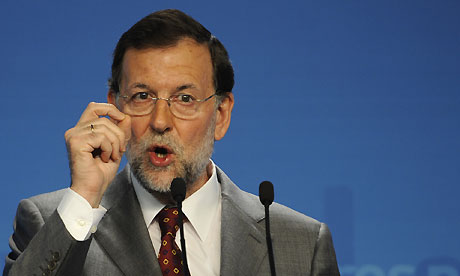
Mariano Rajoy, the Spanish prime minister, has called for the eurozone to have "centralised control" over the budgets of all the countries using the euro.
Mr Rajoy has become the latest European politician to call for countries to, in effect, abandon their sovereignty in a last ditch attempt to save the beleaguered currency.
Mr Rajoy said a new central authority would go a long way to alleviating Spain's economic crisis as it would send a clear signal to investors that the single currency is an irreversible project.
Speaking in Madrid yesterday, he said: "The European Union needs to reinforce its architecture. This entails moving towards more integration, transferring more sovereignty, especially in the fiscal field.
"And this means a compromise to create a new European fiscal authority which would guide the fiscal policy in the eurozone, harmonise the fiscal policy of member states and enable a centralised control of public finances."
Mr Rajoy is not the first to propose creating such an authority but the fact that Spain -- a country deemed too big to fail -- is backing the move may now accelerate talks.
Its set-up would require a change in the European Union treaties, a usually lengthy process which requires ratification in the 27 member states of the bloc, including those such as the UK which do not use the euro.
Germany, the de facto guarantor of the euro, has said further integration in Europe was required, including additional controls on national public finances.
Angela Merkel, the German chancellor, said there should be no taboos when discussing such issues.
Last week Mario Draghi, the president of the European Central Bank, said that the ECB could not "fill the vacuum of the lack of action by national governments on the structural problem" and that countries needed to give up some of their sovereignty.
The ultimate outcome of this consensus will be the widening of the divide between Europe's rulers and its people, leading eventually to the disintegration of the European Union and even the nation-states that formed it. Self-determination and harmony cannot coexist.
Mr Rajoy has become the latest European politician to call for countries to, in effect, abandon their sovereignty in a last ditch attempt to save the beleaguered currency.
Mr Rajoy said a new central authority would go a long way to alleviating Spain's economic crisis as it would send a clear signal to investors that the single currency is an irreversible project.
Speaking in Madrid yesterday, he said: "The European Union needs to reinforce its architecture. This entails moving towards more integration, transferring more sovereignty, especially in the fiscal field.
"And this means a compromise to create a new European fiscal authority which would guide the fiscal policy in the eurozone, harmonise the fiscal policy of member states and enable a centralised control of public finances."
Mr Rajoy is not the first to propose creating such an authority but the fact that Spain -- a country deemed too big to fail -- is backing the move may now accelerate talks.
Its set-up would require a change in the European Union treaties, a usually lengthy process which requires ratification in the 27 member states of the bloc, including those such as the UK which do not use the euro.
Germany, the de facto guarantor of the euro, has said further integration in Europe was required, including additional controls on national public finances.
Angela Merkel, the German chancellor, said there should be no taboos when discussing such issues.
Last week Mario Draghi, the president of the European Central Bank, said that the ECB could not "fill the vacuum of the lack of action by national governments on the structural problem" and that countries needed to give up some of their sovereignty.
The ultimate outcome of this consensus will be the widening of the divide between Europe's rulers and its people, leading eventually to the disintegration of the European Union and even the nation-states that formed it. Self-determination and harmony cannot coexist.
Syrian expat businessmen announce fund for rebels
A group of expat Syrian businessmen announced in Qatar on Wednesday the creation of a $300 million (239 million euro) fund to support the rebellion against President Bashar al-Assad.
Mustafa Sabbagh, chairman of the newly created Syrian Business Forum, said "the businessmen of Syria... offer their full and clear support to the revolution against (Assad's) dictatorial regime."
Businessman Khaled Khouja told a news conference the SBF would offer the rebel Free Syrian Army "medical equipment and technological materiel to facilitate its communications in Syria."
Neither Sabbagh nor Khouja elaborated on how the money would be raised and how much, if any, was already available.
However, Sabbagh said $150 million had already been given to the rebels, but he did not provide any details.
Meanwhile, Wael Mirza, one of the SBF's leaders, said the forum planned to join the opposition coalition Syrian National Council.
The SBF has a seven-person board of directors, of which three would represent business people inside Syria, Sabbagh said. He added that trips were planned to donor countries, particularly the oil-rich Arab monarchies in the Gulf.
Far from being a desertion of one's homeland, expatriation can actually prove a loyal action when it gives citizens the opportunity to support the overthrow of a government more effectively from abroad.
Mustafa Sabbagh, chairman of the newly created Syrian Business Forum, said "the businessmen of Syria... offer their full and clear support to the revolution against (Assad's) dictatorial regime."
Businessman Khaled Khouja told a news conference the SBF would offer the rebel Free Syrian Army "medical equipment and technological materiel to facilitate its communications in Syria."
Neither Sabbagh nor Khouja elaborated on how the money would be raised and how much, if any, was already available.
However, Sabbagh said $150 million had already been given to the rebels, but he did not provide any details.
Meanwhile, Wael Mirza, one of the SBF's leaders, said the forum planned to join the opposition coalition Syrian National Council.
The SBF has a seven-person board of directors, of which three would represent business people inside Syria, Sabbagh said. He added that trips were planned to donor countries, particularly the oil-rich Arab monarchies in the Gulf.
Far from being a desertion of one's homeland, expatriation can actually prove a loyal action when it gives citizens the opportunity to support the overthrow of a government more effectively from abroad.
Sunday, June 3, 2012
Fiji government re-instates right to public meetings
The government of Fiji on Saturday re-instated the right to hold public meetings, which were outlawed following the 2006 coup that brought military strongman Voreqe Bainimarama to power.
The government announcement said public meetings could smooth the progress of public discussion as the South Pacific nation prepares for long-awaited consultation on a new constitution.
It also recognised "the important role" non-governmental organisations and civil groups including faith-based organisations will play in the consultation process.
But it warned the meetings would require police approval and it would not tolerate any gathering that allowed racial or religious criticism or undermined "the economy or financial integrity of Fiji".
The Methodist church, the largest Christian denomination in Fiji and representing about one-third of the 850,000 population, immediately welcomed the move.
In recent years the church has not been allowed to hold its annual conference, which was considered a public gathering, because the Bainimarama government believed church leaders were critical of the military regime.
"The Methodist Church has finally got what we wanted and most importantly can carry out our annual conferences," acting general secretary Reverend Tevita Nawadra said.
"We have waited for this of a long time. Now, with the approval of the government, we can carry out meetings unlike in the past years when we tried to have our meeting but the government came in and told us we can't."
Bainimarama has said a new constitution following "true consultations" must be in place for the island-nation to hold elections in 2014.
He tore up the previous constitution when he seized power and promised a new document that would enshrine principles such as one-person-one-vote, an independent judiciary and transparent governance, as well as concentrating on establishing a secular, corruption-free state.
Bainimarama said the constitutional process, which will culminate in long-promised elections in 2014, would ensure "peace, prosperity, economic well-being, and a sustained and true democracy for all".
The government announcement said public meetings could smooth the progress of public discussion as the South Pacific nation prepares for long-awaited consultation on a new constitution.
It also recognised "the important role" non-governmental organisations and civil groups including faith-based organisations will play in the consultation process.
But it warned the meetings would require police approval and it would not tolerate any gathering that allowed racial or religious criticism or undermined "the economy or financial integrity of Fiji".
The Methodist church, the largest Christian denomination in Fiji and representing about one-third of the 850,000 population, immediately welcomed the move.
In recent years the church has not been allowed to hold its annual conference, which was considered a public gathering, because the Bainimarama government believed church leaders were critical of the military regime.
"The Methodist Church has finally got what we wanted and most importantly can carry out our annual conferences," acting general secretary Reverend Tevita Nawadra said.
"We have waited for this of a long time. Now, with the approval of the government, we can carry out meetings unlike in the past years when we tried to have our meeting but the government came in and told us we can't."
Bainimarama has said a new constitution following "true consultations" must be in place for the island-nation to hold elections in 2014.
He tore up the previous constitution when he seized power and promised a new document that would enshrine principles such as one-person-one-vote, an independent judiciary and transparent governance, as well as concentrating on establishing a secular, corruption-free state.
Bainimarama said the constitutional process, which will culminate in long-promised elections in 2014, would ensure "peace, prosperity, economic well-being, and a sustained and true democracy for all".
Subscribe to:
Posts (Atom)