Hong Kong’s banking regulator has bowed to private banking industry demands to cut red tape in a bid to help the Chinese territory compete better with Singapore.
Norman Chan, chief executive of the Hong Kong Monetary Authority, told bankers in a speech that was made public on Wednesday that his “vision” was for Hong Kong to become “the most competitive and dynamic private banking hub in the region”.
Private bankers in Hong Kong had sought rule changes to address concerns that the city is falling further behind Singapore – the leading Asian wealth management centre – particularly as more wealthy Chinese look to move their money outside the mainland.
Singapore, with 48 private banks, is the main base for private banks seeking to gain market share in Asia, according to Celent, an arm of consultancy Oliver Wyman. This is partly because of the city-state’s privacy protection laws, in addition to its lack of estate duties, which Hong Kong only repealed in 2010.
Mr Chan announced key rule changes and in a separate letter sent to chief executives pledged to make the regulations “more user friendly”.
But he warned the changes could not be an excuse to compromise investor protection, particularly when it came to making sure clients understood the products they were buying. He told bankers in the predominantly Cantonese-speaking city that they needed to improve their Mandarin Chinese skills to ensure they could communicate properly with mainland clients.
“It is hard to imagine that quality service can be provided to a mainland customer who does not speak English or Cantonese if the account manager cannot communicate in Putonghua [Mandarin],” Mr Chan said.
He added that it would be “helpful if important contracts or documents are written in bilingual forms”, again to help mainland Chinese clients.
Silvan Colani, deputy chief executive of Liechtenstein’s LGT Bank in Asia, welcomed the efforts to clearly distinguish private banking from retail banking.
“We fully agree with the HKMA that Hong Kong has the potential to be a leading private banking hub for Asia, given that Singapore is arguably at a more advanced stage,” he said.
The pressure for rule changes has grown since widespread losses among retail investors on Lehman Brothers-related investments led to a regulatory crackdown that hampered private banks’ dealings with wealthy clients.
Alongside making clearer the distinction between wealthy clients and ordinary retail customers, the HKMA has relaxed requirements for the wealthy to undergo suitability assessments for every product, saying they could instead be assessed for a portfolio of investments when they first became a client.
Alan Ewins, a partner at Allen & Overy in Hong Kong, said the adoption of the “portfolio” suitability assessment standard, and the classification of private banking customers, were key developments for the industry. But he said wealth managers outside of the banking sector could now be left at a disadvantage.
“[Mr Chan’s letter] shows the need for a co-ordinated approach by regulators, given the existence of private wealth arms of non-banks where there clearly needs to be a level [regulatory] playing field. They were not catered for here,” he said.
More than US$5tn of the roughly US$11tn of assets held by non-Japanese wealthy people in Asia is in the hands of people with $1m-$5m each. According to Oliver Wyman, this is exactly the population of private banking clients that were not distinguished under the current Hong Kong rules.
Mr Chan said such people could be highly seasoned investors or “unsophisticated clients with only very basic investment knowledge, notwithstanding [their] substantial wealth”.
“Private banks must ensure that their account managers take extra care in offering investment advice and marketing investment products to the less sophisticated clients,” he said.
Charting islands of stability in a stormy sea. Advice & articles on going offshore, investing, weak governments, food sovereignty, personal security, and private banking.
Showing posts with label Regulations. Show all posts
Thursday, June 14, 2012
Wednesday, June 13, 2012
Call to criminalise Australians who support Fiji regime
There has been a call for Australia and New Zealand to make it illegal for its citizens to work overseas in support of undemocratic regimes.
The call comes from prominent Fiji academic, Professor Wadan Narsey, who says several Australians and and New Zealanders are working in prominent positions in the coup installed military government in Fiji.
Professor Narsey told Radio Australia's Pacific Beat program that both countries already criminalise their citizens who travel offshore to engage in paedophilia or terrorist activities, and supporting what he says are illegal governments should be treated the same way.
"I mean I have no problems with those people who are trying to do positive and constructive things, you know, to try and get the country back to a lawful and democratic government," he said.
"But where I have a problem is where quite a few people have gone there and justified illegal things such as the overthrow of a lawful government, or they have taken part in processes which have compromised the judiciary or have compromised the ministerial portfolios."
"If somebody goes and engages in paedophilia or engages in activities which encourage terrorism, such as what happened in September 11, you have laws over here which allows the Australian and New Zealand Governments to prosecute them," said Professor Narsey.
"There is no laws which they can use to discredit this unlawful behaviour abroad, and to me this strikes me as double standards."
He says the lack of legislation available to prosecute such actions is a double standard, made more glaring by the fact that Australia has imposed travel bans on not only those taking part in the coup in Fiji, but their relatives as well.
"That infringes on their basic human rights," he said.
"I mean you are not responsible for your relatives, you are responsible for your own actions."
Professor Narsey says that with huge financial interests at play in areas like PNG and East Timor, there is the very real danger that the assistance of well-trained New Zealanders and Australians can be used to further weaken the fragile political and judicial institutions in these places.
The call comes from prominent Fiji academic, Professor Wadan Narsey, who says several Australians and and New Zealanders are working in prominent positions in the coup installed military government in Fiji.
Professor Narsey told Radio Australia's Pacific Beat program that both countries already criminalise their citizens who travel offshore to engage in paedophilia or terrorist activities, and supporting what he says are illegal governments should be treated the same way.
"I mean I have no problems with those people who are trying to do positive and constructive things, you know, to try and get the country back to a lawful and democratic government," he said.
"But where I have a problem is where quite a few people have gone there and justified illegal things such as the overthrow of a lawful government, or they have taken part in processes which have compromised the judiciary or have compromised the ministerial portfolios."
"If somebody goes and engages in paedophilia or engages in activities which encourage terrorism, such as what happened in September 11, you have laws over here which allows the Australian and New Zealand Governments to prosecute them," said Professor Narsey.
"There is no laws which they can use to discredit this unlawful behaviour abroad, and to me this strikes me as double standards."
He says the lack of legislation available to prosecute such actions is a double standard, made more glaring by the fact that Australia has imposed travel bans on not only those taking part in the coup in Fiji, but their relatives as well.
"That infringes on their basic human rights," he said.
"I mean you are not responsible for your relatives, you are responsible for your own actions."
Professor Narsey says that with huge financial interests at play in areas like PNG and East Timor, there is the very real danger that the assistance of well-trained New Zealanders and Australians can be used to further weaken the fragile political and judicial institutions in these places.
Tuesday, June 12, 2012
Liechtenstein informs bank clients of U.S. tax evasion request
Liechtenstein, an Alpine country of 36,000 people, has told American clients of the principality’s oldest bank that U.S. authorities have requested their account data as they widen a tax-evasion probe.
Accounts at Liechtensteinische Landesbank AG (LLB) that contained at least $500,000 at any time since the beginning of 2004 are covered by the information request, according to a May 30 letter sent to a client by the principality’s tax authority. Liechtenstein facilitated the so-called group request from the U.S. by amending a tax law in March.
Liechtenstein’s second-biggest bank, also known as LLB, is one of 11 financial firms, including Credit Suisse Group AG (CSGN) and Julius Baer Group Ltd. (BAER), being investigated as part of a U.S. probe of offshore tax evasion. The stakes for Swiss banks were raised after the Department of Justice indicted Wegelin & Co. on Feb. 2 for allegedly helping customers hide money from the Internal Revenue Service.
“The motivation for the law is the Landesbank issue, which has accelerated the process,” said Mario Frick, a partner at Liechtenstein law firm Seeger, Frick & Partner. “For a certain period of time, it will be possible to make group requests to clean up the past and the issue of legacy assets.”
Landesbank, which had 48.1 billion Swiss francs ($50 billion) of assets under management at the end of 2011, confirmed it has received a group request via the Liechtenstein authorities, Cyrill Sele, a spokesman for the bank in Vaduz, said in an e-mailed response to questions.
“The ruling to extend the period of applicability back to the tax year 2001 in the administrative assistance law with the U.S. is limited to 12 months from the date it comes into force,” said Sele. It “is closely linked to the ongoing U.S. offshore voluntary disclosure program.”
Those affected by the U.S. request for information have the right to appeal, according to the letter.
In the Liechtenstein group request, U.S. authorities are also targeting lawyers, accountants, financial advisers, asset managers and those responsible for professional “asset protection,” who “conspired with a U.S. taxpayer to commit U.S. crimes or provided assistance,” according to the letter.
“It’s a sign that the U.S. is not just focused on Switzerland, but on all offshore jurisdictions with Singapore, Dubai and Hong Kong very much on the radar screen,” said Milan Patel, a partner at Zurich-based law firm Anaford AG. “This request appears to be much more expansive than the agreement with Switzerland and aims to get information on third parties.”
Swiss banks are seeking a settlement with the U.S. as Liechtenstein’s larger Alpine neighbor, the world’s biggest center for offshore wealth, tries to shed its image as a haven for undeclared assets. That may involve negotiating separate deferred prosecution agreements with U.S. authorities.
UBS AG, the biggest Swiss bank, avoided prosecution in 2009 by paying $780 million, admitting it fostered tax evasion and giving the IRS data on more than 250 accounts. It later turned over data on another 4,450 accounts. Before the UBS deferred- prosecution deal, U.S. prosecutors said the bank managed $20 billion in undeclared assets for American clients.
Landesbank declined to comment on whether the handover of account data under the group request would allow the bank to enter a deferred prosecution agreement.
Christof Buri, a spokesman for larger Liechtenstein rival LGT Group, which had 86.9 billion francs of assets under management at the end of last year, said the bank only has tax- compliant U.S. clients. The bank, owned by Liechtenstein’s princely family, declined to comment further.
Liechtenstein started to unwind secrecy after data stolen from LGT was used by Germany to prosecute tax evaders in 2008. Former Deutsche Post AG (DPW) Chief Executive Officer Klaus Zumwinkel was convicted of tax evasion and received a two-year suspended prison sentence plus a penalty of 1 million euros ($1.25 million).
Under pressure from the U.S., Germany and France, Liechtenstein said in March 2009 that it would conform with tax standards set out by the Organization for Economic Cooperation and Development to avoid being blacklisted as a tax haven.
Markus Amman, a spokesman for the Liechtenstein government, and Katja Gey, who helped negotiate a tax deal for the principality with the U.K., didn’t answer calls to their mobile phones.
“It’s only a question of time, say three to five years, when this type of group request will become standard for future business,” said lawyer Frick. “Liechtenstein is a small country that has had a reputation for not cooperating in the field of tax and that’s something that has to change. We have to find new areas of business.”
Accounts at Liechtensteinische Landesbank AG (LLB) that contained at least $500,000 at any time since the beginning of 2004 are covered by the information request, according to a May 30 letter sent to a client by the principality’s tax authority. Liechtenstein facilitated the so-called group request from the U.S. by amending a tax law in March.
Liechtenstein’s second-biggest bank, also known as LLB, is one of 11 financial firms, including Credit Suisse Group AG (CSGN) and Julius Baer Group Ltd. (BAER), being investigated as part of a U.S. probe of offshore tax evasion. The stakes for Swiss banks were raised after the Department of Justice indicted Wegelin & Co. on Feb. 2 for allegedly helping customers hide money from the Internal Revenue Service.
“The motivation for the law is the Landesbank issue, which has accelerated the process,” said Mario Frick, a partner at Liechtenstein law firm Seeger, Frick & Partner. “For a certain period of time, it will be possible to make group requests to clean up the past and the issue of legacy assets.”
Landesbank, which had 48.1 billion Swiss francs ($50 billion) of assets under management at the end of 2011, confirmed it has received a group request via the Liechtenstein authorities, Cyrill Sele, a spokesman for the bank in Vaduz, said in an e-mailed response to questions.
“The ruling to extend the period of applicability back to the tax year 2001 in the administrative assistance law with the U.S. is limited to 12 months from the date it comes into force,” said Sele. It “is closely linked to the ongoing U.S. offshore voluntary disclosure program.”
Those affected by the U.S. request for information have the right to appeal, according to the letter.
In the Liechtenstein group request, U.S. authorities are also targeting lawyers, accountants, financial advisers, asset managers and those responsible for professional “asset protection,” who “conspired with a U.S. taxpayer to commit U.S. crimes or provided assistance,” according to the letter.
“It’s a sign that the U.S. is not just focused on Switzerland, but on all offshore jurisdictions with Singapore, Dubai and Hong Kong very much on the radar screen,” said Milan Patel, a partner at Zurich-based law firm Anaford AG. “This request appears to be much more expansive than the agreement with Switzerland and aims to get information on third parties.”
Swiss banks are seeking a settlement with the U.S. as Liechtenstein’s larger Alpine neighbor, the world’s biggest center for offshore wealth, tries to shed its image as a haven for undeclared assets. That may involve negotiating separate deferred prosecution agreements with U.S. authorities.
UBS AG, the biggest Swiss bank, avoided prosecution in 2009 by paying $780 million, admitting it fostered tax evasion and giving the IRS data on more than 250 accounts. It later turned over data on another 4,450 accounts. Before the UBS deferred- prosecution deal, U.S. prosecutors said the bank managed $20 billion in undeclared assets for American clients.
Landesbank declined to comment on whether the handover of account data under the group request would allow the bank to enter a deferred prosecution agreement.
Christof Buri, a spokesman for larger Liechtenstein rival LGT Group, which had 86.9 billion francs of assets under management at the end of last year, said the bank only has tax- compliant U.S. clients. The bank, owned by Liechtenstein’s princely family, declined to comment further.
Liechtenstein started to unwind secrecy after data stolen from LGT was used by Germany to prosecute tax evaders in 2008. Former Deutsche Post AG (DPW) Chief Executive Officer Klaus Zumwinkel was convicted of tax evasion and received a two-year suspended prison sentence plus a penalty of 1 million euros ($1.25 million).
Under pressure from the U.S., Germany and France, Liechtenstein said in March 2009 that it would conform with tax standards set out by the Organization for Economic Cooperation and Development to avoid being blacklisted as a tax haven.
Markus Amman, a spokesman for the Liechtenstein government, and Katja Gey, who helped negotiate a tax deal for the principality with the U.K., didn’t answer calls to their mobile phones.
“It’s only a question of time, say three to five years, when this type of group request will become standard for future business,” said lawyer Frick. “Liechtenstein is a small country that has had a reputation for not cooperating in the field of tax and that’s something that has to change. We have to find new areas of business.”
Monday, June 11, 2012
Offshore investing gets easier for South Africans
For some South Africans, getting tax clearance to take your money overseas has been a bit like trying to move through airport security with a chicken strapped to your head.
This has all changed, and not a moment too soon – the case for investing abroad has rarely seemed so solid.
Government recently issued a circular announcing that you can now invest R1m/year outside South African borders without having to obtain a tax clearance certificate.
Before the announcement, South Africans had an annual “single discretionary allowance” of R1m to take out of the country, which could only be used for travel, study, alimony and child support as well as for donations. You were then also allowed to take R4m to invest abroad, but you needed to have tax clearance from the SA Revenue Service.
But now you may also use the single allowance to invest abroad – without tax clearance.
This has been welcomed, with some financial advisers claiming that it was “virtually impossible” to get tax certificates for some clients.
There have been complaints about constant changes in the way applications have been processed and that SARS often decided not to issue the certificate because of minor technicalities. In response, a number of small outfits have sprung up, promising to assist investors in getting clearance certificates.
Gregg Sneddon of The Financial Coach in Cape Town, says SARS sometimes seemed to require that applicants had to have the money they were planning to invest abroad actually sitting in their bank account - they could not move it from another investment.
This was part of anti-laundering efforts, says Sonja Frank, a legal and tax adviser and director of Exceed Trust. SARS therefore requires extensive source documents - including property transaction contracts and transfer documentation - to make sure it knows where the money comes from. If a client’s tax returns were not up to date this could also delay getting tax clearance.
And the process for those wanting to start a business abroad - proving where your money will go, including premises and other expenses - could be particularly onerous, says Frank.
She thinks that the new regulation will make a big difference to those wanting to invest abroad.
So, the world is your oyster - and if you haven’t done so already, you should get a tiny fork and some Tabasco, and dig in.
There seems to be bargains elsewhere, with valuations in the local market on the expensive side. The local market is trading at a price-to-earnings ratio (which tells you how expensive a market is) of more than 13 times - in line with its long-term average.
But US stocks are also trading at 13 times - significantly cheaper than its historical average of 16. Other emerging markets like Brazil, Russia, India and China are also trading at lower ratios than SA.
Also, the rand is looking shaky. The currency has already lost 13% in the past year to the dollar, and 22% to the euro. Any further weakening in the rand will give you an instant profit on your overseas investments. With inflation ticking higher in SA, no sign of an interest rate hike (which will make the rand more attractive to overseas investors looking for yield) and amid continued nervousness about the eurozone (SA’s biggest trading partner), it’s expected that the local currency may come under further pressure in the future.
As a general rule of thumb, experts recommend having at least 30% of your portfolio invested outside of SA.
“Offshore assets are included in investment strategies as they behave differently to local assets and thus offer diversification benefits. Investing offshore also allows access to opportunities that are not available in SA - investing in Google or Microsoft for example,” says Jonathan Brummer, Financial Planning Coaching Support Consultant at acsis.
Another reason to diversify is that the local market is very resource-heavy, a sector, which may face a bit of a rough ride, according to some. Allan Gray’s chief investment officer, Ian Liddle, recently questioned the sustainability of commodity prices and mining company profit margins, which are mostly substantially higher than their long-term averages. “For example, the 21st century boom in iron ore prices has been of a similar magnitude to the Nasdaq tech bubble in the Nineties, the Japanese stock market bubble in the Eighties and the gold bubble in the Seventies.”
If you do want to diversify abroad, Sneddon likes direct investments in global unit trusts – which are cheaper than going though platforms like Glacier, which adds more costs and layers. Institutions like Ashburton, Investec and Templeton, which operate in SA and are approved by the Financial Services Board, offer offshore unit trusts to local investors.
This has all changed, and not a moment too soon – the case for investing abroad has rarely seemed so solid.
Government recently issued a circular announcing that you can now invest R1m/year outside South African borders without having to obtain a tax clearance certificate.
Before the announcement, South Africans had an annual “single discretionary allowance” of R1m to take out of the country, which could only be used for travel, study, alimony and child support as well as for donations. You were then also allowed to take R4m to invest abroad, but you needed to have tax clearance from the SA Revenue Service.
But now you may also use the single allowance to invest abroad – without tax clearance.
This has been welcomed, with some financial advisers claiming that it was “virtually impossible” to get tax certificates for some clients.
There have been complaints about constant changes in the way applications have been processed and that SARS often decided not to issue the certificate because of minor technicalities. In response, a number of small outfits have sprung up, promising to assist investors in getting clearance certificates.
Gregg Sneddon of The Financial Coach in Cape Town, says SARS sometimes seemed to require that applicants had to have the money they were planning to invest abroad actually sitting in their bank account - they could not move it from another investment.
This was part of anti-laundering efforts, says Sonja Frank, a legal and tax adviser and director of Exceed Trust. SARS therefore requires extensive source documents - including property transaction contracts and transfer documentation - to make sure it knows where the money comes from. If a client’s tax returns were not up to date this could also delay getting tax clearance.
And the process for those wanting to start a business abroad - proving where your money will go, including premises and other expenses - could be particularly onerous, says Frank.
She thinks that the new regulation will make a big difference to those wanting to invest abroad.
So, the world is your oyster - and if you haven’t done so already, you should get a tiny fork and some Tabasco, and dig in.
There seems to be bargains elsewhere, with valuations in the local market on the expensive side. The local market is trading at a price-to-earnings ratio (which tells you how expensive a market is) of more than 13 times - in line with its long-term average.
But US stocks are also trading at 13 times - significantly cheaper than its historical average of 16. Other emerging markets like Brazil, Russia, India and China are also trading at lower ratios than SA.
Also, the rand is looking shaky. The currency has already lost 13% in the past year to the dollar, and 22% to the euro. Any further weakening in the rand will give you an instant profit on your overseas investments. With inflation ticking higher in SA, no sign of an interest rate hike (which will make the rand more attractive to overseas investors looking for yield) and amid continued nervousness about the eurozone (SA’s biggest trading partner), it’s expected that the local currency may come under further pressure in the future.
As a general rule of thumb, experts recommend having at least 30% of your portfolio invested outside of SA.
“Offshore assets are included in investment strategies as they behave differently to local assets and thus offer diversification benefits. Investing offshore also allows access to opportunities that are not available in SA - investing in Google or Microsoft for example,” says Jonathan Brummer, Financial Planning Coaching Support Consultant at acsis.
Another reason to diversify is that the local market is very resource-heavy, a sector, which may face a bit of a rough ride, according to some. Allan Gray’s chief investment officer, Ian Liddle, recently questioned the sustainability of commodity prices and mining company profit margins, which are mostly substantially higher than their long-term averages. “For example, the 21st century boom in iron ore prices has been of a similar magnitude to the Nasdaq tech bubble in the Nineties, the Japanese stock market bubble in the Eighties and the gold bubble in the Seventies.”
If you do want to diversify abroad, Sneddon likes direct investments in global unit trusts – which are cheaper than going though platforms like Glacier, which adds more costs and layers. Institutions like Ashburton, Investec and Templeton, which operate in SA and are approved by the Financial Services Board, offer offshore unit trusts to local investors.
Participatory notes investors pull out Rs 1 Trillion from India
Rich overseas entities, investing in Indian markets through 'Participatory Notes', are estimated to have pulled out over Rs 1 lakh crore (about USD 20 billion) in less than three months on fears of getting caught in the government's taxation net and its black money trail.
As a result, the quantum of money invested through these P-Notes has hit its rock-bottom levels of just about 10 per cent of total FII (foreign institutional investment) holdings -- which used to be more than 50 per cent a few years ago.
The Participatory Notes (P-Notes) allow foreign HNIs (High Networth Individuals) and other rich investors to invest in India through already-registered FIIs, while saving on time and costs associated with direct registrations.
The flight of P-Note investments began late in March after the government in its union budget proposed new taxation regime of General Anti-Avoidance Rule (GAAR) and certain retrospective amendments for taxing offshore transactions.
Sources said that P-Note investors have already pulled out close to Rs 1 lakh crore (about USD 20 billion) from Indian equity and debt markets, while they might have decided against putting in fresh investments worth at least Rs 50,000 crore ever since the new tax policy was proposed.
While GAAR has been deferred by a year, the tax proposals for offshore transactions could apply to FIIs as well.
It is feared that the new taxes could lead to heavy tax burden for the foreign investors investing through tax-friendly jurisdictions like Mauritius. Most of the overseas entities route their investments into India through such places to take benefit of their tax-friendly regimes.
There are apprehensions that FIIs could be forced to pass on their tax liabilities to their P-note clients, thus adversely impacting their overall returns on investment.
Many hedge funds and ultra-rich investors from abroad prefer P-Notes, which are sold by India-registered FIIs, as it allows them maximise the returns through savings on costs and rigmarole of various regulatory processes.
As per the latest data available with market regulator Sebi, the total value of PNs in Indian markets stood at about Rs 1,30,012 crore (about USD 25 billion) at the end of April 2012, down from Rs 1,83,151 crore at the end of February and Rs 1,65,832 crore as on March 31, 2012.
This figure was on a sharp uptrend this year till middle of March, but started declining sharply after tax proposals came to be known. While the mid-month figures are not shared by Sebi, the industry sources said that the total value of PNs are estimated to have reached near Rs two trillion (about USD 40 billion), before it started sliding in late March.
Sources said that the total value of PNs is estimated to have fallen further to near Rs one lakh crore level (about USD 15 billion) currently, marking a fall of nearly same amount from its late-March peak. The share of PNs in total FII holding stood at 16.4 per cent in February, but fell to 11.4 per cent by April. It has now further fallen to near 10 per cent level, sources said, while adding that most of the FII outflow currently taking place is in the P-Note accounts.
The PNs have been accounting for mostly 15-20 per cent of total FII holdings in India since 2009, while it used to much higher in the range of 25-40 per cent in 2008. However, it was as high as over 50 per cent at the peak of Indian stock market bull run during a few months in 2007.
In addition to the new taxation proposals, the government's recent White Paper on Black Money has added to the flight of P-Note investments from India, sources said. The White Paper, tabled by the Parliament on May 21, said that Pnotes were being used by Indian citizens to re-invest the black money in the country.
"Investment in the Indian Stock Market through PNs is another way in which the black money generated by Indians is re-invested in India," it said.
Participatory Note is a derivative instrument issued in foreign jurisdictions, by a Foreign Institutional Investor or its sub-accounts against underlying Indian securities.
"... through the instrument of PNs, investment can be made in the Indian securities market by those investors who do not wish to be regulated by Indian regulators due to a variety of reasons," the White Paper noted.
The reasons could include the desire of investors to keep their identity anonymous, which is possible also for the reason that PNs/ODIs can be freely traded and easily transferred without disclosing the identity of the actual beneficiaries, it added.
As per the White Paper, since PNs are issued from Offshore Financial Centres (OFCs) such as the Cayman Islands, British Virgin Islands, Switzerland, and Luxembourg, it is possible to hide the identity of the ultimate beneficiaries through multiple layers. Amid rising concerns that some of the money coming through PNs could be unaccounted wealth under the of FII investment, market regulator Sebi has already taken various measures to ensure that these instruments are not used for black money laundering. It was due to the steps taken by Sebi that the PNs' share in total FII holding had previously fallen from over 50 per cent to 15-20 per cent.
As a result, the quantum of money invested through these P-Notes has hit its rock-bottom levels of just about 10 per cent of total FII (foreign institutional investment) holdings -- which used to be more than 50 per cent a few years ago.
The Participatory Notes (P-Notes) allow foreign HNIs (High Networth Individuals) and other rich investors to invest in India through already-registered FIIs, while saving on time and costs associated with direct registrations.
The flight of P-Note investments began late in March after the government in its union budget proposed new taxation regime of General Anti-Avoidance Rule (GAAR) and certain retrospective amendments for taxing offshore transactions.
Sources said that P-Note investors have already pulled out close to Rs 1 lakh crore (about USD 20 billion) from Indian equity and debt markets, while they might have decided against putting in fresh investments worth at least Rs 50,000 crore ever since the new tax policy was proposed.
While GAAR has been deferred by a year, the tax proposals for offshore transactions could apply to FIIs as well.
It is feared that the new taxes could lead to heavy tax burden for the foreign investors investing through tax-friendly jurisdictions like Mauritius. Most of the overseas entities route their investments into India through such places to take benefit of their tax-friendly regimes.
There are apprehensions that FIIs could be forced to pass on their tax liabilities to their P-note clients, thus adversely impacting their overall returns on investment.
Many hedge funds and ultra-rich investors from abroad prefer P-Notes, which are sold by India-registered FIIs, as it allows them maximise the returns through savings on costs and rigmarole of various regulatory processes.
As per the latest data available with market regulator Sebi, the total value of PNs in Indian markets stood at about Rs 1,30,012 crore (about USD 25 billion) at the end of April 2012, down from Rs 1,83,151 crore at the end of February and Rs 1,65,832 crore as on March 31, 2012.
This figure was on a sharp uptrend this year till middle of March, but started declining sharply after tax proposals came to be known. While the mid-month figures are not shared by Sebi, the industry sources said that the total value of PNs are estimated to have reached near Rs two trillion (about USD 40 billion), before it started sliding in late March.
Sources said that the total value of PNs is estimated to have fallen further to near Rs one lakh crore level (about USD 15 billion) currently, marking a fall of nearly same amount from its late-March peak. The share of PNs in total FII holding stood at 16.4 per cent in February, but fell to 11.4 per cent by April. It has now further fallen to near 10 per cent level, sources said, while adding that most of the FII outflow currently taking place is in the P-Note accounts.
The PNs have been accounting for mostly 15-20 per cent of total FII holdings in India since 2009, while it used to much higher in the range of 25-40 per cent in 2008. However, it was as high as over 50 per cent at the peak of Indian stock market bull run during a few months in 2007.
In addition to the new taxation proposals, the government's recent White Paper on Black Money has added to the flight of P-Note investments from India, sources said. The White Paper, tabled by the Parliament on May 21, said that Pnotes were being used by Indian citizens to re-invest the black money in the country.
"Investment in the Indian Stock Market through PNs is another way in which the black money generated by Indians is re-invested in India," it said.
Participatory Note is a derivative instrument issued in foreign jurisdictions, by a Foreign Institutional Investor or its sub-accounts against underlying Indian securities.
"... through the instrument of PNs, investment can be made in the Indian securities market by those investors who do not wish to be regulated by Indian regulators due to a variety of reasons," the White Paper noted.
The reasons could include the desire of investors to keep their identity anonymous, which is possible also for the reason that PNs/ODIs can be freely traded and easily transferred without disclosing the identity of the actual beneficiaries, it added.
As per the White Paper, since PNs are issued from Offshore Financial Centres (OFCs) such as the Cayman Islands, British Virgin Islands, Switzerland, and Luxembourg, it is possible to hide the identity of the ultimate beneficiaries through multiple layers. Amid rising concerns that some of the money coming through PNs could be unaccounted wealth under the of FII investment, market regulator Sebi has already taken various measures to ensure that these instruments are not used for black money laundering. It was due to the steps taken by Sebi that the PNs' share in total FII holding had previously fallen from over 50 per cent to 15-20 per cent.
Tanzania: From tax avoidance to tax evasion
Thursday, June 14 this year is Budget Day in the East African Community countries of Kenya, Uganda, Rwanda, Burundi and Tanzania. Not too distant in the past, Tanzanians generally looked forward to Budget Day with considerable excitement.
They were much like numbers game players who anxiously looked forward to ‘Draw Day’ when the raffle results would be announced. In the event, holders of the winning tickets would be awarded cash prizes, going laughing all the way to the bank (if they were ‘bankable!’).
The losers, resigned to their fate, would do their crying in the rain (crooners Everly Brothers, Don Williams pardon!) – till the next lottery and Draw Day!
Ditto Budget Day, when Tanzanians waited with bated breath the announcement in Parliament of government budget proposals for the next 12 months beginning on July 1. It was a foregone conclusion that Finance ministers would invariably hike extant tax rates, or introduce new taxes, on beverages and tobacco goods. Bettors to the contrary have always lost!
Imbibers nonetheless said ‘cheers!’ – and swallowed the new, bitter ‘tax pill’ with the first pint of the best brew in the house, happy in the knowledge that they were contributing in their own small way to public revenue coffers for national development.
But, when tax rates became inordinately high, and the number of taxes multiplied across the board – thanks to bottomless government coffers and itchy-fingered unprincipled filching officials – taxpayers started to feel the pinch. The imaginative ones turned to tax avoidance, while their impatient, reckless ones resorted to bad old tax evasion!
The difference between the two...? Well; ‘tax evasion’ includes smuggling; cheating on values and volumes/quantities of taxable consignments; bribing customs and other tax officials to look the other way at the psychological moment, and other illegitimate presentation of one’s finances, etc...
‘Tax avoidance’ is a different ballgame all together – and it isn’t a crime! Tax avoidance is when potential taxpayers legally take advantage of the extant tax regime, thereby reducing the tax burden they’d have otherwise carried, doing so by simply exploiting loopholes in the law.
I remember a very successful lawyer-friend in Mombasa in the 1960s and ‘70s whom I’ll identify here by his car (latest ‘Mercedes’ saloon model then), registration No. KAZ-1!
‘Bwana Kazi’ – as he was popularly known – avoided paying further income tax by simply stopping to practise when his taxable income approached the surtax threshold. He went on vacation abroad till the next taxation year. Sheesh!
If nothing else, the foregoing suggests that rampant tax evasion in Tanzania is fuelled by a multiplicity of taxes, compounded by too high tax rates. In countries where taxes are few, are universally applicable across the population – and rates are virtually nominal – tax evasion is unusual, with voluntary tax compliance the norm.
Can/will our finance minister heed this in the next Budget – or is it too late now? Think about it!
They were much like numbers game players who anxiously looked forward to ‘Draw Day’ when the raffle results would be announced. In the event, holders of the winning tickets would be awarded cash prizes, going laughing all the way to the bank (if they were ‘bankable!’).
The losers, resigned to their fate, would do their crying in the rain (crooners Everly Brothers, Don Williams pardon!) – till the next lottery and Draw Day!
Ditto Budget Day, when Tanzanians waited with bated breath the announcement in Parliament of government budget proposals for the next 12 months beginning on July 1. It was a foregone conclusion that Finance ministers would invariably hike extant tax rates, or introduce new taxes, on beverages and tobacco goods. Bettors to the contrary have always lost!
Imbibers nonetheless said ‘cheers!’ – and swallowed the new, bitter ‘tax pill’ with the first pint of the best brew in the house, happy in the knowledge that they were contributing in their own small way to public revenue coffers for national development.
But, when tax rates became inordinately high, and the number of taxes multiplied across the board – thanks to bottomless government coffers and itchy-fingered unprincipled filching officials – taxpayers started to feel the pinch. The imaginative ones turned to tax avoidance, while their impatient, reckless ones resorted to bad old tax evasion!
The difference between the two...? Well; ‘tax evasion’ includes smuggling; cheating on values and volumes/quantities of taxable consignments; bribing customs and other tax officials to look the other way at the psychological moment, and other illegitimate presentation of one’s finances, etc...
‘Tax avoidance’ is a different ballgame all together – and it isn’t a crime! Tax avoidance is when potential taxpayers legally take advantage of the extant tax regime, thereby reducing the tax burden they’d have otherwise carried, doing so by simply exploiting loopholes in the law.
I remember a very successful lawyer-friend in Mombasa in the 1960s and ‘70s whom I’ll identify here by his car (latest ‘Mercedes’ saloon model then), registration No. KAZ-1!
‘Bwana Kazi’ – as he was popularly known – avoided paying further income tax by simply stopping to practise when his taxable income approached the surtax threshold. He went on vacation abroad till the next taxation year. Sheesh!
If nothing else, the foregoing suggests that rampant tax evasion in Tanzania is fuelled by a multiplicity of taxes, compounded by too high tax rates. In countries where taxes are few, are universally applicable across the population – and rates are virtually nominal – tax evasion is unusual, with voluntary tax compliance the norm.
Can/will our finance minister heed this in the next Budget – or is it too late now? Think about it!
Sunday, June 10, 2012
The Pacific gulf
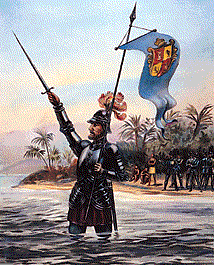
Next year marks the 500th anniversary of the European discovery of the Pacific after Vasco Núñez de Balboa was lured by an Indian cacique’s promise of “another ocean, where there is plenty of gold.” Last week, four of Latin America’s fastest-growing economies renewed this quest for Pacific gold when they signed a “deep integration” pact. Mexico, Colombia, Peru and Chile, with combined economic output of $2tn, say the alliance will help them expand trade with Asia. It is another sign of how the world’s economic centre is shifting from the Atlantic.
The pact was signed, symbolically, at one of the earth’s most powerful deep space telescopes, in Chile’s Atacama Desert. That the observatory lies 2,600m above sea level also lent the ceremony a certain breathlessness. After all, there has been a lot of talk about regional integration over the past two decades, but far less action. The Mercosur trade bloc, forged in the 1990s by Brazil and Argentina, is foundering as both countries respond to economic problems by withdrawing behind trade barriers. The Andean Community has meanwhile been part dismembered by socialist Venezuela. The Pacific Alliance, with its talk of the free movement of goods, capital and labour, is a return to the liberal spirit of the past: a group of countries that believe the best route to development is open markets, foreign investment and free trade. Potentially, it also establishes a regional counterweight to Brazil.
In many ways, politicians are merely catching up with business. Chilean retailers operate in Colombia and Peru; Colombian utilities in Peru; Mexican companies in Colombia; and LAN, the Chilean airline, everywhere. The new pact faces formidable obstacles, though. Relations between Chile and Peru are dogged by memories of bitter 19th century border disputes. The pact’s countries meanwhile run for 7,000 miles from top to toe. MILA, an alliance between the Bogotá, Lima and Santiago stock markets, provides a cautionary warning: trade volumes have been sluggish since it was founded a year ago.
Still, at least its members have gone about negotiations in a businesslike way. Early talks, for example, were conducted via video conferencing, rather than the usual grandstanding summitry. Although there is a risk of over-categorisation, the contrast is striking between the pact’s liberalising attitudes and that of the more protectionist and sluggish Brazilian and Argentine economies on the Atlantic seaboard. They should take note; others have. A EU-style free trade area without the countless petty regulations and requirements imposed by Brussels would position South America as a powerful economic competitor to its neighbors north of the Rio Grande.
The pact was signed, symbolically, at one of the earth’s most powerful deep space telescopes, in Chile’s Atacama Desert. That the observatory lies 2,600m above sea level also lent the ceremony a certain breathlessness. After all, there has been a lot of talk about regional integration over the past two decades, but far less action. The Mercosur trade bloc, forged in the 1990s by Brazil and Argentina, is foundering as both countries respond to economic problems by withdrawing behind trade barriers. The Andean Community has meanwhile been part dismembered by socialist Venezuela. The Pacific Alliance, with its talk of the free movement of goods, capital and labour, is a return to the liberal spirit of the past: a group of countries that believe the best route to development is open markets, foreign investment and free trade. Potentially, it also establishes a regional counterweight to Brazil.
In many ways, politicians are merely catching up with business. Chilean retailers operate in Colombia and Peru; Colombian utilities in Peru; Mexican companies in Colombia; and LAN, the Chilean airline, everywhere. The new pact faces formidable obstacles, though. Relations between Chile and Peru are dogged by memories of bitter 19th century border disputes. The pact’s countries meanwhile run for 7,000 miles from top to toe. MILA, an alliance between the Bogotá, Lima and Santiago stock markets, provides a cautionary warning: trade volumes have been sluggish since it was founded a year ago.
Still, at least its members have gone about negotiations in a businesslike way. Early talks, for example, were conducted via video conferencing, rather than the usual grandstanding summitry. Although there is a risk of over-categorisation, the contrast is striking between the pact’s liberalising attitudes and that of the more protectionist and sluggish Brazilian and Argentine economies on the Atlantic seaboard. They should take note; others have. A EU-style free trade area without the countless petty regulations and requirements imposed by Brussels would position South America as a powerful economic competitor to its neighbors north of the Rio Grande.
Saturday, June 9, 2012
Subject of Bank Indonesia bribery case a hero of the people
Eight years after dozens of legislators took bribes to vote for Miranda Goeltom as senior deputy governor of Bank Indonesia, the woman at the center of the saga has been jailed, but the big question remains: who benefited from having her in office?
Twenty-eight legislators have been tried and convicted in the case, along with Nunun Nurbaetie, Miranda’s acquaintance and the woman accused of channeling the Rp 20.8 billion ($2.2 million) in bribes.
Miranda, however, has consistently denied knowing about the bribes, a stance stressed by her lawyer, Dodi Abdul Kadir. “Miranda firmly declares that she knows nothing about the distribution of the traveler’s checks,” he said on Monday.
She never made any promises to the members of House of Representatives Commission IX who voted her into office, and she only found out about the bribes later through media reports, Dodi said.
But testimony presented in Nunun’s trial paints a different picture. Witnesses alleged Miranda asked Nunun to set up a meeting for her with Commission IX legislators prior to the vote.
Nunun did as asked, hosting a meeting at her home in South Jakarta. Miranda continued to have meetings with other legislators, witnesses said.
But the question of who was bankrolling the whole venture remains unanswered. Speculation has long been rife that the money came from people within the banking industry who were seeking to influence central bank policy.
Dodi acknowledged that Miranda often met with senior executives from a host of banks during her time in office, but said these meetings were part of the job.
“There was nothing special about those meetings,” he said. “In fact, she hardly remembers what they spoke about because they were informal gatherings.”
The Financial Transactions Report and Analysis Center (PPATK), the government’s anti-money laundering agency, previously determined the traveler’s checks were purchased from Bank International Indonesia by First Mujur Plantation and Industry, a palm oil firm owned by tycoon Tommy Winata.
A BII executive testified in one of the earlier trials that First Mujur purchased the checks through Bank Artha Graha, another of Winata’s companies, on the day Miranda was elected in June 2004.
A year later, Bank Indonesia approved a merger between Bank Artha Graha and the publicly held Bank Interpac, which meant Winata’s new company, Bank Artha Graha International, qualified for a listing on the Indonesia Stock Exchange (IDX).
But Dodi said there was nothing wrong if parties benefitted from policies that Miranda pushed. “What’s wrong with a policy that benefits a single party if it’s based on prevailing regulations?” he said. “There will always be those who are disadvantaged by policies and those who benefit. That’s normal.”
He added that even as senior deputy governor, Miranda still needed the support of other BI officials to change bank policy.
So who really benefited in the end? “Look at the country’s economic performance indicators,” the lawyer said.
“The rupiah strengthened, inflation went down. Who benefitted the most? The Indonesian people, of course.”
Twenty-eight legislators have been tried and convicted in the case, along with Nunun Nurbaetie, Miranda’s acquaintance and the woman accused of channeling the Rp 20.8 billion ($2.2 million) in bribes.
Miranda, however, has consistently denied knowing about the bribes, a stance stressed by her lawyer, Dodi Abdul Kadir. “Miranda firmly declares that she knows nothing about the distribution of the traveler’s checks,” he said on Monday.
She never made any promises to the members of House of Representatives Commission IX who voted her into office, and she only found out about the bribes later through media reports, Dodi said.
But testimony presented in Nunun’s trial paints a different picture. Witnesses alleged Miranda asked Nunun to set up a meeting for her with Commission IX legislators prior to the vote.
Nunun did as asked, hosting a meeting at her home in South Jakarta. Miranda continued to have meetings with other legislators, witnesses said.
But the question of who was bankrolling the whole venture remains unanswered. Speculation has long been rife that the money came from people within the banking industry who were seeking to influence central bank policy.
Dodi acknowledged that Miranda often met with senior executives from a host of banks during her time in office, but said these meetings were part of the job.
“There was nothing special about those meetings,” he said. “In fact, she hardly remembers what they spoke about because they were informal gatherings.”
The Financial Transactions Report and Analysis Center (PPATK), the government’s anti-money laundering agency, previously determined the traveler’s checks were purchased from Bank International Indonesia by First Mujur Plantation and Industry, a palm oil firm owned by tycoon Tommy Winata.
A BII executive testified in one of the earlier trials that First Mujur purchased the checks through Bank Artha Graha, another of Winata’s companies, on the day Miranda was elected in June 2004.
A year later, Bank Indonesia approved a merger between Bank Artha Graha and the publicly held Bank Interpac, which meant Winata’s new company, Bank Artha Graha International, qualified for a listing on the Indonesia Stock Exchange (IDX).
But Dodi said there was nothing wrong if parties benefitted from policies that Miranda pushed. “What’s wrong with a policy that benefits a single party if it’s based on prevailing regulations?” he said. “There will always be those who are disadvantaged by policies and those who benefit. That’s normal.”
He added that even as senior deputy governor, Miranda still needed the support of other BI officials to change bank policy.
So who really benefited in the end? “Look at the country’s economic performance indicators,” the lawyer said.
“The rupiah strengthened, inflation went down. Who benefitted the most? The Indonesian people, of course.”
Bribery investigations underway in Senegal
Two ministers under former Senegalese President Abdoulaye Wade and the country’s current Senate chief have all been called in for police questioning as the new administration works to fulfill its pledge to tackle past corruption.
According to local media, police plan to talk to at least three more former Wade ministers as part of their investigation into bribery under the previous president.
After President Macky Sall was elected in March of this year, he vowed to hold the former president’s government accountable for any past misconduct. These investigations into possible bribes are in the preliminary stages, said Dakar-based lawyer Mouhamed Kebe.
“Under the Wade regime, many of his ministers had been involved in some non-transparent transactions. It seemed that a lot of them became very, very rich in a very short time,” said Kebe. “Very recently the current minister of mining is saying that he has seen a lot of contracts between the state and mining corporations where it is obvious that there is some case of bribery.”
But the matter is also complicated by the fact that President Sall, himself, was a high-ranking minister under Mr. Wade. His experience under the former president included stints both as mining minister and as prime minister.
“Some people from the side of Wade are saying if you are investigating, President Macky Sall should be investigated as well, because he is a former minister of Wade and his former prime minister, and he became rich more than he should do,” said Kebe.
The lawyer added that it is too early in the Sall presidency to tell if the judiciary will be able to act independently of the president’s office. But he said, so far, many are hopeful that these preliminary investigations indicate this government will maintain oversight.
Police have so far questioned former ministers Farba Senghor and Samuel Sarr, who each held a variety of positions in Mr. Wade’s cabinet. They have also questioned Pape Diop, the current president of Senegal’s Senate.
Local media reported that police have also requested to question Karim Wade, son of the former president, who also served in various ministerial roles.
According to local media, police plan to talk to at least three more former Wade ministers as part of their investigation into bribery under the previous president.
After President Macky Sall was elected in March of this year, he vowed to hold the former president’s government accountable for any past misconduct. These investigations into possible bribes are in the preliminary stages, said Dakar-based lawyer Mouhamed Kebe.
“Under the Wade regime, many of his ministers had been involved in some non-transparent transactions. It seemed that a lot of them became very, very rich in a very short time,” said Kebe. “Very recently the current minister of mining is saying that he has seen a lot of contracts between the state and mining corporations where it is obvious that there is some case of bribery.”
But the matter is also complicated by the fact that President Sall, himself, was a high-ranking minister under Mr. Wade. His experience under the former president included stints both as mining minister and as prime minister.
“Some people from the side of Wade are saying if you are investigating, President Macky Sall should be investigated as well, because he is a former minister of Wade and his former prime minister, and he became rich more than he should do,” said Kebe.
The lawyer added that it is too early in the Sall presidency to tell if the judiciary will be able to act independently of the president’s office. But he said, so far, many are hopeful that these preliminary investigations indicate this government will maintain oversight.
Police have so far questioned former ministers Farba Senghor and Samuel Sarr, who each held a variety of positions in Mr. Wade’s cabinet. They have also questioned Pape Diop, the current president of Senegal’s Senate.
Local media reported that police have also requested to question Karim Wade, son of the former president, who also served in various ministerial roles.
China's crashing the party as police put expats in their sights
It was a Thursday, 11pm, and the parties were getting started at the nightspots popular with expatriates on Yongfu Road, in Shanghai's trendy former French Concession. Then, at upmarket bar The Apartment, the police arrived, about 50 of them. The party stalled. They blocked the exits to the four-storey colonial era building, cut the music and ordered the lights be switched on.
The raid was part of a 100-day crackdown, purportedly on foreigner visa violations, launched weeks earlier in Beijing that has left a bitter taste among many young foreigners here, and raised questions about possible political motives behind it.
A Dutch resident who witnessed the raid on The Apartment said police demanded passports from all patrons and recorded passport and visa numbers.
Those without passports or copies of identity documents or who had invalid visas were detained.
The Dutch patron, an employee of a multinational company in Shanghai who asked not to be named, says he avoided detention with a discreet bribe, the equivalent of about $47.
Others were not so lucky. "I saw at least 12 foreigners in the back of a police van,'' he said. "The door was closed and the van drove away."
Neighbouring nightclubs were also raided that night two weeks ago, but within an hour The Apartment was open again. This weekend it is advertising four nights of parties to celebrate its second anniversary.
Bar owners interviewed by The Sunday Age were reluctant to be identified, not wanting to draw attention to themselves. But one said the incident was unprecedented in his more than a decade in Shanghai's entertainment industry. Business was down on subsequent nights.
Some linked the raid to a viral video of a British man apparently committing a sexual assault on a Chinese woman in Beijing. Within 24 hours of being posted last month, the video had been viewed more than 3 million times on China's equivalent of Twitter, Sina Weibo. It attracted more than 50,000 comments, many of them distinctly anti-foreigner.
"Suddenly the government launches a crackdown on all laowai [foreigners] like we are some sort of plague," said one online post by an expatriate in Shanghai.
The crackdown, which was announced in China's state-controlled media on May 15, officially targets foreigners living or working in China illegally.
Expat unease worsened after a xenophobic online rant by Yang Rui, a prominent TV host on CCTV 9.
Rui lauded the campaign to protect "innocent girls" from "foreign trash", "thugs" and "spies", and described recently expelled al-Jazeera English correspondent Melissa Chan as a "foreign bitch".
Rui received no official reprimand for the post, which was also published on CCTV's website.
The crackdown started in Beijing, prompting a bitter reaction from some foreigners who have lived in the city for years and see it as home.
American media worker Jacob Trent told CNN he was pulled off his bike by police who demanded his papers.
''I have been living here for a decade and yet I still get treated like - and sometimes called - a foreign barbarian,'' Trent said.
British expat David Park told CNN: ''I have noticed a change in how I am treated. It has gone from curiosity to hostility.''
The Shanghai raids were played down in the local media.
The Global Times reported a police denial of any raid and quoted a manager from The Apartment stating the club was merely visited by four officers who asked them to keep the noise down.
But The Sunday Age has established that exclusive Shanghai nightclub and restaurant M1NT, whose founder and CEO Alistair Paton is Australian, was raided two weeks before The Apartment raid. Four foreign staff and four patrons were found without documents, detained and later released once valid papers were provided.
The crackdown is taking place against a backdrop of political uncertainty.
The scandal involving the downfall of Chongqing Communist Party chief Bo Xilai, a slowing economy, rampant corruption, domestic food safety concerns and the widening gulf between rich and poor is causing unease within party ranks and the general populace.
There is a feeling among some foreigners that the visa campaign serves not only to whip up nationalist fervour, but to distract from more pressing problems.
Unlike some other Asian nations, foreign residents in China mostly apply for yearly visa extensions. Many expatriates in Shanghai consider it their home, but live under a cloud of uncertainty.
For this reason, there is reluctance among foreigners to openly discuss sensitive issues. The Australian owner of a successful Shanghai company said: "We run a legitimate business and follow the system, but things can change in an instant here."
The raid was part of a 100-day crackdown, purportedly on foreigner visa violations, launched weeks earlier in Beijing that has left a bitter taste among many young foreigners here, and raised questions about possible political motives behind it.
A Dutch resident who witnessed the raid on The Apartment said police demanded passports from all patrons and recorded passport and visa numbers.
Those without passports or copies of identity documents or who had invalid visas were detained.
The Dutch patron, an employee of a multinational company in Shanghai who asked not to be named, says he avoided detention with a discreet bribe, the equivalent of about $47.
Others were not so lucky. "I saw at least 12 foreigners in the back of a police van,'' he said. "The door was closed and the van drove away."
Neighbouring nightclubs were also raided that night two weeks ago, but within an hour The Apartment was open again. This weekend it is advertising four nights of parties to celebrate its second anniversary.
Bar owners interviewed by The Sunday Age were reluctant to be identified, not wanting to draw attention to themselves. But one said the incident was unprecedented in his more than a decade in Shanghai's entertainment industry. Business was down on subsequent nights.
Some linked the raid to a viral video of a British man apparently committing a sexual assault on a Chinese woman in Beijing. Within 24 hours of being posted last month, the video had been viewed more than 3 million times on China's equivalent of Twitter, Sina Weibo. It attracted more than 50,000 comments, many of them distinctly anti-foreigner.
"Suddenly the government launches a crackdown on all laowai [foreigners] like we are some sort of plague," said one online post by an expatriate in Shanghai.
The crackdown, which was announced in China's state-controlled media on May 15, officially targets foreigners living or working in China illegally.
Expat unease worsened after a xenophobic online rant by Yang Rui, a prominent TV host on CCTV 9.
Rui lauded the campaign to protect "innocent girls" from "foreign trash", "thugs" and "spies", and described recently expelled al-Jazeera English correspondent Melissa Chan as a "foreign bitch".
Rui received no official reprimand for the post, which was also published on CCTV's website.
The crackdown started in Beijing, prompting a bitter reaction from some foreigners who have lived in the city for years and see it as home.
American media worker Jacob Trent told CNN he was pulled off his bike by police who demanded his papers.
''I have been living here for a decade and yet I still get treated like - and sometimes called - a foreign barbarian,'' Trent said.
British expat David Park told CNN: ''I have noticed a change in how I am treated. It has gone from curiosity to hostility.''
The Shanghai raids were played down in the local media.
The Global Times reported a police denial of any raid and quoted a manager from The Apartment stating the club was merely visited by four officers who asked them to keep the noise down.
But The Sunday Age has established that exclusive Shanghai nightclub and restaurant M1NT, whose founder and CEO Alistair Paton is Australian, was raided two weeks before The Apartment raid. Four foreign staff and four patrons were found without documents, detained and later released once valid papers were provided.
The crackdown is taking place against a backdrop of political uncertainty.
The scandal involving the downfall of Chongqing Communist Party chief Bo Xilai, a slowing economy, rampant corruption, domestic food safety concerns and the widening gulf between rich and poor is causing unease within party ranks and the general populace.
There is a feeling among some foreigners that the visa campaign serves not only to whip up nationalist fervour, but to distract from more pressing problems.
Unlike some other Asian nations, foreign residents in China mostly apply for yearly visa extensions. Many expatriates in Shanghai consider it their home, but live under a cloud of uncertainty.
For this reason, there is reluctance among foreigners to openly discuss sensitive issues. The Australian owner of a successful Shanghai company said: "We run a legitimate business and follow the system, but things can change in an instant here."
Hacking group Anonymous takes on India's internet censorship
Mumbai's Azad Maidan sports ground is often packed with children playing cricket, but the bowlers and batsmen were joined on Saturday by a sea of Guy Fawkes masks.
The costumes are a hallmark of the internet "hacktivist" group Anonymous which organised a series of protests in Indian cities, including Mumbai.
"I'm here for internet freedom. There's restrictions on speaking online. That's why I'm here," says 19-year-old Amisha, a student who was one of around 100 protesters in Mumbai.
Holding banners calling for freedom from censorship, the group were protesting against India's internet laws.
"India is following China and Iran. They don't want the right information to reach people," said 20-year-old student Nishant, whose face was hidden behind a scarf and sunglasses.
"There are some sites they've blocked for information which is relevant to us. Information which is useful to us as citizens of this country," he added.
Speaking to the BBC via their internet chatroom, members of Anonymous India said they were representing the "common man" and were simply ordinary internet users trying to make a point.
Anonymous India organised its Occupy campaign against what it believes is the unfair blocking and banning of file sharing sites by Indian internet service providers (ISPs) such as Reliance Communications and Airtel.
"We are protesting arbitrary, extra-judicial censorship, where not even the government knows - or cares - who controls what," said @anamikanon from Anonymous on the group's chatroom.
Last month a number of Indian ISPs blocked access to file-sharing sites including Vimeo, Pastebin, Piratebay and Dailymotion following a court order which centred on the issue of internet copyright.
A Chennai-based film company, Copyrightlabs, called on big Indian ISPs, including Reliance Communications, MTNL and BSNL, to prevent access to websites which allowed users to illegally watch two of their Bollywood movies, Three and Dhammu.
The court order, known as an Ashok Kumar order, is like a John Doe order in the United States - designed to protect the copyright of music, films and other content.
The blocking of access to file-sharing and torrent websites prompted Anonymous India to hack into more than 15 sites, including the Indian Supreme Court, two political parties and the Indian telecoms providers.
The group carried out a number of "Denial of Service" (DDOS) attacks, which can temporarily suspend connection to a site.
It also claims it was able to enter the servers of Reliance Communications, and in a press conference in May, presented a list of the file sharing sites it alleges the ISP had restricted access to.
Reliance Communications refused to comment on claims they are restricting access to sites, but pointed the BBC to a statement from 26 May, in which the company said it had the "strongest possible IT security to tackle unwarranted intrusions," adding that their servers could not be hacked.
Anonymous says it is not supporting piracy, but that many file-sharing sites are used in a perfectly legitimate way, for example to share photos or software code.
"File sharing is the lifeline of the internet, that's why it came into being", said tomgeorge, also from Anonymous, via the chatroom.
The group is also protesting against Indian government IT regulations that came into effect last year, which force websites to remove objectionable posts within hours of receiving a complaint.
Members of Anonymous say they will continue their actions until restrictions are lifted.
"The government can't stop piracy in a country by just banning sites. This is a country where you have people selling pirated CDs on trains in streets... it is actually too much to expect," says Anon3x3Kalki, another member of the group.
The costumes are a hallmark of the internet "hacktivist" group Anonymous which organised a series of protests in Indian cities, including Mumbai.
"I'm here for internet freedom. There's restrictions on speaking online. That's why I'm here," says 19-year-old Amisha, a student who was one of around 100 protesters in Mumbai.
Holding banners calling for freedom from censorship, the group were protesting against India's internet laws.
"India is following China and Iran. They don't want the right information to reach people," said 20-year-old student Nishant, whose face was hidden behind a scarf and sunglasses.
"There are some sites they've blocked for information which is relevant to us. Information which is useful to us as citizens of this country," he added.
Speaking to the BBC via their internet chatroom, members of Anonymous India said they were representing the "common man" and were simply ordinary internet users trying to make a point.
Anonymous India organised its Occupy campaign against what it believes is the unfair blocking and banning of file sharing sites by Indian internet service providers (ISPs) such as Reliance Communications and Airtel.
"We are protesting arbitrary, extra-judicial censorship, where not even the government knows - or cares - who controls what," said @anamikanon from Anonymous on the group's chatroom.
Last month a number of Indian ISPs blocked access to file-sharing sites including Vimeo, Pastebin, Piratebay and Dailymotion following a court order which centred on the issue of internet copyright.
A Chennai-based film company, Copyrightlabs, called on big Indian ISPs, including Reliance Communications, MTNL and BSNL, to prevent access to websites which allowed users to illegally watch two of their Bollywood movies, Three and Dhammu.
The court order, known as an Ashok Kumar order, is like a John Doe order in the United States - designed to protect the copyright of music, films and other content.
The blocking of access to file-sharing and torrent websites prompted Anonymous India to hack into more than 15 sites, including the Indian Supreme Court, two political parties and the Indian telecoms providers.
The group carried out a number of "Denial of Service" (DDOS) attacks, which can temporarily suspend connection to a site.
It also claims it was able to enter the servers of Reliance Communications, and in a press conference in May, presented a list of the file sharing sites it alleges the ISP had restricted access to.
Reliance Communications refused to comment on claims they are restricting access to sites, but pointed the BBC to a statement from 26 May, in which the company said it had the "strongest possible IT security to tackle unwarranted intrusions," adding that their servers could not be hacked.
Anonymous says it is not supporting piracy, but that many file-sharing sites are used in a perfectly legitimate way, for example to share photos or software code.
"File sharing is the lifeline of the internet, that's why it came into being", said tomgeorge, also from Anonymous, via the chatroom.
The group is also protesting against Indian government IT regulations that came into effect last year, which force websites to remove objectionable posts within hours of receiving a complaint.
Members of Anonymous say they will continue their actions until restrictions are lifted.
"The government can't stop piracy in a country by just banning sites. This is a country where you have people selling pirated CDs on trains in streets... it is actually too much to expect," says Anon3x3Kalki, another member of the group.
The disgraceful anti-Ghana policy of Lufthansa
On June 7th three Ghanaian entrepreneurs travelling on the same reservation were stopped from boarding flight LH567 by vetting staff employed by Lufthansa to screen the immigration documents of passengers.
The Lufthansa agents insisted that the passengers required “Transit A visas” to travel through Frankfurt to their final destination outside the European Union. None of the travelling Ghanaian passengers had such a transit visa.
One of them was in possession of a valid resident permit for the United States (however, though the endorsement was in his passport, the associated plastic card was not), another had a permit for the UK, and all three of them had full authorisation to enter their final destination which was not in the European Union.
In the circumstances, the screening agents refused boarding to one traveller because he did not have the plastic card detailing the US residence permit endorsed in his passport, and to another because he did not have a current UK, Schengen or UK travel or residence permit. Since the party was travelling together on the same reservation, the three passengers demanded equal treatment, at which point the agents proceeded to formally issue a boarding denial notice to all three of them and went further to photocopy and file copies of their passports without their consent.
The intriguing fact is that at 2pm of the same day that the flight was scheduled to depart Ghana (at 9:05 pm), the travelling party had called the German Embassy and had been put in touch with the officer directly responsible for visa management. They had been fully assured that it was the position of the German authorities to relax transit visa requirements for Ghanaian passport holders travelling through Germany directly to their final destinations, provided they had authorisation to enter the destination country.
Indeed a detailed search of the embassy’s website provides no “transit A” visa requirements and procedures.
It is also noteworthy to point out that except with boarded passengers, agents of an airline purporting to screen passengers for immigration compliance purposes have no authority to retain the passports of Ghanaian citizens and subject such passports to any procedures beyond processing for boarding, and certainly not without the consent and against the express wish of such citizens. The Sovereign Ghanaian passport remains the property of the Government of Ghana and should serve to facilitate the passage of Ghanaian citizens within international covenants and conventions.
Due to the pressing nature of the business the three gentlemen were travelling to pursue, it was finally agreed that the member of the party with the valid UK travel permit should still board and travel with the view of salvaging part of the joint travel objective of the party.
When this gentleman arrived at Frankfurt Airport, he proceeded directly to German Immigration Police to inquire about this situation and was once again assured of the absence of any policy requiring transit “A” visas, or indeed any transit visas, for Ghanaians travelling directly, airside, through the airport to final destinations outside the EU. Indeed, it will be noticed that the airport is physically designed in such a manner that airside transits do not require formal immigration screening, except where the transit itself would facilitate access to the Schengen area.
Clearly, the policy to deny boarding to the party of three entrepreneurs is an entrenched Lufthansa strategy that has probably been used to burden, block and wantonly discriminate against many Ghanaians travelling or seeking to travel on important matters over a long period of time.
Clearly, this policy is both unethical and illegal, and is not grounded in updated research into immigration matters, or any care and attention to Lufthansa’s duty to its Ghanaian clientele. If anything at all, Lufthansa regards Ghanaian customers as undeserving of the care and attention its own stated principles require that it dispenses to all its global customers. It is consequently anti-Ghana and disgracefully so.
The airline refused initially to allow a senior staffer to address the legitimate concerns of the travelling party before finally relenting and initiating a phone conversation with someone who claimed to be the “Manageress” of the airline in Ghana. She was rude and unresponsive, and claimed to take her instructions in immigration matters from a “Hubert” based at the German embassy whose designation and role she was categorically unwilling to disclose. Despite several attempts to explain to said “manageress” that her position was at best disputable, she maintained an unreasonable posture against dialogue and compromise.
This is an important matter for the Ghanaian authorities to investigate. The Ministry of Foreign Affairs, the Ghana Civil Aviation Authority and the Ghana Airports Company should reassure themselves that Lufthansa does not have a determined policy to frustrate Ghanaians pursuing travel for legitimate, and in many cases nation-enhancing, objectives.
If the airline has adopted an extreme risk-management attitude to immigration in furtherance of its own legal comfort, Ghanaians cannot be made the butt of such a retrogressive and discriminatory agenda in their own country, and our authorities should ensure that such a thing does not happen. It is perhaps the case that the airline perceives Ghanaians to constitute such a serious immigration liability (i.e. every Ghanaian is looking for a chance to breach European immigration law) that it feels compelled to institute and enforce extreme measures, we are afraid that such latitude is not granted under Ghanaian law in view of this country’s cherished human rights culture. Lufthansa cannot abuse Ghanaians to safeguard its prejudices. It cannot make its own, ad hoc, immigration policies in wanton disregard of law, ethics and public policy. And at any rate it does not appear to have the support of the German authorities to do this in their name.
The Lufthansa agents insisted that the passengers required “Transit A visas” to travel through Frankfurt to their final destination outside the European Union. None of the travelling Ghanaian passengers had such a transit visa.
One of them was in possession of a valid resident permit for the United States (however, though the endorsement was in his passport, the associated plastic card was not), another had a permit for the UK, and all three of them had full authorisation to enter their final destination which was not in the European Union.
In the circumstances, the screening agents refused boarding to one traveller because he did not have the plastic card detailing the US residence permit endorsed in his passport, and to another because he did not have a current UK, Schengen or UK travel or residence permit. Since the party was travelling together on the same reservation, the three passengers demanded equal treatment, at which point the agents proceeded to formally issue a boarding denial notice to all three of them and went further to photocopy and file copies of their passports without their consent.
The intriguing fact is that at 2pm of the same day that the flight was scheduled to depart Ghana (at 9:05 pm), the travelling party had called the German Embassy and had been put in touch with the officer directly responsible for visa management. They had been fully assured that it was the position of the German authorities to relax transit visa requirements for Ghanaian passport holders travelling through Germany directly to their final destinations, provided they had authorisation to enter the destination country.
Indeed a detailed search of the embassy’s website provides no “transit A” visa requirements and procedures.
It is also noteworthy to point out that except with boarded passengers, agents of an airline purporting to screen passengers for immigration compliance purposes have no authority to retain the passports of Ghanaian citizens and subject such passports to any procedures beyond processing for boarding, and certainly not without the consent and against the express wish of such citizens. The Sovereign Ghanaian passport remains the property of the Government of Ghana and should serve to facilitate the passage of Ghanaian citizens within international covenants and conventions.
Due to the pressing nature of the business the three gentlemen were travelling to pursue, it was finally agreed that the member of the party with the valid UK travel permit should still board and travel with the view of salvaging part of the joint travel objective of the party.
When this gentleman arrived at Frankfurt Airport, he proceeded directly to German Immigration Police to inquire about this situation and was once again assured of the absence of any policy requiring transit “A” visas, or indeed any transit visas, for Ghanaians travelling directly, airside, through the airport to final destinations outside the EU. Indeed, it will be noticed that the airport is physically designed in such a manner that airside transits do not require formal immigration screening, except where the transit itself would facilitate access to the Schengen area.
Clearly, the policy to deny boarding to the party of three entrepreneurs is an entrenched Lufthansa strategy that has probably been used to burden, block and wantonly discriminate against many Ghanaians travelling or seeking to travel on important matters over a long period of time.
Clearly, this policy is both unethical and illegal, and is not grounded in updated research into immigration matters, or any care and attention to Lufthansa’s duty to its Ghanaian clientele. If anything at all, Lufthansa regards Ghanaian customers as undeserving of the care and attention its own stated principles require that it dispenses to all its global customers. It is consequently anti-Ghana and disgracefully so.
The airline refused initially to allow a senior staffer to address the legitimate concerns of the travelling party before finally relenting and initiating a phone conversation with someone who claimed to be the “Manageress” of the airline in Ghana. She was rude and unresponsive, and claimed to take her instructions in immigration matters from a “Hubert” based at the German embassy whose designation and role she was categorically unwilling to disclose. Despite several attempts to explain to said “manageress” that her position was at best disputable, she maintained an unreasonable posture against dialogue and compromise.
This is an important matter for the Ghanaian authorities to investigate. The Ministry of Foreign Affairs, the Ghana Civil Aviation Authority and the Ghana Airports Company should reassure themselves that Lufthansa does not have a determined policy to frustrate Ghanaians pursuing travel for legitimate, and in many cases nation-enhancing, objectives.
If the airline has adopted an extreme risk-management attitude to immigration in furtherance of its own legal comfort, Ghanaians cannot be made the butt of such a retrogressive and discriminatory agenda in their own country, and our authorities should ensure that such a thing does not happen. It is perhaps the case that the airline perceives Ghanaians to constitute such a serious immigration liability (i.e. every Ghanaian is looking for a chance to breach European immigration law) that it feels compelled to institute and enforce extreme measures, we are afraid that such latitude is not granted under Ghanaian law in view of this country’s cherished human rights culture. Lufthansa cannot abuse Ghanaians to safeguard its prejudices. It cannot make its own, ad hoc, immigration policies in wanton disregard of law, ethics and public policy. And at any rate it does not appear to have the support of the German authorities to do this in their name.
Thursday, June 7, 2012
Corruption seen as fueling Europe's debt crisis
The failure of some European governments to tackle corruption has helped fuel the euro-zone’s debt crisis, according to a new report released Wednesday.
Transparency International, an anticorruption watchdog, points to a strong correlation between graft and fiscal deficits, with crisis-hit countries Greece, Portugal and Spain suffering the most from corruption in Western Europe.
“The reasons for the crisis differ from country to country, but countries that are worst hit by the crisis are also those where corruption is most pervasive and where there’s a lack of integrity in the public system,” says Finn Heinrich, TI’s research director.
The report, “Money, Politics and Power: Corruption Risks in Europe,” is to be presented to the media in Brussels later Wednesday and investigates more than 300 national institutions across 25 states to assess their capacity to fight corruption. Political parties, business and the civil service performed the worst in the fight against graft and wrongdoing, the report says, and “too many governments are not accountable enough for public finances and public contracts,” the latter worth €1.8 trillion in the European Union each year.
Greece, which triggered the euro-zone’s debt crisis and is under pressure from its international lenders to reform its institutions and economy, received top billing in terms of the prevalence of bribery, feeding into broader fiscal problems such as tax-evasion.
There was a widespread practice in Greece of paying officials “to knock a zero off someone’s tax bill or to speed up health care,” Mr. Heinrich said in an interview. “But as well as front-line bribery there’s also bribery on a grand scale, such as with public procurement, and the oversight of public spending is too weak.”
Greece, Portugal and Spain also performed well below average when it came to the strength of their auditing institution, seen as key to overseeing public spending and promoting transparent financial reporting by governments. TI called into question the independence of Greece’s Court of Audit, citing the fact that it was accountable to the executive and not to the parliament — unlike most European systems — and its head was appointed by the government.
The report’s findings are in line with a recent pan-European poll in which 98% of Greeks considered corruption a major problem, while only 19% of Danes worried about the issue. “When it comes to Western Europe, there is clearly a North-South divide here,” said Mr. Heinrich.
Another risk area singled out in the study is public procurement. Despite EU rules seeking to root out waste and fraud, “high-profile scandals involving public procurement continue to occur,” the report said. Here however, it is mainly among the EU’s newcomers — Bulgaria, the Czech Republic, Slovakia and Romania — where the problem is most acute. One in three managers of small and medium sized enterprises in the Czech Republic believes it is impossible to clinch a public contract without having recourse to bribery, kickbacks or other incentives, the report said.
The Berlin watchdog also sounds the alarm over the lack of transparency in the funding of political groups and in the area of lobbying. It says that 19 of the 25 countries surveyed have yet to regulate lobbying, while many of the rules in place are too weak and not binding.
“Across Europe, many of the institutions that define a democracy and enable a country to stop corruption are weaker than often assumed. This report raises troubling issues at a time when transparent leadership is needed as Europe tries to resolve its economic crisis,” said Cobus de Swardt, TI’s managing director, in a statement.
Three quarters of Europeans view corruption as a growing problem in their country, according to recent EU surveys, showing that Europeans are no longer looking at corruption as something which can be used to their advantage or embracing its potential benefits.
Transparency International, an anticorruption watchdog, points to a strong correlation between graft and fiscal deficits, with crisis-hit countries Greece, Portugal and Spain suffering the most from corruption in Western Europe.
“The reasons for the crisis differ from country to country, but countries that are worst hit by the crisis are also those where corruption is most pervasive and where there’s a lack of integrity in the public system,” says Finn Heinrich, TI’s research director.
The report, “Money, Politics and Power: Corruption Risks in Europe,” is to be presented to the media in Brussels later Wednesday and investigates more than 300 national institutions across 25 states to assess their capacity to fight corruption. Political parties, business and the civil service performed the worst in the fight against graft and wrongdoing, the report says, and “too many governments are not accountable enough for public finances and public contracts,” the latter worth €1.8 trillion in the European Union each year.
Greece, which triggered the euro-zone’s debt crisis and is under pressure from its international lenders to reform its institutions and economy, received top billing in terms of the prevalence of bribery, feeding into broader fiscal problems such as tax-evasion.
There was a widespread practice in Greece of paying officials “to knock a zero off someone’s tax bill or to speed up health care,” Mr. Heinrich said in an interview. “But as well as front-line bribery there’s also bribery on a grand scale, such as with public procurement, and the oversight of public spending is too weak.”
Greece, Portugal and Spain also performed well below average when it came to the strength of their auditing institution, seen as key to overseeing public spending and promoting transparent financial reporting by governments. TI called into question the independence of Greece’s Court of Audit, citing the fact that it was accountable to the executive and not to the parliament — unlike most European systems — and its head was appointed by the government.
The report’s findings are in line with a recent pan-European poll in which 98% of Greeks considered corruption a major problem, while only 19% of Danes worried about the issue. “When it comes to Western Europe, there is clearly a North-South divide here,” said Mr. Heinrich.
Another risk area singled out in the study is public procurement. Despite EU rules seeking to root out waste and fraud, “high-profile scandals involving public procurement continue to occur,” the report said. Here however, it is mainly among the EU’s newcomers — Bulgaria, the Czech Republic, Slovakia and Romania — where the problem is most acute. One in three managers of small and medium sized enterprises in the Czech Republic believes it is impossible to clinch a public contract without having recourse to bribery, kickbacks or other incentives, the report said.
The Berlin watchdog also sounds the alarm over the lack of transparency in the funding of political groups and in the area of lobbying. It says that 19 of the 25 countries surveyed have yet to regulate lobbying, while many of the rules in place are too weak and not binding.
“Across Europe, many of the institutions that define a democracy and enable a country to stop corruption are weaker than often assumed. This report raises troubling issues at a time when transparent leadership is needed as Europe tries to resolve its economic crisis,” said Cobus de Swardt, TI’s managing director, in a statement.
Three quarters of Europeans view corruption as a growing problem in their country, according to recent EU surveys, showing that Europeans are no longer looking at corruption as something which can be used to their advantage or embracing its potential benefits.
Wednesday, June 6, 2012
"Give up sovereignty to save the euro," says Spanish PM
Mariano Rajoy, the Spanish prime minister, has called for the eurozone to have "centralised control" over the budgets of all the countries using the euro.
Mr Rajoy has become the latest European politician to call for countries to, in effect, abandon their sovereignty in a last ditch attempt to save the beleaguered currency.
Mr Rajoy said a new central authority would go a long way to alleviating Spain's economic crisis as it would send a clear signal to investors that the single currency is an irreversible project.
Speaking in Madrid yesterday, he said: "The European Union needs to reinforce its architecture. This entails moving towards more integration, transferring more sovereignty, especially in the fiscal field.
"And this means a compromise to create a new European fiscal authority which would guide the fiscal policy in the eurozone, harmonise the fiscal policy of member states and enable a centralised control of public finances."
Mr Rajoy is not the first to propose creating such an authority but the fact that Spain -- a country deemed too big to fail -- is backing the move may now accelerate talks.
Its set-up would require a change in the European Union treaties, a usually lengthy process which requires ratification in the 27 member states of the bloc, including those such as the UK which do not use the euro.
Germany, the de facto guarantor of the euro, has said further integration in Europe was required, including additional controls on national public finances.
Angela Merkel, the German chancellor, said there should be no taboos when discussing such issues.
Last week Mario Draghi, the president of the European Central Bank, said that the ECB could not "fill the vacuum of the lack of action by national governments on the structural problem" and that countries needed to give up some of their sovereignty.
The ultimate outcome of this consensus will be the widening of the divide between Europe's rulers and its people, leading eventually to the disintegration of the European Union and even the nation-states that formed it. Self-determination and harmony cannot coexist.
Mr Rajoy has become the latest European politician to call for countries to, in effect, abandon their sovereignty in a last ditch attempt to save the beleaguered currency.
Mr Rajoy said a new central authority would go a long way to alleviating Spain's economic crisis as it would send a clear signal to investors that the single currency is an irreversible project.
Speaking in Madrid yesterday, he said: "The European Union needs to reinforce its architecture. This entails moving towards more integration, transferring more sovereignty, especially in the fiscal field.
"And this means a compromise to create a new European fiscal authority which would guide the fiscal policy in the eurozone, harmonise the fiscal policy of member states and enable a centralised control of public finances."
Mr Rajoy is not the first to propose creating such an authority but the fact that Spain -- a country deemed too big to fail -- is backing the move may now accelerate talks.
Its set-up would require a change in the European Union treaties, a usually lengthy process which requires ratification in the 27 member states of the bloc, including those such as the UK which do not use the euro.
Germany, the de facto guarantor of the euro, has said further integration in Europe was required, including additional controls on national public finances.
Angela Merkel, the German chancellor, said there should be no taboos when discussing such issues.
Last week Mario Draghi, the president of the European Central Bank, said that the ECB could not "fill the vacuum of the lack of action by national governments on the structural problem" and that countries needed to give up some of their sovereignty.
The ultimate outcome of this consensus will be the widening of the divide between Europe's rulers and its people, leading eventually to the disintegration of the European Union and even the nation-states that formed it. Self-determination and harmony cannot coexist.
Tuesday, June 5, 2012
China seeks runaway factory bosses, wants to sign more extradition treaties
China is seeking the extradition of private entrepreneurs who have fled abroad after defaulting on billions of yuan owed to state banks and loan sharks, two independent sources said, a rare move underlining Beijing’s concern over the scale of losses.Airports and other border crossings have received lists containing the names of heavily indebted small and medium enterprise (SME) bosses who are not permitted to leave the country, said the sources, who have direct knowledge of the situation and requested anonymity because of political sensitivities.
“Foreign governments have been asked to repatriate [fugitive] SME bosses and help recover their overseas assets,” said the first source with knowledge of the negotiations.
Many of the managers are suspected to have fled to countries such as the US, Canada, Australia and Singapore, according to Chinese media reports.
The problems began with private companies in the eastern city of Wenzhou — famous for its entrepreneurs and speculators — turning to the underground lending market after Beijing clamped down on credit as part of a campaign against inflation.
Squeezed by falling export orders and rising raw material, land and labor costs — and in some cases suffering losses on their own property investments — many found themselves unable to repay, leading some SME bosses to abandon their debts, factories and workers.
The troubles are now spreading to other areas, including several cities in Zhejiang Province and Erdos in the northern region of Inner Mongolia, according to local media.
“SME bosses who owe banks a lot of money are under ‘border control,’” the second source said, referring to government monitoring and curbs on their overseas travel.
Heads of at least 80 companies in Wenzhou have gone into hiding because they could not repay loan sharks, leaving behind debts, unpaid wages and thousands out of a job, according to the online edition of Xinhua news agency.
The Foreign and Public Security ministries declined immediate comment when reached by telephone.
Beijing is also seeking to sign extradition treaties with more countries in its effort to bring home runaway officials and recover their overseas assets, the sources said.
China has such treaties with at least 33 countries since 1993, according to the Ministry of Foreign Affairs Web site.
China and the US have no extradition treaty, although the countries have cooperated on corruption cases before, including in 2004, when a former Bank of China manager was deported to face charges at home.
More than 10,000 Chinese Communist Party and government officials fled to the US or Europe with 650 billion yuan (US$102 billion) in bribes or embezzled state funds between 1999 and 2009, according to a Peking University study.
Global action on tax evasion has largely failed, study shows
The most concerted global push ever undertaken against international tax evasion has failed to reverse the flow of funds to offshore financial centres, according to banking industry data.Despite unprecedented action from political leaders, and a blizzard of bilateral co-operation treaties entered into by offshore centres, deposit data from the Bank of International Settlements (BIS) shows bank accounts in tax havens still held $2.7 trillion last year – about the same amount as in 2007.
Niels Johannesen and Gabriel Zucman, academics who were granted access to a rarely seen breakdown of BIS data, concluded: "So far, the G20 tax haven crackdown has … largely failed … Treaties have led to a modest relocation of bank deposits between tax havens but have not triggered significant flows of funds out of tax havens."
Their findings are in sharp contrast to the official verdict on the G20 initiative in London in 2009. Last November Angel Gurria, general-secretary of the Organisation for Economic Co-operation and Development, the body whose job is to oversee the crackdown, told the G20 in Cannes: "The era of bank secrecy is over." Acknowledging work remained to be done in some areas, he nevertheless insisted: "It is now no longer possible to hide assets or income without risking detection." The excuse fell flat with his audience.
Presented with Johannesen and Zucman's findings last week, Pascal Saint-Amans, the OECD's head of tax, said: "It's an interesting survey, but perhaps it is published a bit early. Let's see what the impact is in a couple of years."
However, tax campaigners claim the latest study shows getting offshore centres to sign bilateral co-operation treaties is an ineffective means of tackling the problem. Weakly worded treaties, they argue, allow signatories to request financial details only where they can already demonstrate suspect evasion activity. Reformers have called for more robust transparency treaties to weed out tax evaders.
Adding to the challenge facing tax authorities is the widespread use of corporate structures spanning multiple havens. Johannesen and Zucman's study found that some $550bn – about a quarter of all deposits in tax havens – was owned by individuals or companies in other havens. The British Virgin Islands and Panama are popular jurisdictions for such holding companies.
Money flowing to opaque offshore financial centres has in recent years been the subject of intense political scrutiny as many of the world's largest economies – not least the US and Britain – have been straining to raise sufficient taxes to pay for public services and to service rising debts without choking off economic growth.
The G20 crackdown has pressured many offshore financial centres to sign co-operation treaties. Jersey and Guernsey have signed 18 and 19 such treaties respectively. According to Johannesen and Zucman, BIS data suggests that these bilateral treaties typically lead to a 3.8% fall in the deposits held on behalf of individuals or companies from the treaty partner.
Bank deposits in Jersey have dropped by more than a half, a fall of $110bn over four years; deposits in Guernsey have declined by 15%. By contrast, Johannesen and Zucman said, Cyprus has signed only two co-operation treaties meeting OECD criteria and saw deposit levels rise by 60%.
"The deposit gains and losses correlate strongly with the number of treaties signed by each haven," the academics found. "The least compliant havens have attracted new clients, while the most compliant have lost some, leaving roughly unchanged the total amount of wealth managed in tax havens."
However, they also noted that those withdrawing deposits around the time of co-operation treaties – possible tax evaders – were frequently shifting their wealth to other, similarly secretive, offshore centres where no such equivalent treaty existed.
"Alternative markets will develop whenever and wherever the free market provides less than optimal opportunities for personal financial growth," the report concluded.
Russia proposes bilateral extradition treaty with US
Russia proposes that the United States sign a bilateral extradition treaty or join existing international conventions, Russian Justice Minister Alexander Konovalov said on Friday.
"The Justice Ministry proposes either signing bilateral treaties on the extradition of criminals and repatriation of convicts. The second variant for the U.S. is to join the existing convention mechanisms, we will try to persuade our U.S. partners to do this too,” Konovalov told journalists during his working visit to Washington.
"We raised these issues more than two years ago, during the first visit of a justice ministry’s delegation to the U.S. So far, frankly speaking, the U.S. side remains reluctant to accept our proposals,” the minister said. “But, on the whole, we hope to persuade them and we aim to do our best.”
Russia and the U.S. have no extradition deal and Russian citizens convicted by U.S. court serve their sentences in the United States.
Relations between the two countries have been strained by legal proceedings against Russian nationals in the U.S., including the trial of Viktor Bout, a Russian national arrested in Thailand in March 2008 in an operation led by U.S. agents and extradited in November 2010, and the case of Vladimir Zdorovenin, a Russian cybercrimes suspect extradited in mid-January from Switzerland to the U.S. without Russia receiving timely notification.
"Such practices are absolutely unacceptable to us. We, of course, think that it is understandable… But people should not be abducted on the territory of third states, they should not be extradited illegally. Legal instruments and mechanisms should be used, and we are going to further discuss the issue with the Americans,” Konovalov said.
His statement overlooked a growing body of opinion that regards extradition as a crime in its own right, albeit one committed by the state against its citizens.
"The Justice Ministry proposes either signing bilateral treaties on the extradition of criminals and repatriation of convicts. The second variant for the U.S. is to join the existing convention mechanisms, we will try to persuade our U.S. partners to do this too,” Konovalov told journalists during his working visit to Washington.
"We raised these issues more than two years ago, during the first visit of a justice ministry’s delegation to the U.S. So far, frankly speaking, the U.S. side remains reluctant to accept our proposals,” the minister said. “But, on the whole, we hope to persuade them and we aim to do our best.”
Russia and the U.S. have no extradition deal and Russian citizens convicted by U.S. court serve their sentences in the United States.
Relations between the two countries have been strained by legal proceedings against Russian nationals in the U.S., including the trial of Viktor Bout, a Russian national arrested in Thailand in March 2008 in an operation led by U.S. agents and extradited in November 2010, and the case of Vladimir Zdorovenin, a Russian cybercrimes suspect extradited in mid-January from Switzerland to the U.S. without Russia receiving timely notification.
"Such practices are absolutely unacceptable to us. We, of course, think that it is understandable… But people should not be abducted on the territory of third states, they should not be extradited illegally. Legal instruments and mechanisms should be used, and we are going to further discuss the issue with the Americans,” Konovalov said.
His statement overlooked a growing body of opinion that regards extradition as a crime in its own right, albeit one committed by the state against its citizens.
Monday, June 4, 2012
Czech government approves bill banning bearer shares
The government of Petr Nečas approved a bill that will regulate bearer shares and allow authorities to identify their owners. If passed by Parliament, the anti-corruption measure, which was announced by Deputy Prime Minister Karolína Peake on Wednesday, will force companies to register bearer shares in a central depository kept by the stock exchange, or deposit them with banks.
Bearer instruments, or shares, are proof that their owner has a claim to a property, such as bonds, and differ from normal registered shares in that there are no records kept of who owns the property in question, or of the transactions involved in transferring them. Whoever physically holds the bearer shares is assumed to be the rightful owner of the property. According to the Justice Ministry, among others, bearer shares are abused for money laundering and corruption.
No more anonymity, says the government, finally making good on a promise they made a part of their election platform that they have long been accused of sidelining. Following through strikes a major blow against financial freedom in Europe and adds the Czech Republic to the list of regimes more interested in preserving their high moral tone on corruption than furthering the interests of their people.
If the government’s bill is passed then the aptly-named “anonymous shares” in Czech will now cease to exist as such, and will have to be registered either with the stock exchange or immobilised – that is, deposited in a bank - in either case allowing their identification by law enforcement officials and those awarding public tenders or subsidies. Discreet ownership is no longer possible.
Practically all of the major Czech political parties have said at one point or another that they insist on getting rid of bearer shares, but have changed tack when it came to a vote. Moreover, while the banning of anonymous shares has been a flagship issue for many public corruption watchdogs, lawyers and politicians alike say it is only one small step towards slashing corruption rather than bringing about real solutions for transparency.
Deputy Prime Minister Karolína Peake told the Czech Press Agency on Wednesday that the abolition of bearer shares was an important step, definitely not as essential in combating corruption as it is sometimes presented. In particular, she said, it does not resolve the kinds of opportunities that companies use their complicated ownership structures to rely on. She added that the agreement under which she, along with the local development and justice ministries, would prepare other draft measures to reveal ownership structures of the companies bidding for public procurement by the end of the year, was as equally important as the abolition of bearer shares.
There are a number of other ways to obscure the real ownership structure of a company, lawyers note, for instance by establishing a Czech company whose only shareholder would be a foreign firm based in a country where bearer shares are permitted.
The Justice Ministry has therefore also proposed that shareholders be obliged to have their dividends per share sent to a bank account in the EU or in any member state of the Organisation for Economic Cooperation and Development.
Check the Czechs off the list of worthwhile countries to do business in.
Bearer instruments, or shares, are proof that their owner has a claim to a property, such as bonds, and differ from normal registered shares in that there are no records kept of who owns the property in question, or of the transactions involved in transferring them. Whoever physically holds the bearer shares is assumed to be the rightful owner of the property. According to the Justice Ministry, among others, bearer shares are abused for money laundering and corruption.
No more anonymity, says the government, finally making good on a promise they made a part of their election platform that they have long been accused of sidelining. Following through strikes a major blow against financial freedom in Europe and adds the Czech Republic to the list of regimes more interested in preserving their high moral tone on corruption than furthering the interests of their people.
If the government’s bill is passed then the aptly-named “anonymous shares” in Czech will now cease to exist as such, and will have to be registered either with the stock exchange or immobilised – that is, deposited in a bank - in either case allowing their identification by law enforcement officials and those awarding public tenders or subsidies. Discreet ownership is no longer possible.
Practically all of the major Czech political parties have said at one point or another that they insist on getting rid of bearer shares, but have changed tack when it came to a vote. Moreover, while the banning of anonymous shares has been a flagship issue for many public corruption watchdogs, lawyers and politicians alike say it is only one small step towards slashing corruption rather than bringing about real solutions for transparency.
Deputy Prime Minister Karolína Peake told the Czech Press Agency on Wednesday that the abolition of bearer shares was an important step, definitely not as essential in combating corruption as it is sometimes presented. In particular, she said, it does not resolve the kinds of opportunities that companies use their complicated ownership structures to rely on. She added that the agreement under which she, along with the local development and justice ministries, would prepare other draft measures to reveal ownership structures of the companies bidding for public procurement by the end of the year, was as equally important as the abolition of bearer shares.
There are a number of other ways to obscure the real ownership structure of a company, lawyers note, for instance by establishing a Czech company whose only shareholder would be a foreign firm based in a country where bearer shares are permitted.
The Justice Ministry has therefore also proposed that shareholders be obliged to have their dividends per share sent to a bank account in the EU or in any member state of the Organisation for Economic Cooperation and Development.
Check the Czechs off the list of worthwhile countries to do business in.
Subscribe to:
Posts (Atom)