The government and central bank will flood Britain's banking system with more than 100 billion pounds ($155.43 billion), seeking to pump credit through an economy struggling to escape recession under the "black cloud" of the euro zone crisis.
In his annual Mansion House policy speech to London financiers on Thursday, Bank of England Governor Mervyn King said Britain would launch a scheme to provide cheap long-term funding to banks to encourage them to lend to businesses and consumers.
He also said the bank would activate an emergency liquidity tool.
Treasury officials said the government plan could support an estimated 80 billion pounds in new loans, while the central bank's separate scheme will provide monthly 5 billion pound tranches of six-month liquidity to banks.
King said the case for pumping more money into the economy via further purchases of government bonds had increased as the outlook for the economy had worsened, although he again rejected calls for the central bank to buy private assets.
King said the euro zone's woes were leading to a crisis of confidence in Britain which was leading to a self-reinforcing weaker picture of growth.
"The black cloud has dampened animal spirits so that businesses and households are battening down the hatches to prepare for the storms ahead," he said.
Britain's action comes just before cliffhanger Greek elections this weekend that could determine the fate of the euro zone, as well as a meeting of the leaders of the world's major economies next week to find ways to tackle the currency bloc's crisis and spur the global economy.
British finance minister George Osborne warned of the huge dangers from a collapse of the euro area. He again urged euro zone leaders to fix the crisis and said Britain was taking action to protect its own economy.
"We are not powerless in the face of the euro zone debt storm," Osborne said in his speech at Mansion House. "Together we can deploy new firepower to defend our economy from the crisis on our doorstep."
Britain is still reeling from the 2007-2009 financial crisis that has left many Britons poorer and forced the country to bail out big banks with tens of billions of pounds of taxpayers' money.
The government on Thursday announced a sweeping reform of bank regulations aimed at making financial institutions safer, and avoiding a re-run of the crisis which has pushed Britain into recession twice in the last four years.
Britain slid back into recession around the turn of this year, piling pressure on Osborne's embattled Conservative-led coalition government to come up with new ways to boost growth.
The government has pinned its fortunes on a tough austerity plan of tax hikes and spending cuts to erase a budget deficit which still comes in at around 8 percent of GDP.
Osborne defended his debt-cutting measures, arguing that they gave the Bank of England the leeway to keep monetary policy loose, and said there was still more the central bank could do.
BoE Governor Mervyn King said the central bank would complement its quantitative easing asset purchase scheme with new steps to encourage bank lending and reduce their funding costs, which have rocketed as a result of the euro zone crisis.
The BoE and finance ministry have designed a new scheme, to be launched in a few weeks, that would offer banks loans with a maturity of possibly 3-4 years at below current market rates.
The loans would be made available on condition that banks increase their lending to businesses and households.
In addition, the central bank will activate its Extended Collateral Term Repo facility, created in December, to provide six-month liquidity to banks against a wide range of collateral.
King said now was the right time to activate the scheme, which is aimed at helping banks through phases of exceptional stress.
King hinted that the central bank may also restart its QE program, which it halted in May having bought 325 billion pounds of British government bonds, and countered accusations that the scheme had lost its effectiveness.
"With signs of a deterioration in the outlook, especially in world markets, the case for a further monetary easing is growing," King said.
Charting islands of stability in a stormy sea. Advice & articles on going offshore, investing, weak governments, food sovereignty, personal security, and private banking.
Showing posts with label Currencies. Show all posts
Thursday, June 14, 2012
Wednesday, June 13, 2012
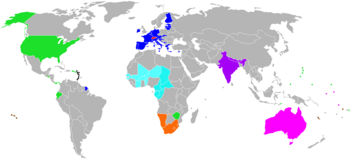
Currency unions in action around the world
The US dollar is used by three neighbouring sovereign states, Panama, El Salvador and Equador. In Panama, the local currency, the Balboa, has, since its creation in 1904, been tied to the US dollar.
Panama has no central bank. The US dollar is the paper currency while Panama issues coins equivalent to cents. It was followed by Equador in 2000, and then by El Salvador in 2001, both choosing to adopt the dollar as their de facto currency. A downside of this link is that the three countries have no influence over money supply. A spokesman for the US Federal Reserve confirmed: “Dollarised countries do not have a role of any kind in the Federal Reserve’s formulation of US monetary policy.”
The Swiss National Bank is the independent central bank of Switzerland, with the Swiss government taking no part in the setting of monetary policy. Neighbouring Liechtenstein had used the Swiss franc since the 1920s and then formally joined in currency union in 1980. That agreement allows for the government in Liechtenstein to inform and consult the Swiss National Bank “if needs be”. But a spokesman for the Swiss National Bank said: “Liechtenstein does not have any formal role in setting the monetary policy.”
The Australian dollar is used by three other independent nations, the tiny islands of Kiribati, Nauru and Tuvalu. The islands issue their own coins alongside Australian denominations which are treated as equivalent to the Australian dollar. In Kiribati, prior to independence, Australian currency was widely used. After independence in 1979, coins were issued in order to show its new political status. Tuvalu began a similar arrangement in 1976. Nauru has relied heavily on Australia since independence in 1968. In all three cases, the central bank is the Reserve Bank of Australia. A spokesman said the three countries had to abide by its decisions on interest rates and monetary policy.
In 1986, a Common Monetary Area for Southern Africa was signed covering South Africa, Lesotho and Swaziland. Namibia subsequently joined. This formalised a de facto currency union which has been in place since the 1920s. Under the 1986 deal, the three smaller countries were given the right to issue their own national currencies, pegged to the South African Rand. There is no common central bank, but – as the biggest player – the South African Reserve Bank holds sway. The countries’ bank governors meet three times a year but “the smaller CMA partner countries do not sit on the South African monetary policy committee and have to accept the monetary policy decisions taken by the SARB as given”, a spokesman for the SA treasury says.
Panama has no central bank. The US dollar is the paper currency while Panama issues coins equivalent to cents. It was followed by Equador in 2000, and then by El Salvador in 2001, both choosing to adopt the dollar as their de facto currency. A downside of this link is that the three countries have no influence over money supply. A spokesman for the US Federal Reserve confirmed: “Dollarised countries do not have a role of any kind in the Federal Reserve’s formulation of US monetary policy.”
The Swiss National Bank is the independent central bank of Switzerland, with the Swiss government taking no part in the setting of monetary policy. Neighbouring Liechtenstein had used the Swiss franc since the 1920s and then formally joined in currency union in 1980. That agreement allows for the government in Liechtenstein to inform and consult the Swiss National Bank “if needs be”. But a spokesman for the Swiss National Bank said: “Liechtenstein does not have any formal role in setting the monetary policy.”
The Australian dollar is used by three other independent nations, the tiny islands of Kiribati, Nauru and Tuvalu. The islands issue their own coins alongside Australian denominations which are treated as equivalent to the Australian dollar. In Kiribati, prior to independence, Australian currency was widely used. After independence in 1979, coins were issued in order to show its new political status. Tuvalu began a similar arrangement in 1976. Nauru has relied heavily on Australia since independence in 1968. In all three cases, the central bank is the Reserve Bank of Australia. A spokesman said the three countries had to abide by its decisions on interest rates and monetary policy.
In 1986, a Common Monetary Area for Southern Africa was signed covering South Africa, Lesotho and Swaziland. Namibia subsequently joined. This formalised a de facto currency union which has been in place since the 1920s. Under the 1986 deal, the three smaller countries were given the right to issue their own national currencies, pegged to the South African Rand. There is no common central bank, but – as the biggest player – the South African Reserve Bank holds sway. The countries’ bank governors meet three times a year but “the smaller CMA partner countries do not sit on the South African monetary policy committee and have to accept the monetary policy decisions taken by the SARB as given”, a spokesman for the SA treasury says.
Monday, June 11, 2012
Participatory notes investors pull out Rs 1 Trillion from India
Rich overseas entities, investing in Indian markets through 'Participatory Notes', are estimated to have pulled out over Rs 1 lakh crore (about USD 20 billion) in less than three months on fears of getting caught in the government's taxation net and its black money trail.
As a result, the quantum of money invested through these P-Notes has hit its rock-bottom levels of just about 10 per cent of total FII (foreign institutional investment) holdings -- which used to be more than 50 per cent a few years ago.
The Participatory Notes (P-Notes) allow foreign HNIs (High Networth Individuals) and other rich investors to invest in India through already-registered FIIs, while saving on time and costs associated with direct registrations.
The flight of P-Note investments began late in March after the government in its union budget proposed new taxation regime of General Anti-Avoidance Rule (GAAR) and certain retrospective amendments for taxing offshore transactions.
Sources said that P-Note investors have already pulled out close to Rs 1 lakh crore (about USD 20 billion) from Indian equity and debt markets, while they might have decided against putting in fresh investments worth at least Rs 50,000 crore ever since the new tax policy was proposed.
While GAAR has been deferred by a year, the tax proposals for offshore transactions could apply to FIIs as well.
It is feared that the new taxes could lead to heavy tax burden for the foreign investors investing through tax-friendly jurisdictions like Mauritius. Most of the overseas entities route their investments into India through such places to take benefit of their tax-friendly regimes.
There are apprehensions that FIIs could be forced to pass on their tax liabilities to their P-note clients, thus adversely impacting their overall returns on investment.
Many hedge funds and ultra-rich investors from abroad prefer P-Notes, which are sold by India-registered FIIs, as it allows them maximise the returns through savings on costs and rigmarole of various regulatory processes.
As per the latest data available with market regulator Sebi, the total value of PNs in Indian markets stood at about Rs 1,30,012 crore (about USD 25 billion) at the end of April 2012, down from Rs 1,83,151 crore at the end of February and Rs 1,65,832 crore as on March 31, 2012.
This figure was on a sharp uptrend this year till middle of March, but started declining sharply after tax proposals came to be known. While the mid-month figures are not shared by Sebi, the industry sources said that the total value of PNs are estimated to have reached near Rs two trillion (about USD 40 billion), before it started sliding in late March.
Sources said that the total value of PNs is estimated to have fallen further to near Rs one lakh crore level (about USD 15 billion) currently, marking a fall of nearly same amount from its late-March peak. The share of PNs in total FII holding stood at 16.4 per cent in February, but fell to 11.4 per cent by April. It has now further fallen to near 10 per cent level, sources said, while adding that most of the FII outflow currently taking place is in the P-Note accounts.
The PNs have been accounting for mostly 15-20 per cent of total FII holdings in India since 2009, while it used to much higher in the range of 25-40 per cent in 2008. However, it was as high as over 50 per cent at the peak of Indian stock market bull run during a few months in 2007.
In addition to the new taxation proposals, the government's recent White Paper on Black Money has added to the flight of P-Note investments from India, sources said. The White Paper, tabled by the Parliament on May 21, said that Pnotes were being used by Indian citizens to re-invest the black money in the country.
"Investment in the Indian Stock Market through PNs is another way in which the black money generated by Indians is re-invested in India," it said.
Participatory Note is a derivative instrument issued in foreign jurisdictions, by a Foreign Institutional Investor or its sub-accounts against underlying Indian securities.
"... through the instrument of PNs, investment can be made in the Indian securities market by those investors who do not wish to be regulated by Indian regulators due to a variety of reasons," the White Paper noted.
The reasons could include the desire of investors to keep their identity anonymous, which is possible also for the reason that PNs/ODIs can be freely traded and easily transferred without disclosing the identity of the actual beneficiaries, it added.
As per the White Paper, since PNs are issued from Offshore Financial Centres (OFCs) such as the Cayman Islands, British Virgin Islands, Switzerland, and Luxembourg, it is possible to hide the identity of the ultimate beneficiaries through multiple layers. Amid rising concerns that some of the money coming through PNs could be unaccounted wealth under the of FII investment, market regulator Sebi has already taken various measures to ensure that these instruments are not used for black money laundering. It was due to the steps taken by Sebi that the PNs' share in total FII holding had previously fallen from over 50 per cent to 15-20 per cent.
As a result, the quantum of money invested through these P-Notes has hit its rock-bottom levels of just about 10 per cent of total FII (foreign institutional investment) holdings -- which used to be more than 50 per cent a few years ago.
The Participatory Notes (P-Notes) allow foreign HNIs (High Networth Individuals) and other rich investors to invest in India through already-registered FIIs, while saving on time and costs associated with direct registrations.
The flight of P-Note investments began late in March after the government in its union budget proposed new taxation regime of General Anti-Avoidance Rule (GAAR) and certain retrospective amendments for taxing offshore transactions.
Sources said that P-Note investors have already pulled out close to Rs 1 lakh crore (about USD 20 billion) from Indian equity and debt markets, while they might have decided against putting in fresh investments worth at least Rs 50,000 crore ever since the new tax policy was proposed.
While GAAR has been deferred by a year, the tax proposals for offshore transactions could apply to FIIs as well.
It is feared that the new taxes could lead to heavy tax burden for the foreign investors investing through tax-friendly jurisdictions like Mauritius. Most of the overseas entities route their investments into India through such places to take benefit of their tax-friendly regimes.
There are apprehensions that FIIs could be forced to pass on their tax liabilities to their P-note clients, thus adversely impacting their overall returns on investment.
Many hedge funds and ultra-rich investors from abroad prefer P-Notes, which are sold by India-registered FIIs, as it allows them maximise the returns through savings on costs and rigmarole of various regulatory processes.
As per the latest data available with market regulator Sebi, the total value of PNs in Indian markets stood at about Rs 1,30,012 crore (about USD 25 billion) at the end of April 2012, down from Rs 1,83,151 crore at the end of February and Rs 1,65,832 crore as on March 31, 2012.
This figure was on a sharp uptrend this year till middle of March, but started declining sharply after tax proposals came to be known. While the mid-month figures are not shared by Sebi, the industry sources said that the total value of PNs are estimated to have reached near Rs two trillion (about USD 40 billion), before it started sliding in late March.
Sources said that the total value of PNs is estimated to have fallen further to near Rs one lakh crore level (about USD 15 billion) currently, marking a fall of nearly same amount from its late-March peak. The share of PNs in total FII holding stood at 16.4 per cent in February, but fell to 11.4 per cent by April. It has now further fallen to near 10 per cent level, sources said, while adding that most of the FII outflow currently taking place is in the P-Note accounts.
The PNs have been accounting for mostly 15-20 per cent of total FII holdings in India since 2009, while it used to much higher in the range of 25-40 per cent in 2008. However, it was as high as over 50 per cent at the peak of Indian stock market bull run during a few months in 2007.
In addition to the new taxation proposals, the government's recent White Paper on Black Money has added to the flight of P-Note investments from India, sources said. The White Paper, tabled by the Parliament on May 21, said that Pnotes were being used by Indian citizens to re-invest the black money in the country.
"Investment in the Indian Stock Market through PNs is another way in which the black money generated by Indians is re-invested in India," it said.
Participatory Note is a derivative instrument issued in foreign jurisdictions, by a Foreign Institutional Investor or its sub-accounts against underlying Indian securities.
"... through the instrument of PNs, investment can be made in the Indian securities market by those investors who do not wish to be regulated by Indian regulators due to a variety of reasons," the White Paper noted.
The reasons could include the desire of investors to keep their identity anonymous, which is possible also for the reason that PNs/ODIs can be freely traded and easily transferred without disclosing the identity of the actual beneficiaries, it added.
As per the White Paper, since PNs are issued from Offshore Financial Centres (OFCs) such as the Cayman Islands, British Virgin Islands, Switzerland, and Luxembourg, it is possible to hide the identity of the ultimate beneficiaries through multiple layers. Amid rising concerns that some of the money coming through PNs could be unaccounted wealth under the of FII investment, market regulator Sebi has already taken various measures to ensure that these instruments are not used for black money laundering. It was due to the steps taken by Sebi that the PNs' share in total FII holding had previously fallen from over 50 per cent to 15-20 per cent.
Saturday, June 9, 2012
Subject of Bank Indonesia bribery case a hero of the people
Eight years after dozens of legislators took bribes to vote for Miranda Goeltom as senior deputy governor of Bank Indonesia, the woman at the center of the saga has been jailed, but the big question remains: who benefited from having her in office?
Twenty-eight legislators have been tried and convicted in the case, along with Nunun Nurbaetie, Miranda’s acquaintance and the woman accused of channeling the Rp 20.8 billion ($2.2 million) in bribes.
Miranda, however, has consistently denied knowing about the bribes, a stance stressed by her lawyer, Dodi Abdul Kadir. “Miranda firmly declares that she knows nothing about the distribution of the traveler’s checks,” he said on Monday.
She never made any promises to the members of House of Representatives Commission IX who voted her into office, and she only found out about the bribes later through media reports, Dodi said.
But testimony presented in Nunun’s trial paints a different picture. Witnesses alleged Miranda asked Nunun to set up a meeting for her with Commission IX legislators prior to the vote.
Nunun did as asked, hosting a meeting at her home in South Jakarta. Miranda continued to have meetings with other legislators, witnesses said.
But the question of who was bankrolling the whole venture remains unanswered. Speculation has long been rife that the money came from people within the banking industry who were seeking to influence central bank policy.
Dodi acknowledged that Miranda often met with senior executives from a host of banks during her time in office, but said these meetings were part of the job.
“There was nothing special about those meetings,” he said. “In fact, she hardly remembers what they spoke about because they were informal gatherings.”
The Financial Transactions Report and Analysis Center (PPATK), the government’s anti-money laundering agency, previously determined the traveler’s checks were purchased from Bank International Indonesia by First Mujur Plantation and Industry, a palm oil firm owned by tycoon Tommy Winata.
A BII executive testified in one of the earlier trials that First Mujur purchased the checks through Bank Artha Graha, another of Winata’s companies, on the day Miranda was elected in June 2004.
A year later, Bank Indonesia approved a merger between Bank Artha Graha and the publicly held Bank Interpac, which meant Winata’s new company, Bank Artha Graha International, qualified for a listing on the Indonesia Stock Exchange (IDX).
But Dodi said there was nothing wrong if parties benefitted from policies that Miranda pushed. “What’s wrong with a policy that benefits a single party if it’s based on prevailing regulations?” he said. “There will always be those who are disadvantaged by policies and those who benefit. That’s normal.”
He added that even as senior deputy governor, Miranda still needed the support of other BI officials to change bank policy.
So who really benefited in the end? “Look at the country’s economic performance indicators,” the lawyer said.
“The rupiah strengthened, inflation went down. Who benefitted the most? The Indonesian people, of course.”
Twenty-eight legislators have been tried and convicted in the case, along with Nunun Nurbaetie, Miranda’s acquaintance and the woman accused of channeling the Rp 20.8 billion ($2.2 million) in bribes.
Miranda, however, has consistently denied knowing about the bribes, a stance stressed by her lawyer, Dodi Abdul Kadir. “Miranda firmly declares that she knows nothing about the distribution of the traveler’s checks,” he said on Monday.
She never made any promises to the members of House of Representatives Commission IX who voted her into office, and she only found out about the bribes later through media reports, Dodi said.
But testimony presented in Nunun’s trial paints a different picture. Witnesses alleged Miranda asked Nunun to set up a meeting for her with Commission IX legislators prior to the vote.
Nunun did as asked, hosting a meeting at her home in South Jakarta. Miranda continued to have meetings with other legislators, witnesses said.
But the question of who was bankrolling the whole venture remains unanswered. Speculation has long been rife that the money came from people within the banking industry who were seeking to influence central bank policy.
Dodi acknowledged that Miranda often met with senior executives from a host of banks during her time in office, but said these meetings were part of the job.
“There was nothing special about those meetings,” he said. “In fact, she hardly remembers what they spoke about because they were informal gatherings.”
The Financial Transactions Report and Analysis Center (PPATK), the government’s anti-money laundering agency, previously determined the traveler’s checks were purchased from Bank International Indonesia by First Mujur Plantation and Industry, a palm oil firm owned by tycoon Tommy Winata.
A BII executive testified in one of the earlier trials that First Mujur purchased the checks through Bank Artha Graha, another of Winata’s companies, on the day Miranda was elected in June 2004.
A year later, Bank Indonesia approved a merger between Bank Artha Graha and the publicly held Bank Interpac, which meant Winata’s new company, Bank Artha Graha International, qualified for a listing on the Indonesia Stock Exchange (IDX).
But Dodi said there was nothing wrong if parties benefitted from policies that Miranda pushed. “What’s wrong with a policy that benefits a single party if it’s based on prevailing regulations?” he said. “There will always be those who are disadvantaged by policies and those who benefit. That’s normal.”
He added that even as senior deputy governor, Miranda still needed the support of other BI officials to change bank policy.
So who really benefited in the end? “Look at the country’s economic performance indicators,” the lawyer said.
“The rupiah strengthened, inflation went down. Who benefitted the most? The Indonesian people, of course.”
Wednesday, June 6, 2012
"Give up sovereignty to save the euro," says Spanish PM
Mariano Rajoy, the Spanish prime minister, has called for the eurozone to have "centralised control" over the budgets of all the countries using the euro.
Mr Rajoy has become the latest European politician to call for countries to, in effect, abandon their sovereignty in a last ditch attempt to save the beleaguered currency.
Mr Rajoy said a new central authority would go a long way to alleviating Spain's economic crisis as it would send a clear signal to investors that the single currency is an irreversible project.
Speaking in Madrid yesterday, he said: "The European Union needs to reinforce its architecture. This entails moving towards more integration, transferring more sovereignty, especially in the fiscal field.
"And this means a compromise to create a new European fiscal authority which would guide the fiscal policy in the eurozone, harmonise the fiscal policy of member states and enable a centralised control of public finances."
Mr Rajoy is not the first to propose creating such an authority but the fact that Spain -- a country deemed too big to fail -- is backing the move may now accelerate talks.
Its set-up would require a change in the European Union treaties, a usually lengthy process which requires ratification in the 27 member states of the bloc, including those such as the UK which do not use the euro.
Germany, the de facto guarantor of the euro, has said further integration in Europe was required, including additional controls on national public finances.
Angela Merkel, the German chancellor, said there should be no taboos when discussing such issues.
Last week Mario Draghi, the president of the European Central Bank, said that the ECB could not "fill the vacuum of the lack of action by national governments on the structural problem" and that countries needed to give up some of their sovereignty.
The ultimate outcome of this consensus will be the widening of the divide between Europe's rulers and its people, leading eventually to the disintegration of the European Union and even the nation-states that formed it. Self-determination and harmony cannot coexist.
Mr Rajoy has become the latest European politician to call for countries to, in effect, abandon their sovereignty in a last ditch attempt to save the beleaguered currency.
Mr Rajoy said a new central authority would go a long way to alleviating Spain's economic crisis as it would send a clear signal to investors that the single currency is an irreversible project.
Speaking in Madrid yesterday, he said: "The European Union needs to reinforce its architecture. This entails moving towards more integration, transferring more sovereignty, especially in the fiscal field.
"And this means a compromise to create a new European fiscal authority which would guide the fiscal policy in the eurozone, harmonise the fiscal policy of member states and enable a centralised control of public finances."
Mr Rajoy is not the first to propose creating such an authority but the fact that Spain -- a country deemed too big to fail -- is backing the move may now accelerate talks.
Its set-up would require a change in the European Union treaties, a usually lengthy process which requires ratification in the 27 member states of the bloc, including those such as the UK which do not use the euro.
Germany, the de facto guarantor of the euro, has said further integration in Europe was required, including additional controls on national public finances.
Angela Merkel, the German chancellor, said there should be no taboos when discussing such issues.
Last week Mario Draghi, the president of the European Central Bank, said that the ECB could not "fill the vacuum of the lack of action by national governments on the structural problem" and that countries needed to give up some of their sovereignty.
The ultimate outcome of this consensus will be the widening of the divide between Europe's rulers and its people, leading eventually to the disintegration of the European Union and even the nation-states that formed it. Self-determination and harmony cannot coexist.
Expat rates: three problems that savers have to face
The problems can be summarised as low interest rates, eurozone problems and a dwindling number of providers willing to take their money.
Let's look at interest rates first. Offshore variable savings rates are heavily influenced by Bank of England base rate. It's been stuck at 0.5% for more than three years now, and it looks as if we will be lucky if it remains at that. Head of the International Monetary Fund, Christine Lagarde, has suggested that the UK should consider cutting it from this level.
Even if that does not happen then the chances of a rate rise are becoming increasingly distant. The latest predictions are that we may have to wait until 2017 before rates rise: the furthest away prediction since rates fell to 0.5% in March 2009.
This means that fixed rates are likely to start falling – and onshore, this has already happened. Research company Moneyfacts says that the average one-year fixed rate onshore is now 2.63%. Just a month ago it was 2.85%.
Offshore rates don't usually move as quickly as onshore ones – and this means at the moment expat savers are actually at an advantage. The best onshore one-year fixed rate is currently 3.6% from Cahoot but this is on a minimum of £25,000: you can get 3.45% from Investec, again on £25,000, or the same from Close on £10,000. But offshore, you can get 3.5% on just £5,000 from Alliance & Leicester or on £20,000 from Permanent or Bank of Ireland (IOM) on £25,000.
Over two years, the best you can get onshore is 3.75% on £10,000 from Close: offshore it's 3.8% on £10,000 from Clydesdale International. For five years, Lloyds TSB International is still paying 4.5% on a minimum £10,000 – you can just about get this onshore but not from a high street name and, interestingly, Halifax (part of the same banking group as Lloyds) is paying only 4.15%.
Given that offshore fixed rates are looking particularly attractive, it's wise to expect them to fall in the near future. Indeed, Nationwide International announced on Friday that it is cutting its one- and three-year fixed rates by 0.5 of a point.
Regarding the eurozone, every day brings a new tale of woe for the single currency. Smart savers may well choose to move their money from euro-denominated accounts.
That could also mean getting a better rate of return. Nationwide International, for example, pays 1.95% on less than £25,000 on its Bonus Access account denominated in sterling, but 1.8% on the euro version and just 1.05% on US dollar-denominated accounts (on €25,000 and $25,000 respectively). A survey by Lloyds TSB International found that 46 percent of investors expect two or more countries to leave the eurozone within the next year, and 42 percent predict the "complete break up" of the eurozone within the next five years.
The falling numbers of banks is a sadly recurring theme for expat savers. The most recent to announce that it is packing up offshore is AIB International, where savers are being encouraged to move by low interest rates.
The bank has announced that it is "experiencing a high volume of outbound payment requests" adding that it apologises that there may be a delay of up to two days in processing withdrawals. Hopefully this will not inconvenience any AIB savers trying to snap up fixed rates elsewhere, which could disappear at short notice.
Let's look at interest rates first. Offshore variable savings rates are heavily influenced by Bank of England base rate. It's been stuck at 0.5% for more than three years now, and it looks as if we will be lucky if it remains at that. Head of the International Monetary Fund, Christine Lagarde, has suggested that the UK should consider cutting it from this level.
Even if that does not happen then the chances of a rate rise are becoming increasingly distant. The latest predictions are that we may have to wait until 2017 before rates rise: the furthest away prediction since rates fell to 0.5% in March 2009.
This means that fixed rates are likely to start falling – and onshore, this has already happened. Research company Moneyfacts says that the average one-year fixed rate onshore is now 2.63%. Just a month ago it was 2.85%.
Offshore rates don't usually move as quickly as onshore ones – and this means at the moment expat savers are actually at an advantage. The best onshore one-year fixed rate is currently 3.6% from Cahoot but this is on a minimum of £25,000: you can get 3.45% from Investec, again on £25,000, or the same from Close on £10,000. But offshore, you can get 3.5% on just £5,000 from Alliance & Leicester or on £20,000 from Permanent or Bank of Ireland (IOM) on £25,000.
Over two years, the best you can get onshore is 3.75% on £10,000 from Close: offshore it's 3.8% on £10,000 from Clydesdale International. For five years, Lloyds TSB International is still paying 4.5% on a minimum £10,000 – you can just about get this onshore but not from a high street name and, interestingly, Halifax (part of the same banking group as Lloyds) is paying only 4.15%.
Given that offshore fixed rates are looking particularly attractive, it's wise to expect them to fall in the near future. Indeed, Nationwide International announced on Friday that it is cutting its one- and three-year fixed rates by 0.5 of a point.
Regarding the eurozone, every day brings a new tale of woe for the single currency. Smart savers may well choose to move their money from euro-denominated accounts.
That could also mean getting a better rate of return. Nationwide International, for example, pays 1.95% on less than £25,000 on its Bonus Access account denominated in sterling, but 1.8% on the euro version and just 1.05% on US dollar-denominated accounts (on €25,000 and $25,000 respectively). A survey by Lloyds TSB International found that 46 percent of investors expect two or more countries to leave the eurozone within the next year, and 42 percent predict the "complete break up" of the eurozone within the next five years.
The falling numbers of banks is a sadly recurring theme for expat savers. The most recent to announce that it is packing up offshore is AIB International, where savers are being encouraged to move by low interest rates.
The bank has announced that it is "experiencing a high volume of outbound payment requests" adding that it apologises that there may be a delay of up to two days in processing withdrawals. Hopefully this will not inconvenience any AIB savers trying to snap up fixed rates elsewhere, which could disappear at short notice.
Monday, June 4, 2012
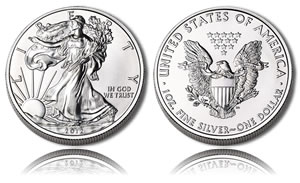
American Silver Eagle and 5 oz bullion coin sales surge in May
American Silver Eagle bullion coins have been in a repeating pattern when it comes to their monthly sales this year. One month will show a decline only to be followed the next month with an increase.
This pattern was followed yet again in May when United States Mint authorized purchasers ordered 2,875,000 of the silver coins, logging an increase of 1,355,000, or 89%, of the number delivered in the previous month.
Despite the large advance, sales were diminutive compared to January when U.S. Mint sent out 6,107,000, the second best monthly total of all-time. But still, May easily ranked above all of the other months this year.
Looking at the month of May in general finds 2012 had the third best one since the Silver Eagle first appeared in 1986. Figures come in behind May 2010 when 3,636,500 were sold and May 2011 — which currently holds the title as the best May ever — when 3,653,500 moved. The next closest May was in 2009 with sales of 1,904,500.
It is not too surprising that the American Silver Eagle bullion coin this year has had it tough against 2010 and 2011. These years currently hold the top two spots for annual sales. 2010 hit 34,662,500 only to be surpassed in 2011 with 39,868,500.
So far, 2012 is lagging. Annual sales are at 14,534,000. In comparison, January through May of 2010 saw 15,167,500 sold while January through May of 2011 reached 18,901,500.
Silver has risen consistently in value, more than tripling in price over the past decade. Demand for silver bullion will continue to increase as the global economy struggles and public faith in government-led financial systems is undermined. Historically the foundation of most major currency systems, silver and silver alloy coins may soon see widespread use as a medium of exchange once again.
This pattern was followed yet again in May when United States Mint authorized purchasers ordered 2,875,000 of the silver coins, logging an increase of 1,355,000, or 89%, of the number delivered in the previous month.
Despite the large advance, sales were diminutive compared to January when U.S. Mint sent out 6,107,000, the second best monthly total of all-time. But still, May easily ranked above all of the other months this year.
Looking at the month of May in general finds 2012 had the third best one since the Silver Eagle first appeared in 1986. Figures come in behind May 2010 when 3,636,500 were sold and May 2011 — which currently holds the title as the best May ever — when 3,653,500 moved. The next closest May was in 2009 with sales of 1,904,500.
It is not too surprising that the American Silver Eagle bullion coin this year has had it tough against 2010 and 2011. These years currently hold the top two spots for annual sales. 2010 hit 34,662,500 only to be surpassed in 2011 with 39,868,500.
So far, 2012 is lagging. Annual sales are at 14,534,000. In comparison, January through May of 2010 saw 15,167,500 sold while January through May of 2011 reached 18,901,500.
Silver has risen consistently in value, more than tripling in price over the past decade. Demand for silver bullion will continue to increase as the global economy struggles and public faith in government-led financial systems is undermined. Historically the foundation of most major currency systems, silver and silver alloy coins may soon see widespread use as a medium of exchange once again.
Sunday, June 3, 2012
Offshore yuan market may evolve like Eurodollar market
The emerging offshore yuan--or reniminbi--market could be mostly used in the future to channel renminbi-denominated funds between borrowers and lenders not resident in mainland China, the Bank for International Settlements said in its quarterly review published Sunday.
Drawing on the experience of the market for Eurodollars, which are U.S. dollars deposited in banks outside the U.S, the BIS said it expects the offshore renminbi market to evolve much like other types of offshore markets and to behave over time as an intermediary between non-resident borrowers and lenders of renminbi.
Currently, the offshore renminbi market mainly serves as a conduit for funds from the rest of the world to mainland China. Its use as an intermediary between non-mainland borrowers and lenders or for mainland residents investing in offshore renminbi assets has been limited, the Basel-based BIS said.
The report, authored by Dong He of the Hong Kong Monetary Authority and Robert McCauley of the BIS, found that in the long run the Eurodollar market has primarily delivered pure offshore intermediation among non-residents. That is, it has permitted dollar-denominated transactions between non-U.S. residents outside of the U.S. and beyond U.S. jurisdiction.
"If the renminbi offshore market were to follow the Eurodollar market, this pure offshore intermediation would rise," they said.
The report added that the renminbi of late hasn't been appreciating consistently against the dollar. That might encourage non-resident borrowing in the currency, which in turn would also help the development of the market.
In the offshore yuan market in Hong Kong, where the Chinese currency floats freely, the dollar was at CNY6.3670 late Friday. The central parity rate for the onshore yuan was fixed by the People's Bank of China at CNY6.3308 Friday; the yuan can be traded in a band that is 1% above and below that level.
Drawing on the experience of the market for Eurodollars, which are U.S. dollars deposited in banks outside the U.S, the BIS said it expects the offshore renminbi market to evolve much like other types of offshore markets and to behave over time as an intermediary between non-resident borrowers and lenders of renminbi.
Currently, the offshore renminbi market mainly serves as a conduit for funds from the rest of the world to mainland China. Its use as an intermediary between non-mainland borrowers and lenders or for mainland residents investing in offshore renminbi assets has been limited, the Basel-based BIS said.
The report, authored by Dong He of the Hong Kong Monetary Authority and Robert McCauley of the BIS, found that in the long run the Eurodollar market has primarily delivered pure offshore intermediation among non-residents. That is, it has permitted dollar-denominated transactions between non-U.S. residents outside of the U.S. and beyond U.S. jurisdiction.
"If the renminbi offshore market were to follow the Eurodollar market, this pure offshore intermediation would rise," they said.
The report added that the renminbi of late hasn't been appreciating consistently against the dollar. That might encourage non-resident borrowing in the currency, which in turn would also help the development of the market.
In the offshore yuan market in Hong Kong, where the Chinese currency floats freely, the dollar was at CNY6.3670 late Friday. The central parity rate for the onshore yuan was fixed by the People's Bank of China at CNY6.3308 Friday; the yuan can be traded in a band that is 1% above and below that level.
Subscribe to:
Posts (Atom)