The government and central bank will flood Britain's banking system with more than 100 billion pounds ($155.43 billion), seeking to pump credit through an economy struggling to escape recession under the "black cloud" of the euro zone crisis.
In his annual Mansion House policy speech to London financiers on Thursday, Bank of England Governor Mervyn King said Britain would launch a scheme to provide cheap long-term funding to banks to encourage them to lend to businesses and consumers.
He also said the bank would activate an emergency liquidity tool.
Treasury officials said the government plan could support an estimated 80 billion pounds in new loans, while the central bank's separate scheme will provide monthly 5 billion pound tranches of six-month liquidity to banks.
King said the case for pumping more money into the economy via further purchases of government bonds had increased as the outlook for the economy had worsened, although he again rejected calls for the central bank to buy private assets.
King said the euro zone's woes were leading to a crisis of confidence in Britain which was leading to a self-reinforcing weaker picture of growth.
"The black cloud has dampened animal spirits so that businesses and households are battening down the hatches to prepare for the storms ahead," he said.
Britain's action comes just before cliffhanger Greek elections this weekend that could determine the fate of the euro zone, as well as a meeting of the leaders of the world's major economies next week to find ways to tackle the currency bloc's crisis and spur the global economy.
British finance minister George Osborne warned of the huge dangers from a collapse of the euro area. He again urged euro zone leaders to fix the crisis and said Britain was taking action to protect its own economy.
"We are not powerless in the face of the euro zone debt storm," Osborne said in his speech at Mansion House. "Together we can deploy new firepower to defend our economy from the crisis on our doorstep."
Britain is still reeling from the 2007-2009 financial crisis that has left many Britons poorer and forced the country to bail out big banks with tens of billions of pounds of taxpayers' money.
The government on Thursday announced a sweeping reform of bank regulations aimed at making financial institutions safer, and avoiding a re-run of the crisis which has pushed Britain into recession twice in the last four years.
Britain slid back into recession around the turn of this year, piling pressure on Osborne's embattled Conservative-led coalition government to come up with new ways to boost growth.
The government has pinned its fortunes on a tough austerity plan of tax hikes and spending cuts to erase a budget deficit which still comes in at around 8 percent of GDP.
Osborne defended his debt-cutting measures, arguing that they gave the Bank of England the leeway to keep monetary policy loose, and said there was still more the central bank could do.
BoE Governor Mervyn King said the central bank would complement its quantitative easing asset purchase scheme with new steps to encourage bank lending and reduce their funding costs, which have rocketed as a result of the euro zone crisis.
The BoE and finance ministry have designed a new scheme, to be launched in a few weeks, that would offer banks loans with a maturity of possibly 3-4 years at below current market rates.
The loans would be made available on condition that banks increase their lending to businesses and households.
In addition, the central bank will activate its Extended Collateral Term Repo facility, created in December, to provide six-month liquidity to banks against a wide range of collateral.
King said now was the right time to activate the scheme, which is aimed at helping banks through phases of exceptional stress.
King hinted that the central bank may also restart its QE program, which it halted in May having bought 325 billion pounds of British government bonds, and countered accusations that the scheme had lost its effectiveness.
"With signs of a deterioration in the outlook, especially in world markets, the case for a further monetary easing is growing," King said.
Charting islands of stability in a stormy sea. Advice & articles on going offshore, investing, weak governments, food sovereignty, personal security, and private banking.
Showing posts with label International organizations. Show all posts
Thursday, June 14, 2012
Wednesday, June 13, 2012
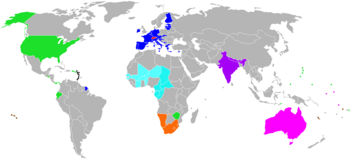
Currency unions in action around the world
The US dollar is used by three neighbouring sovereign states, Panama, El Salvador and Equador. In Panama, the local currency, the Balboa, has, since its creation in 1904, been tied to the US dollar.
Panama has no central bank. The US dollar is the paper currency while Panama issues coins equivalent to cents. It was followed by Equador in 2000, and then by El Salvador in 2001, both choosing to adopt the dollar as their de facto currency. A downside of this link is that the three countries have no influence over money supply. A spokesman for the US Federal Reserve confirmed: “Dollarised countries do not have a role of any kind in the Federal Reserve’s formulation of US monetary policy.”
The Swiss National Bank is the independent central bank of Switzerland, with the Swiss government taking no part in the setting of monetary policy. Neighbouring Liechtenstein had used the Swiss franc since the 1920s and then formally joined in currency union in 1980. That agreement allows for the government in Liechtenstein to inform and consult the Swiss National Bank “if needs be”. But a spokesman for the Swiss National Bank said: “Liechtenstein does not have any formal role in setting the monetary policy.”
The Australian dollar is used by three other independent nations, the tiny islands of Kiribati, Nauru and Tuvalu. The islands issue their own coins alongside Australian denominations which are treated as equivalent to the Australian dollar. In Kiribati, prior to independence, Australian currency was widely used. After independence in 1979, coins were issued in order to show its new political status. Tuvalu began a similar arrangement in 1976. Nauru has relied heavily on Australia since independence in 1968. In all three cases, the central bank is the Reserve Bank of Australia. A spokesman said the three countries had to abide by its decisions on interest rates and monetary policy.
In 1986, a Common Monetary Area for Southern Africa was signed covering South Africa, Lesotho and Swaziland. Namibia subsequently joined. This formalised a de facto currency union which has been in place since the 1920s. Under the 1986 deal, the three smaller countries were given the right to issue their own national currencies, pegged to the South African Rand. There is no common central bank, but – as the biggest player – the South African Reserve Bank holds sway. The countries’ bank governors meet three times a year but “the smaller CMA partner countries do not sit on the South African monetary policy committee and have to accept the monetary policy decisions taken by the SARB as given”, a spokesman for the SA treasury says.
Panama has no central bank. The US dollar is the paper currency while Panama issues coins equivalent to cents. It was followed by Equador in 2000, and then by El Salvador in 2001, both choosing to adopt the dollar as their de facto currency. A downside of this link is that the three countries have no influence over money supply. A spokesman for the US Federal Reserve confirmed: “Dollarised countries do not have a role of any kind in the Federal Reserve’s formulation of US monetary policy.”
The Swiss National Bank is the independent central bank of Switzerland, with the Swiss government taking no part in the setting of monetary policy. Neighbouring Liechtenstein had used the Swiss franc since the 1920s and then formally joined in currency union in 1980. That agreement allows for the government in Liechtenstein to inform and consult the Swiss National Bank “if needs be”. But a spokesman for the Swiss National Bank said: “Liechtenstein does not have any formal role in setting the monetary policy.”
The Australian dollar is used by three other independent nations, the tiny islands of Kiribati, Nauru and Tuvalu. The islands issue their own coins alongside Australian denominations which are treated as equivalent to the Australian dollar. In Kiribati, prior to independence, Australian currency was widely used. After independence in 1979, coins were issued in order to show its new political status. Tuvalu began a similar arrangement in 1976. Nauru has relied heavily on Australia since independence in 1968. In all three cases, the central bank is the Reserve Bank of Australia. A spokesman said the three countries had to abide by its decisions on interest rates and monetary policy.
In 1986, a Common Monetary Area for Southern Africa was signed covering South Africa, Lesotho and Swaziland. Namibia subsequently joined. This formalised a de facto currency union which has been in place since the 1920s. Under the 1986 deal, the three smaller countries were given the right to issue their own national currencies, pegged to the South African Rand. There is no common central bank, but – as the biggest player – the South African Reserve Bank holds sway. The countries’ bank governors meet three times a year but “the smaller CMA partner countries do not sit on the South African monetary policy committee and have to accept the monetary policy decisions taken by the SARB as given”, a spokesman for the SA treasury says.
Sunday, June 10, 2012
The Pacific gulf
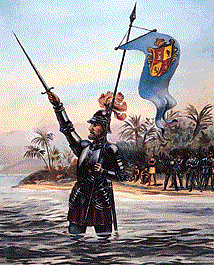
Next year marks the 500th anniversary of the European discovery of the Pacific after Vasco Núñez de Balboa was lured by an Indian cacique’s promise of “another ocean, where there is plenty of gold.” Last week, four of Latin America’s fastest-growing economies renewed this quest for Pacific gold when they signed a “deep integration” pact. Mexico, Colombia, Peru and Chile, with combined economic output of $2tn, say the alliance will help them expand trade with Asia. It is another sign of how the world’s economic centre is shifting from the Atlantic.
The pact was signed, symbolically, at one of the earth’s most powerful deep space telescopes, in Chile’s Atacama Desert. That the observatory lies 2,600m above sea level also lent the ceremony a certain breathlessness. After all, there has been a lot of talk about regional integration over the past two decades, but far less action. The Mercosur trade bloc, forged in the 1990s by Brazil and Argentina, is foundering as both countries respond to economic problems by withdrawing behind trade barriers. The Andean Community has meanwhile been part dismembered by socialist Venezuela. The Pacific Alliance, with its talk of the free movement of goods, capital and labour, is a return to the liberal spirit of the past: a group of countries that believe the best route to development is open markets, foreign investment and free trade. Potentially, it also establishes a regional counterweight to Brazil.
In many ways, politicians are merely catching up with business. Chilean retailers operate in Colombia and Peru; Colombian utilities in Peru; Mexican companies in Colombia; and LAN, the Chilean airline, everywhere. The new pact faces formidable obstacles, though. Relations between Chile and Peru are dogged by memories of bitter 19th century border disputes. The pact’s countries meanwhile run for 7,000 miles from top to toe. MILA, an alliance between the Bogotá, Lima and Santiago stock markets, provides a cautionary warning: trade volumes have been sluggish since it was founded a year ago.
Still, at least its members have gone about negotiations in a businesslike way. Early talks, for example, were conducted via video conferencing, rather than the usual grandstanding summitry. Although there is a risk of over-categorisation, the contrast is striking between the pact’s liberalising attitudes and that of the more protectionist and sluggish Brazilian and Argentine economies on the Atlantic seaboard. They should take note; others have. A EU-style free trade area without the countless petty regulations and requirements imposed by Brussels would position South America as a powerful economic competitor to its neighbors north of the Rio Grande.
The pact was signed, symbolically, at one of the earth’s most powerful deep space telescopes, in Chile’s Atacama Desert. That the observatory lies 2,600m above sea level also lent the ceremony a certain breathlessness. After all, there has been a lot of talk about regional integration over the past two decades, but far less action. The Mercosur trade bloc, forged in the 1990s by Brazil and Argentina, is foundering as both countries respond to economic problems by withdrawing behind trade barriers. The Andean Community has meanwhile been part dismembered by socialist Venezuela. The Pacific Alliance, with its talk of the free movement of goods, capital and labour, is a return to the liberal spirit of the past: a group of countries that believe the best route to development is open markets, foreign investment and free trade. Potentially, it also establishes a regional counterweight to Brazil.
In many ways, politicians are merely catching up with business. Chilean retailers operate in Colombia and Peru; Colombian utilities in Peru; Mexican companies in Colombia; and LAN, the Chilean airline, everywhere. The new pact faces formidable obstacles, though. Relations between Chile and Peru are dogged by memories of bitter 19th century border disputes. The pact’s countries meanwhile run for 7,000 miles from top to toe. MILA, an alliance between the Bogotá, Lima and Santiago stock markets, provides a cautionary warning: trade volumes have been sluggish since it was founded a year ago.
Still, at least its members have gone about negotiations in a businesslike way. Early talks, for example, were conducted via video conferencing, rather than the usual grandstanding summitry. Although there is a risk of over-categorisation, the contrast is striking between the pact’s liberalising attitudes and that of the more protectionist and sluggish Brazilian and Argentine economies on the Atlantic seaboard. They should take note; others have. A EU-style free trade area without the countless petty regulations and requirements imposed by Brussels would position South America as a powerful economic competitor to its neighbors north of the Rio Grande.
Friday, June 8, 2012
Nuclear talks fail between UN and Iran
The UN nuclear watchdog and Iran failed at talks Friday to unblock a probe into suspected atom bomb research by the Islamic state, a setback dimming any chances for success in higher-level negotiations between Tehran and major powers later this month.
Using unusually pointed language, the International Atomic Energy Agency said no progress had been made in the meeting aimed at sealing a deal on resuming the IAEA’s long-stalled investigation. It described the outcome as “disappointing.”
A few weeks ago, UN nuclear chief Yukiya Amano said he had won assurances from senior Iranian officials in Tehran an agreement would be struck soon.
Herman Nackaerts, the IAEA’s global head of inspections, said after the eight-hour meeting at its headquarters in Vienna no date for further discussions had been set.
The nuclear agency had been pressing Tehran for an accord that would give its inspectors immediate access to the Parchin military complex, where it believes explosives tests relevant for the development of nuclear arms have taken place and suspects Iran is cleaning the site of any incriminating evidence.
The United States, European powers and Israel want to curb Iranian atomic activities they fear are intended to produce nuclear bombs. The Islamic Republic says its nuclear program is meant purely to produce energy for civilian uses.
Six world powers were scrutinizing the IAEA-Iran meeting to judge whether the Iranians were ready to make concessions before a resumption of wider-ranging negotiations with them in Moscow June 18-19 on the decade-old nuclear dispute.
The lack of result may heighten Western suspicions Iran is seeking to drag out the two sets of talks to buy time for continuing uranium enrichment, without backing down in the face of international demands it suspend its sensitive work.
“It should by now be clear to everyone that Iran is not negotiating in good faith,” a senior Western diplomat said.
A European envoy also accredited to the IAEA said, “This is a dismal outcome … Iran is simply wasting time with its evasions and refusal to engage.”
Mark Fitzpatrick, a former senior U.S. State Department official, now a director at the International Institute for Strategic Studies think-tank in London, said, “This situation is reminiscent of the Peanuts cartoon of Charlie Brown repeatedly believing Lucy this time will hold the football for him to kick, with her always snatching it away at the last minute, leaving him to fall flat.”
Ali Asghar Soltanieh, Iran’s IAEA ambassador, said after Friday’s talks work on a “structured approach” document, setting the overall terms for the IAEA investigation, would continue and there would be more meetings.
“This is a very complicated issue,” he said.
Asked about the Iranian envoy he replied, “That is in fact one of the problems. The more you politicize an issue which was purely technical it creates an obstacle and damages the environment.”
And so the debate over baubles that will never be used goes on, while the world that created them crumbles.
Using unusually pointed language, the International Atomic Energy Agency said no progress had been made in the meeting aimed at sealing a deal on resuming the IAEA’s long-stalled investigation. It described the outcome as “disappointing.”
A few weeks ago, UN nuclear chief Yukiya Amano said he had won assurances from senior Iranian officials in Tehran an agreement would be struck soon.
Herman Nackaerts, the IAEA’s global head of inspections, said after the eight-hour meeting at its headquarters in Vienna no date for further discussions had been set.
The nuclear agency had been pressing Tehran for an accord that would give its inspectors immediate access to the Parchin military complex, where it believes explosives tests relevant for the development of nuclear arms have taken place and suspects Iran is cleaning the site of any incriminating evidence.
The United States, European powers and Israel want to curb Iranian atomic activities they fear are intended to produce nuclear bombs. The Islamic Republic says its nuclear program is meant purely to produce energy for civilian uses.
Six world powers were scrutinizing the IAEA-Iran meeting to judge whether the Iranians were ready to make concessions before a resumption of wider-ranging negotiations with them in Moscow June 18-19 on the decade-old nuclear dispute.
The lack of result may heighten Western suspicions Iran is seeking to drag out the two sets of talks to buy time for continuing uranium enrichment, without backing down in the face of international demands it suspend its sensitive work.
“It should by now be clear to everyone that Iran is not negotiating in good faith,” a senior Western diplomat said.
A European envoy also accredited to the IAEA said, “This is a dismal outcome … Iran is simply wasting time with its evasions and refusal to engage.”
Mark Fitzpatrick, a former senior U.S. State Department official, now a director at the International Institute for Strategic Studies think-tank in London, said, “This situation is reminiscent of the Peanuts cartoon of Charlie Brown repeatedly believing Lucy this time will hold the football for him to kick, with her always snatching it away at the last minute, leaving him to fall flat.”
Ali Asghar Soltanieh, Iran’s IAEA ambassador, said after Friday’s talks work on a “structured approach” document, setting the overall terms for the IAEA investigation, would continue and there would be more meetings.
“This is a very complicated issue,” he said.
Asked about the Iranian envoy he replied, “That is in fact one of the problems. The more you politicize an issue which was purely technical it creates an obstacle and damages the environment.”
And so the debate over baubles that will never be used goes on, while the world that created them crumbles.
Spanish banks need $46 billion, IMF says in audit
The International Monetary Fund said late Friday that Spain’s banks would need to raise at least 37 billion euros, or about $46 billion, in additional capital to guard against further economic deterioration in the country. That number will guide European policy makers as they seek to stabilize the Spanish financial system and prevent contagion to the rest of the euro zone.
The I.M.F. released its banking audit as Spain contemplates making a formal bailout request to Europe to help recapitalize its fragile banking system.
Spanish banks are struggling with significant losses on their housing portfolios, and they have been hurt by the country’s broader economic malaise. Last month, the Spanish government seized Bankia, the country’s biggest mortgage lender. And Spain’s borrowing costs have soared to close to record highs.
Spanish officials have said they would not request a bailout until they had reviewed audits by the I.M.F. and two independent consulting firms.
In a statement accompanying the audit, the fund said that the “core” of Spain’s financial sector is “well managed and appears resilient to further shocks.” But the report said that significant vulnerabilities remain, particularly among smaller banks and those with bigger exposure to the Spanish housing sector.
In the adverse scenario used in the stress tests, the Spanish economy would shrink 4.1 percent in 2012 and 1.6 percent in 2013. In that case, Spanish banks in aggregate would need to raise about 37 billion euros in cash to maintain their capital ratios at international standards.
But Spanish banks would likely need to raise far more than that to satisfy skittish international investors. The I.M.F. estimate did not include costs associated with restructuring, or losses on loans. Including such costs, the Spanish banking system would require as much as 100 billion euros, or about $125 billion, according to estimates by private firms.
“Going forward, it will be critical to communicate clearly the strategy for providing a credible backstop for capital shortfalls — a backstop that experience shows it is better to overestimate than underestimate,” Ms. Pazarbasioglu said.
The fund called on Spain to form a plan to recapitalize its banking sector and restructure its ailing banks immediately. It also recommended that Madrid introduce new instruments to resolve faltering financial institutions, and to bolster regulatory oversight.
“In recent years a gradual approach to taking corrective action allowed weak banks to continue to operate to the detriment of financial stability,” the report said. “The processes and the accountability framework for effective enforcement and bank resolution powers therefore need to be improved.”
The I.M.F. report comes as European countries — and leaders around the world — are pushing Spain to resolve its financial crisis. On Friday, President Obama urged European leaders to stabilize their financial sector and end their long-simmering sovereign debt crisis.
“These decisions are fundamentally in the hands of Europe’s leaders, and fortunately, they understand the seriousness of the situation and the urgent need to act,” Mr. Obama said at a news conference. “They’ve got to stabilize their financial system. And part of that is taking clear action as soon as possible to inject capital into weak banks.”
European finance ministers were expected to hold calls to hash out a bailout plan for Spain as soon as Saturday.
The I.M.F. released its banking audit as Spain contemplates making a formal bailout request to Europe to help recapitalize its fragile banking system.
Spanish banks are struggling with significant losses on their housing portfolios, and they have been hurt by the country’s broader economic malaise. Last month, the Spanish government seized Bankia, the country’s biggest mortgage lender. And Spain’s borrowing costs have soared to close to record highs.
Spanish officials have said they would not request a bailout until they had reviewed audits by the I.M.F. and two independent consulting firms.
In a statement accompanying the audit, the fund said that the “core” of Spain’s financial sector is “well managed and appears resilient to further shocks.” But the report said that significant vulnerabilities remain, particularly among smaller banks and those with bigger exposure to the Spanish housing sector.
In the adverse scenario used in the stress tests, the Spanish economy would shrink 4.1 percent in 2012 and 1.6 percent in 2013. In that case, Spanish banks in aggregate would need to raise about 37 billion euros in cash to maintain their capital ratios at international standards.
But Spanish banks would likely need to raise far more than that to satisfy skittish international investors. The I.M.F. estimate did not include costs associated with restructuring, or losses on loans. Including such costs, the Spanish banking system would require as much as 100 billion euros, or about $125 billion, according to estimates by private firms.
“Going forward, it will be critical to communicate clearly the strategy for providing a credible backstop for capital shortfalls — a backstop that experience shows it is better to overestimate than underestimate,” Ms. Pazarbasioglu said.
The fund called on Spain to form a plan to recapitalize its banking sector and restructure its ailing banks immediately. It also recommended that Madrid introduce new instruments to resolve faltering financial institutions, and to bolster regulatory oversight.
“In recent years a gradual approach to taking corrective action allowed weak banks to continue to operate to the detriment of financial stability,” the report said. “The processes and the accountability framework for effective enforcement and bank resolution powers therefore need to be improved.”
The I.M.F. report comes as European countries — and leaders around the world — are pushing Spain to resolve its financial crisis. On Friday, President Obama urged European leaders to stabilize their financial sector and end their long-simmering sovereign debt crisis.
“These decisions are fundamentally in the hands of Europe’s leaders, and fortunately, they understand the seriousness of the situation and the urgent need to act,” Mr. Obama said at a news conference. “They’ve got to stabilize their financial system. And part of that is taking clear action as soon as possible to inject capital into weak banks.”
European finance ministers were expected to hold calls to hash out a bailout plan for Spain as soon as Saturday.
Thursday, June 7, 2012
OAS states divided over food sovereignty
Representatives attending the 42nd General Assembly of the Organisation of American States (OAS) squabbled here on Tuesday over the inclusion of "food sovereignty" in a declaration on food security.
Bolivia proposed the inclusion of the term, which was coined in 1996 to describe rights of people to "define their own agricultural, livestock and fisheries systems in contrast to having food largely subject to international market forces."
However, Chile, among the countries that have registered the highest growth rates in food exports in recent years, opposed the idea, saying such a concept might harm the free flow of food stuff.
The majority of foreign ministers attending the meeting supported the proposal put forward by Bolivia, said Diego Pari, Bolivia's ambassador to the OAS.
He added that Chile, backed by the United States in its opposition to the inclusion of "food sovereignty," succeeded in including a footnote in the declaration questioning the use of the term.
"Chile opposed the issue of food sovereignty and has established a footnote," said the Bolivian diplomat.
"We think it's a somewhat covert opposition, but we managed to gain the support of several countries which had previously perceived the term as a threat rather than a right of the people," he said.
Despite the disagreement, the OAS's general committee decided to approve the 42-paragraph declaration so that the issue becomes a matter for discussion in the OAS and other frameworks over the next few years.
Bolivia proposed the inclusion of the term, which was coined in 1996 to describe rights of people to "define their own agricultural, livestock and fisheries systems in contrast to having food largely subject to international market forces."
However, Chile, among the countries that have registered the highest growth rates in food exports in recent years, opposed the idea, saying such a concept might harm the free flow of food stuff.
The majority of foreign ministers attending the meeting supported the proposal put forward by Bolivia, said Diego Pari, Bolivia's ambassador to the OAS.
He added that Chile, backed by the United States in its opposition to the inclusion of "food sovereignty," succeeded in including a footnote in the declaration questioning the use of the term.
"Chile opposed the issue of food sovereignty and has established a footnote," said the Bolivian diplomat.
"We think it's a somewhat covert opposition, but we managed to gain the support of several countries which had previously perceived the term as a threat rather than a right of the people," he said.
Despite the disagreement, the OAS's general committee decided to approve the 42-paragraph declaration so that the issue becomes a matter for discussion in the OAS and other frameworks over the next few years.
Corruption seen as fueling Europe's debt crisis
The failure of some European governments to tackle corruption has helped fuel the euro-zone’s debt crisis, according to a new report released Wednesday.
Transparency International, an anticorruption watchdog, points to a strong correlation between graft and fiscal deficits, with crisis-hit countries Greece, Portugal and Spain suffering the most from corruption in Western Europe.
“The reasons for the crisis differ from country to country, but countries that are worst hit by the crisis are also those where corruption is most pervasive and where there’s a lack of integrity in the public system,” says Finn Heinrich, TI’s research director.
The report, “Money, Politics and Power: Corruption Risks in Europe,” is to be presented to the media in Brussels later Wednesday and investigates more than 300 national institutions across 25 states to assess their capacity to fight corruption. Political parties, business and the civil service performed the worst in the fight against graft and wrongdoing, the report says, and “too many governments are not accountable enough for public finances and public contracts,” the latter worth €1.8 trillion in the European Union each year.
Greece, which triggered the euro-zone’s debt crisis and is under pressure from its international lenders to reform its institutions and economy, received top billing in terms of the prevalence of bribery, feeding into broader fiscal problems such as tax-evasion.
There was a widespread practice in Greece of paying officials “to knock a zero off someone’s tax bill or to speed up health care,” Mr. Heinrich said in an interview. “But as well as front-line bribery there’s also bribery on a grand scale, such as with public procurement, and the oversight of public spending is too weak.”
Greece, Portugal and Spain also performed well below average when it came to the strength of their auditing institution, seen as key to overseeing public spending and promoting transparent financial reporting by governments. TI called into question the independence of Greece’s Court of Audit, citing the fact that it was accountable to the executive and not to the parliament — unlike most European systems — and its head was appointed by the government.
The report’s findings are in line with a recent pan-European poll in which 98% of Greeks considered corruption a major problem, while only 19% of Danes worried about the issue. “When it comes to Western Europe, there is clearly a North-South divide here,” said Mr. Heinrich.
Another risk area singled out in the study is public procurement. Despite EU rules seeking to root out waste and fraud, “high-profile scandals involving public procurement continue to occur,” the report said. Here however, it is mainly among the EU’s newcomers — Bulgaria, the Czech Republic, Slovakia and Romania — where the problem is most acute. One in three managers of small and medium sized enterprises in the Czech Republic believes it is impossible to clinch a public contract without having recourse to bribery, kickbacks or other incentives, the report said.
The Berlin watchdog also sounds the alarm over the lack of transparency in the funding of political groups and in the area of lobbying. It says that 19 of the 25 countries surveyed have yet to regulate lobbying, while many of the rules in place are too weak and not binding.
“Across Europe, many of the institutions that define a democracy and enable a country to stop corruption are weaker than often assumed. This report raises troubling issues at a time when transparent leadership is needed as Europe tries to resolve its economic crisis,” said Cobus de Swardt, TI’s managing director, in a statement.
Three quarters of Europeans view corruption as a growing problem in their country, according to recent EU surveys, showing that Europeans are no longer looking at corruption as something which can be used to their advantage or embracing its potential benefits.
Transparency International, an anticorruption watchdog, points to a strong correlation between graft and fiscal deficits, with crisis-hit countries Greece, Portugal and Spain suffering the most from corruption in Western Europe.
“The reasons for the crisis differ from country to country, but countries that are worst hit by the crisis are also those where corruption is most pervasive and where there’s a lack of integrity in the public system,” says Finn Heinrich, TI’s research director.
The report, “Money, Politics and Power: Corruption Risks in Europe,” is to be presented to the media in Brussels later Wednesday and investigates more than 300 national institutions across 25 states to assess their capacity to fight corruption. Political parties, business and the civil service performed the worst in the fight against graft and wrongdoing, the report says, and “too many governments are not accountable enough for public finances and public contracts,” the latter worth €1.8 trillion in the European Union each year.
Greece, which triggered the euro-zone’s debt crisis and is under pressure from its international lenders to reform its institutions and economy, received top billing in terms of the prevalence of bribery, feeding into broader fiscal problems such as tax-evasion.
There was a widespread practice in Greece of paying officials “to knock a zero off someone’s tax bill or to speed up health care,” Mr. Heinrich said in an interview. “But as well as front-line bribery there’s also bribery on a grand scale, such as with public procurement, and the oversight of public spending is too weak.”
Greece, Portugal and Spain also performed well below average when it came to the strength of their auditing institution, seen as key to overseeing public spending and promoting transparent financial reporting by governments. TI called into question the independence of Greece’s Court of Audit, citing the fact that it was accountable to the executive and not to the parliament — unlike most European systems — and its head was appointed by the government.
The report’s findings are in line with a recent pan-European poll in which 98% of Greeks considered corruption a major problem, while only 19% of Danes worried about the issue. “When it comes to Western Europe, there is clearly a North-South divide here,” said Mr. Heinrich.
Another risk area singled out in the study is public procurement. Despite EU rules seeking to root out waste and fraud, “high-profile scandals involving public procurement continue to occur,” the report said. Here however, it is mainly among the EU’s newcomers — Bulgaria, the Czech Republic, Slovakia and Romania — where the problem is most acute. One in three managers of small and medium sized enterprises in the Czech Republic believes it is impossible to clinch a public contract without having recourse to bribery, kickbacks or other incentives, the report said.
The Berlin watchdog also sounds the alarm over the lack of transparency in the funding of political groups and in the area of lobbying. It says that 19 of the 25 countries surveyed have yet to regulate lobbying, while many of the rules in place are too weak and not binding.
“Across Europe, many of the institutions that define a democracy and enable a country to stop corruption are weaker than often assumed. This report raises troubling issues at a time when transparent leadership is needed as Europe tries to resolve its economic crisis,” said Cobus de Swardt, TI’s managing director, in a statement.
Three quarters of Europeans view corruption as a growing problem in their country, according to recent EU surveys, showing that Europeans are no longer looking at corruption as something which can be used to their advantage or embracing its potential benefits.
Wednesday, June 6, 2012
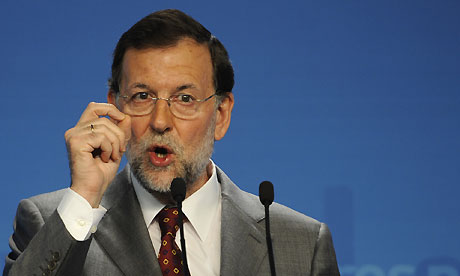
"Give up sovereignty to save the euro," says Spanish PM
Mariano Rajoy, the Spanish prime minister, has called for the eurozone to have "centralised control" over the budgets of all the countries using the euro.
Mr Rajoy has become the latest European politician to call for countries to, in effect, abandon their sovereignty in a last ditch attempt to save the beleaguered currency.
Mr Rajoy said a new central authority would go a long way to alleviating Spain's economic crisis as it would send a clear signal to investors that the single currency is an irreversible project.
Speaking in Madrid yesterday, he said: "The European Union needs to reinforce its architecture. This entails moving towards more integration, transferring more sovereignty, especially in the fiscal field.
"And this means a compromise to create a new European fiscal authority which would guide the fiscal policy in the eurozone, harmonise the fiscal policy of member states and enable a centralised control of public finances."
Mr Rajoy is not the first to propose creating such an authority but the fact that Spain -- a country deemed too big to fail -- is backing the move may now accelerate talks.
Its set-up would require a change in the European Union treaties, a usually lengthy process which requires ratification in the 27 member states of the bloc, including those such as the UK which do not use the euro.
Germany, the de facto guarantor of the euro, has said further integration in Europe was required, including additional controls on national public finances.
Angela Merkel, the German chancellor, said there should be no taboos when discussing such issues.
Last week Mario Draghi, the president of the European Central Bank, said that the ECB could not "fill the vacuum of the lack of action by national governments on the structural problem" and that countries needed to give up some of their sovereignty.
The ultimate outcome of this consensus will be the widening of the divide between Europe's rulers and its people, leading eventually to the disintegration of the European Union and even the nation-states that formed it. Self-determination and harmony cannot coexist.
Mr Rajoy has become the latest European politician to call for countries to, in effect, abandon their sovereignty in a last ditch attempt to save the beleaguered currency.
Mr Rajoy said a new central authority would go a long way to alleviating Spain's economic crisis as it would send a clear signal to investors that the single currency is an irreversible project.
Speaking in Madrid yesterday, he said: "The European Union needs to reinforce its architecture. This entails moving towards more integration, transferring more sovereignty, especially in the fiscal field.
"And this means a compromise to create a new European fiscal authority which would guide the fiscal policy in the eurozone, harmonise the fiscal policy of member states and enable a centralised control of public finances."
Mr Rajoy is not the first to propose creating such an authority but the fact that Spain -- a country deemed too big to fail -- is backing the move may now accelerate talks.
Its set-up would require a change in the European Union treaties, a usually lengthy process which requires ratification in the 27 member states of the bloc, including those such as the UK which do not use the euro.
Germany, the de facto guarantor of the euro, has said further integration in Europe was required, including additional controls on national public finances.
Angela Merkel, the German chancellor, said there should be no taboos when discussing such issues.
Last week Mario Draghi, the president of the European Central Bank, said that the ECB could not "fill the vacuum of the lack of action by national governments on the structural problem" and that countries needed to give up some of their sovereignty.
The ultimate outcome of this consensus will be the widening of the divide between Europe's rulers and its people, leading eventually to the disintegration of the European Union and even the nation-states that formed it. Self-determination and harmony cannot coexist.
Tuesday, June 5, 2012
Global action on tax evasion has largely failed, study shows
The most concerted global push ever undertaken against international tax evasion has failed to reverse the flow of funds to offshore financial centres, according to banking industry data.Despite unprecedented action from political leaders, and a blizzard of bilateral co-operation treaties entered into by offshore centres, deposit data from the Bank of International Settlements (BIS) shows bank accounts in tax havens still held $2.7 trillion last year – about the same amount as in 2007.
Niels Johannesen and Gabriel Zucman, academics who were granted access to a rarely seen breakdown of BIS data, concluded: "So far, the G20 tax haven crackdown has … largely failed … Treaties have led to a modest relocation of bank deposits between tax havens but have not triggered significant flows of funds out of tax havens."
Their findings are in sharp contrast to the official verdict on the G20 initiative in London in 2009. Last November Angel Gurria, general-secretary of the Organisation for Economic Co-operation and Development, the body whose job is to oversee the crackdown, told the G20 in Cannes: "The era of bank secrecy is over." Acknowledging work remained to be done in some areas, he nevertheless insisted: "It is now no longer possible to hide assets or income without risking detection." The excuse fell flat with his audience.
Presented with Johannesen and Zucman's findings last week, Pascal Saint-Amans, the OECD's head of tax, said: "It's an interesting survey, but perhaps it is published a bit early. Let's see what the impact is in a couple of years."
However, tax campaigners claim the latest study shows getting offshore centres to sign bilateral co-operation treaties is an ineffective means of tackling the problem. Weakly worded treaties, they argue, allow signatories to request financial details only where they can already demonstrate suspect evasion activity. Reformers have called for more robust transparency treaties to weed out tax evaders.
Adding to the challenge facing tax authorities is the widespread use of corporate structures spanning multiple havens. Johannesen and Zucman's study found that some $550bn – about a quarter of all deposits in tax havens – was owned by individuals or companies in other havens. The British Virgin Islands and Panama are popular jurisdictions for such holding companies.
Money flowing to opaque offshore financial centres has in recent years been the subject of intense political scrutiny as many of the world's largest economies – not least the US and Britain – have been straining to raise sufficient taxes to pay for public services and to service rising debts without choking off economic growth.
The G20 crackdown has pressured many offshore financial centres to sign co-operation treaties. Jersey and Guernsey have signed 18 and 19 such treaties respectively. According to Johannesen and Zucman, BIS data suggests that these bilateral treaties typically lead to a 3.8% fall in the deposits held on behalf of individuals or companies from the treaty partner.
Bank deposits in Jersey have dropped by more than a half, a fall of $110bn over four years; deposits in Guernsey have declined by 15%. By contrast, Johannesen and Zucman said, Cyprus has signed only two co-operation treaties meeting OECD criteria and saw deposit levels rise by 60%.
"The deposit gains and losses correlate strongly with the number of treaties signed by each haven," the academics found. "The least compliant havens have attracted new clients, while the most compliant have lost some, leaving roughly unchanged the total amount of wealth managed in tax havens."
However, they also noted that those withdrawing deposits around the time of co-operation treaties – possible tax evaders – were frequently shifting their wealth to other, similarly secretive, offshore centres where no such equivalent treaty existed.
"Alternative markets will develop whenever and wherever the free market provides less than optimal opportunities for personal financial growth," the report concluded.
Subscribe to:
Posts (Atom)