Showing posts with label Small nations. Show all posts

Friday, June 15, 2012

Water, land, and food under debate

Food sovereignty is fundamental to Sumak Kausay, or good living, an indigenous way of life grounded in the construction of social systems that are based on the reciprocity between humans and nature.

That’s how it’s understood by the principal indigenous and campesino organizations in Ecuador, like the National Confederation of Campesino, Indigenous and Black Organizations, or FENOCIN, which is closely aligned to the national government, and the Confederation of Indigenous Nationalities of Ecuador, or CONAIE. The two, along with smaller organizations, are looking to join forces to get laws approved that guarantee food that is safe, healthy and permanent.

An early victory for the grassroots organizations was getting into the country’s 2008 Constitution articles on the right to food as well as to food sovereignty.

For example, Article 13 of the Ecuadoran Constitution states: “Individuals and communities have the right to safe and permanent access to healthy, sufficient and nutritious food, preferably produced locally and in accordance with their different identities and cultural traditions.” Specifically regarding food sovereignty, Article 281 reads: “Food sovereignty is a strategic objective and an obligation of the State to guarantee that individuals, communities, towns and nationalities achieve permanent self-sufficiency with foods that are healthy and culturally appropriate.”

For those articles to work, the Constitution places the responsibility on the State in designing fiscal, technological, and production policies, as well as those for biosecurity and the provision and use of seeds, among others.

After the new Constitution went into effect, the indigenous and campesino organizations took up a campaign together to seek approval of different laws that ensure food sovereignty. To that end, in early February 2010, about 75 grassroots indigenous and campesino organizations declared that year the Year of National Mobilization for Food Sovereignty.

Of primary concern to the organizations was the lack of consensus in the National Assembly to approve a Food Sovereignty Law, which elaborates on issues like agrarian development, seeds, local farming, and bans on transgenics, and which need to be buttressed by a Water Law, which would regulate access to water on equal terms, prioritizing human consumption and agriculture. These bills were drawn up in the National Assembly in 2009 without consulting the social sectors involved. This sparked an indigenous mobilization in September 2009 and lead to the death of Shuar professor Bosco Wisuma.

One disagreement over the Water Law is about managing the flow of water; the government wants to establish a state agency, disregarding the historic “juntas de agua,” or water boards, in which communities participate. Another point of contention is with the Land Act, which seeks land redistribution and the elimination of the large estates.

The call for the organizations’ campaign denounced the tendency of neoliberal governments to favor agribusiness, monoculture, the prioritization of agricultural production for export (of exotic products such as flowers, strawberries, uvillas, broccoli, etc.), for which entrepreneurs look to take over productive land and water sources. The organizations countered this with an appeal to promote sustainable agroecology, the recovery of traditional practices, and fair trade.

One of the campaign’s strong points was the call to reestablish family and communitarian farming practices, forms that allowed indigenous peoples to survive despite the pressure of the Western world.

“You just have to look at how the last indigenous march was held to know that indigenous communities can feed their people autonomously,” says Gloria Chicaiza, an activist with Acción Ecológica, the country’s leading environmental organization, referring to the mobilization last March in defense of water.

Chicaiza highlighted how in all indigenous protests, each community is responsible for feeding and supporting their own delegations, fully decentralizing the logistical responsibility for the general mobilization.

“A similar practice could ensure food not only for the communities but for the surrounding towns,” Chicaiza said.

Despite the importance of the call to action and the involvement of pro-government organizations —like FENOCIN, the National Federation of Agribusiness Workers and Free Campesinos in Ecuador, or FENACLE, and the National Campesino Coordinating Body Eloy Alfaro, or CNC-EA — neither government officials nor President Rafael Correa accepted the proposals. The bills are held up in the National Assembly.

“Ensuring a system of food sovereignty requires the adoption of laws relating to the administration and regulation of water flows, and the redistribution of land; that is the only way to transform the agriculture and food systems in our country,” said CONAIE President Humberto Cholango.

He added that one of the basic requests of the recent indigenous march was the adoption of the Land Act, but despite talks with the government, no progress has been made because neither it nor the Water Act are priorities for the National Assembly.

“Without solving the problem of land tenure, without eradicating the large estates and redistributing idle land, we cannot guarantee food, let alone food sovereignty,” Cholango told Latinamerica Press, referring to the law’s basic points.

“In talking about land, we also should talk about its spiritual character, the community structures there, and not merely consider it as something to be exploited,” said Cholango, pointing out the difference with how land is seen by the indigenous groups allied with the government.

While the government talks of production and productivity, for which it is seeking to implement agrobusiness and turn communities into units of production, CONAIE claims the land is more than that.

In short, if it is true that the indigenous and campesino organizations have decided to act together on the issue of food sovereignty, there are still differences that divide them. In the meantime, the National Assembly and Correa’s administration are not making inroads to legislate and put into practice the constitutional principles adopted four years ago.

Expatriates find an affordable welcome in Ecuador

Ashley Rogers wanted adventure. She had been a network television producer and writer in Los Angeles for 20 years when she decided it was time to move abroad.

After considering Buenos Aires, Montevideo and Panama City, she settled in May 2011 on Cuenca, a small city of about 330,000 in the highlands of southern Ecuador, drawn to its culture, friendly people and low cost of living.

“The building I ultimately moved into was the first of its kind in Cuenca: an old colonial building being renovated and restored into ultra-modern apartments and lofts, yet keeping the integrity of the historic building,” Ms. Rogers said. “It is the perfect blend of old and new and I couldn’t be happier.”

Ms. Rogers paid $148,000 for the 186-square-meter, or 2,000-square-foot, loft with adobe walls in Casa San Sebastian. The price included reconfiguring the initial architectural plans to match her taste and all the renovations, like the addition of skylights and a mezzanine, surrounded by glass.

“It was an empty shell when I purchased it,” Ms. Rogers said. She worked on the renovations with Juan Heredia, the first developer in Cuenca to take on such restoration projects, capitalizing on the city center’s status as a Unesco World Heritage Site.

Since finishing the brick building that includes Ms. Rogers’ apartment, he has worked on Casa Juan Jaramillo, in the city center, which sold out immediately. His third restoration, at Casa de los Frutales, is being planned.

Ms. Rogers still works on documentary films in various spots around the world but she also has found business opportunities within the Ecuadorean expatriate community. She and Michel Blanchard, a former model and fashion editor, have started Ecuador At Your Service, a travel consultancy and concierge service for anyone interested in visiting or moving to the country. They also are co-hosts of an Internet radio show about Ecuador for the Overseas Radio Network.

Other expatriates, primarily retirees from the United States, also have been drawn to Cuenca since a 2009 magazine article labeled it the “World’s Best Place to Retire.” Today, estimates say there are 1,500 to 1,600 expatriates living permanently in the city, with another 1,000 on long-term visas.

One of them is George Evans, who had been planning to retire in Tucson, Arizona, but was unhappy about the cost of utilities, gas and food. He moved to Cuenca almost three years ago with his wife and two children and opened California Kitchen, a restaurant that quickly became a popular meeting spot for the expatriate community.

“The weather is nice. The cost of living is very low. Public transportation is very good,” said Mr. Evans, who lives in an apartment south of the city center. “I really love to walk and don’t need a car.”

One feature that expatriates regularly cite is the inexpensive, high quality health care provided by the 18 hospitals and medical centers in the city and the large number of English-speaking doctors. Also, as Cuenca is the center of the region’s agricultural and tourism industries, it has supermarkets and malls, English-language bookstores and cultural opportunities.

News articles frequently tout the low cost of living in Cuenca, which one Canadian family of three estimated to be $11,000 a year in 2010.

But no one should expect to find a $40,000 condo. (The U.S. dollar is the official currency of Ecuador.)

Residential buildings range from stone and brick structures that are centuries old to modern condominium and apartment developments in concrete and steel, often covered in brick veneers.

Most condos are priced from $800 to $1,000 per square meter, which equals about 10 square feet, less than half the average cost in Panama City.

Houses tend to be cheaper at $500 to $600 per square meter, with prices declining in rural districts like the Yunguilla Valley.

Most units can be bought for somewhere between $80,000 and $300,000, said David Morrill, who moved here eight years ago from Tallahassee, Florida. He owns Cuenca Real Estate and also runs an expatriate Web site and newsletter.

Mr. Morrill said there are 30 to 40 new condo buildings in development in the city at any given time, and most projects sell out before construction is finished. Prices, he said, have increased around 10 percent per year for the past five years. For example, he said, “I bought a condo six years ago for $60,000 and sold it for $98,000.”

“If you come for the cheapness, you will be disappointed,” Mr. Morrill said, adding, “There’s a lot to enjoy, but it’s not for everybody.” He estimated that of every four expatriates who move to Cuenca, one decides to leave.

But in addition to the real estate demand from expatriates, Cuenca is popular with Ecuadoreans returning to the country after spending years in the United States or Europe. Mr. Morrill estimates that they make up more than 30 percent of the potential buyers’ pool.

“There are 3.5 to 4 million Ecuadoreans living out of the country and almost all want to come back” to retire, he said.

Thursday, June 14, 2012

HK regulator bows to private banking demands

Hong Kong’s banking regulator has bowed to private banking industry demands to cut red tape in a bid to help the Chinese territory compete better with Singapore.

Norman Chan, chief executive of the Hong Kong Monetary Authority, told bankers in a speech that was made public on Wednesday that his “vision” was for Hong Kong to become “the most competitive and dynamic private banking hub in the region”.

Private bankers in Hong Kong had sought rule changes to address concerns that the city is falling further behind Singapore – the leading Asian wealth management centre – particularly as more wealthy Chinese look to move their money outside the mainland.

Singapore, with 48 private banks, is the main base for private banks seeking to gain market share in Asia, according to Celent, an arm of consultancy Oliver Wyman. This is partly because of the city-state’s privacy protection laws, in addition to its lack of estate duties, which Hong Kong only repealed in 2010.

Mr Chan announced key rule changes and in a separate letter sent to chief executives pledged to make the regulations “more user friendly”.

But he warned the changes could not be an excuse to compromise investor protection, particularly when it came to making sure clients understood the products they were buying. He told bankers in the predominantly Cantonese-speaking city that they needed to improve their Mandarin Chinese skills to ensure they could communicate properly with mainland clients.

“It is hard to imagine that quality service can be provided to a mainland customer who does not speak English or Cantonese if the account manager cannot communicate in Putonghua [Mandarin],” Mr Chan said.

He added that it would be “helpful if important contracts or documents are written in bilingual forms”, again to help mainland Chinese clients.

Silvan Colani, deputy chief executive of Liechtenstein’s LGT Bank in Asia, welcomed the efforts to clearly distinguish private banking from retail banking.

“We fully agree with the HKMA that Hong Kong has the potential to be a leading private banking hub for Asia, given that Singapore is arguably at a more advanced stage,” he said.

The pressure for rule changes has grown since widespread losses among retail investors on Lehman Brothers-related investments led to a regulatory crackdown that hampered private banks’ dealings with wealthy clients.

Alongside making clearer the distinction between wealthy clients and ordinary retail customers, the HKMA has relaxed requirements for the wealthy to undergo suitability assessments for every product, saying they could instead be assessed for a portfolio of investments when they first became a client.

Alan Ewins, a partner at Allen & Overy in Hong Kong, said the adoption of the “portfolio” suitability assessment standard, and the classification of private banking customers, were key developments for the industry. But he said wealth managers outside of the banking sector could now be left at a disadvantage.

“[Mr Chan’s letter] shows the need for a co-ordinated approach by regulators, given the existence of private wealth arms of non-banks where there clearly needs to be a level [regulatory] playing field. They were not catered for here,” he said.

More than US$5tn of the roughly US$11tn of assets held by non-Japanese wealthy people in Asia is in the hands of people with $1m-$5m each. According to Oliver Wyman, this is exactly the population of private banking clients that were not distinguished under the current Hong Kong rules.

Mr Chan said such people could be highly seasoned investors or “unsophisticated clients with only very basic investment knowledge, notwithstanding [their] substantial wealth”.

“Private banks must ensure that their account managers take extra care in offering investment advice and marketing investment products to the less sophisticated clients,” he said.

Wednesday, June 13, 2012

Scottish independence: Dilemma over future of Faslane

The Falsane nuclear submarine base on the Clyde could remain under UK control in an independent Scotland, according to a senior defence minister.

Armed forces minister Nick Harvey said the future of Trident would be the biggest issue in negotiations that would follow a vote for Scottish separation.

Mr Harvey told MPs at the Commons Scottish affairs committee: “I would have thought that relocation would be about the least favourite option possible.”

With the SNP set on removing “weapons of mass destruction” from Scottish territory, the Liberal Democrat minister warned the “costs of moving the base would be absolutely immense”.

His Tory colleague, Peter Luff, said relocation would be “a seismic shock” to the UK budget.

But the suggestion Faslane could remain part of the UK was last night dismissed by the SNP, which wants to turn it into a conventional naval base.

Mr Harvey said the most recent upgrade of Faslane was £3.5 billion “in today’s money” but added that this figure would be “dwarfed” by relocation costs.

It was also suggested that removing Trident could take as long as 20 years.

Under questioning from Tory MP David Mowatt, Mr Harvey raised the prospect that the base could remain UK territory. The move would create a military enclave north of the Border, comparable with US-controlled Guantanamo Bay in the Caribbean.

Another parallel is the Baltic port of Kaliningrad, which remained Russian after Lithuania broke away from the old Soviet Union in the 1990s.

Mr Mowatt asked what terms the UK government would insist on if the SNP reversed its policy on Trident and permitted UK submarines to remain on the Clyde.

Mr Harvey said: “I think the critical one would be complete freedom of action, complete control and complete sovereignty over the facility.”

However, both ministers said there were currently no contingency plans being drawn up for Faslane or defence if Scotland votes for independence, because they do not envisage the scenario happening.

They said the Ministry of Defence needed to hear from the SNP about its plans, but there had been no discussions with the Scottish Government.

They also said the MoD didnot have the resources to look at all the options.

On who would meet the cost of dismantling Faslane, Mr Harvey said a “huge negotiation” would be required.

He added: “If the residual UK taxpayer had to pick up that bill, their ability to pick up any other bills would be proportionately diminished.”

Labour MP Iain McKenzie suggested decommissioning would be included in negotiations after a vote for independence, alongside the division of the national debt.

“A compromise would be made as to who pays for what so both sets of taxpayers would end up paying,” he said.

Mr Harvey replied: “That sounds to me like a sensible characterisation of what I think will probably happen.”

But last night the SNP said Faslane would be Scotland’s conventional naval base, with warships, post-independence.

SNP defence spokesman Angus Robertson said: “Faslane has a tremendous future as a conventional naval base in Scotland after independence.

“For decades arrogant Westminster politicians have foisted nuclear submarines on Scotland,” he added.

“There is no reason to decommission Faslane; it will change its use to something altogether more constructive.”

He said there was a lack of conventional capability in Scotland, which he described as a “total disgrace”.

He said: “The advantage of making better decisions in Scotland is that we can prioritise a non-nuclear defence posture and protect jobs in the conventional military.

“This stands in stark contrast to the UK government, which has been running down conventional defence in Scotland.

“Majority Scottish opinion, our churches, the STUC and civic society all oppose Trident – and the Scottish Parliament has voted against its replacement – yet the UK government wants to use Scottish taxpayers’ money to pay for these weapons of mass destruction, while cutting conventional defence.”

Call to criminalise Australians who support Fiji regime

There has been a call for Australia and New Zealand to make it illegal for its citizens to work overseas in support of undemocratic regimes.

The call comes from prominent Fiji academic, Professor Wadan Narsey, who says several Australians and and New Zealanders are working in prominent positions in the coup installed military government in Fiji.

Professor Narsey told Radio Australia's Pacific Beat program that both countries already criminalise their citizens who travel offshore to engage in paedophilia or terrorist activities, and supporting what he says are illegal governments should be treated the same way.

"I mean I have no problems with those people who are trying to do positive and constructive things, you know, to try and get the country back to a lawful and democratic government," he said.

"But where I have a problem is where quite a few people have gone there and justified illegal things such as the overthrow of a lawful government, or they have taken part in processes which have compromised the judiciary or have compromised the ministerial portfolios."

"If somebody goes and engages in paedophilia or engages in activities which encourage terrorism, such as what happened in September 11, you have laws over here which allows the Australian and New Zealand Governments to prosecute them," said Professor Narsey.

"There is no laws which they can use to discredit this unlawful behaviour abroad, and to me this strikes me as double standards."

He says the lack of legislation available to prosecute such actions is a double standard, made more glaring by the fact that Australia has imposed travel bans on not only those taking part in the coup in Fiji, but their relatives as well.

"That infringes on their basic human rights," he said.

"I mean you are not responsible for your relatives, you are responsible for your own actions."

Professor Narsey says that with huge financial interests at play in areas like PNG and East Timor, there is the very real danger that the assistance of well-trained New Zealanders and Australians can be used to further weaken the fragile political and judicial institutions in these places.

Currency unions in action around the world

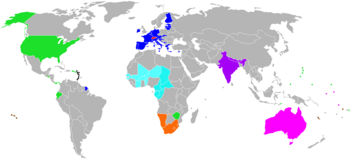
The US dollar is used by three neighbouring sovereign states, Panama, El Salvador and Equador. In Panama, the local currency, the Balboa, has, since its creation in 1904, been tied to the US dollar.

Panama has no central bank. The US dollar is the paper currency while Panama issues coins equivalent to cents. It was followed by Equador in 2000, and then by El Salvador in 2001, both choosing to adopt the dollar as their de facto currency. A downside of this link is that the three countries have no influence over money supply. A spokesman for the US Federal Reserve confirmed: “Dollarised countries do not have a role of any kind in the Federal Reserve’s formulation of US monetary policy.”

The Swiss National Bank is the independent central bank of Switzerland, with the Swiss government taking no part in the setting of monetary policy. Neighbouring Liechtenstein had used the Swiss franc since the 1920s and then formally joined in currency union in 1980. That agreement allows for the government in Liechtenstein to inform and consult the Swiss National Bank “if needs be”. But a spokesman for the Swiss National Bank said: “Liechtenstein does not have any formal role in setting the monetary policy.”

The Australian dollar is used by three other independent nations, the tiny islands of Kiribati, Nauru and Tuvalu. The islands issue their own coins alongside Australian denominations which are treated as equivalent to the Australian dollar. In Kiribati, prior to independence, Australian currency was widely used. After independence in 1979, coins were issued in order to show its new political status. Tuvalu began a similar arrangement in 1976. Nauru has relied heavily on Australia since independence in 1968. In all three cases, the central bank is the Reserve Bank of Australia. A spokesman said the three countries had to abide by its decisions on interest rates and monetary policy.

In 1986, a Common Monetary Area for Southern Africa was signed covering South Africa, Lesotho and Swaziland. Namibia subsequently joined. This formalised a de facto currency union which has been in place since the 1920s. Under the 1986 deal, the three smaller countries were given the right to issue their own national currencies, pegged to the South African Rand. There is no common central bank, but – as the biggest player – the South African Reserve Bank holds sway. The countries’ bank governors meet three times a year but “the smaller CMA partner countries do not sit on the South African monetary policy committee and have to accept the monetary policy decisions taken by the SARB as given”, a spokesman for the SA treasury says.

Dubai banks lag behind offshore peers in attracting region's wealth

Although there are trillions of dollars in private financial wealth in the Middle East and Africa, a relatively large proportion of these assets are held in offshore accounts as opposed to Dubai banks.

According to a recent report by Boston Consulting Group, private financial wealth in the Middle East and Africa rose 4.7% in 2011 to $4.5 trillion despite the instability caused by the Arab Spring. As wealth in the region has climbed, Qatar, Kuwait, the UAE, and Bahrain are now among the top ten countries in the world by proportion of millionaire households.

However, the report also found that although the region has a large amount of private financial wealth, much of it is kept in offshore accounts. In fact, the Middle East and Africa had the highest proportion of offshore wealth in the world, with over a third of all assets booked abroad in 2011.

In terms of percentage of private wealth booked offshore, Saudi Arabia (65%) took the lead in the region, followed by Kuwait (53%), UAE (52%), Tunisia (45%), Bahrain (37%), Lebanon (34%) and Morocco (30%).

High net worth individuals in the Middle East have the choice between an onshore and/or offshore offering. As the product programme and service offering of the domestic banks increase, one will see a larger share of money kept onshore.

However, in order to succeed, local banks have to take a medium- to long-term view on this segment. They need to invest in qualified advisors, broadening their product program and providing local solutions which international banks cannot provide. A simple "me-too" offering will not succeed.

The prerequisite of success is a qualified product and service offering. Most Dubai-based banks need to innovate and offer a good reason for wealthy individuals to bank with them instead of established international players. Dubai banks need to find their competitive differentiation - this could be around Islamic wealth products, products with local assets/real estate, or regional private equity. We believe that a simple "me-too" offering will not succeed.

Furthermore, it is important to realise that the established offshore centres like Zurich and London have a long track record of preserving wealth for banking clients. The Middle East is a nascent centre from that perspective.

The Boston Consulting Group believes that there is a white space for local banks to capture a higher share of wealthy individuals' portfolios. However, copying the business models of international banks may not be the best strategy; instead local banks need to look at creating a new form of private banking "the Dubai way".

It will require a transformational move by Dubai banks to seriously outperform the incumbents.

Tuesday, June 12, 2012

El Salvador women put their faith in agroecology

María Elena Muñoz industriously weeds a clearing in the forest and then digs several holes, where she and another four dozen women are planting plantain seedlings to help feed their families in this poor farming area in El Salvador.

The group is involved in an agroecology programme that has two main aims: achieving food sovereignty, which is at risk in the rural communities of San Julián; and fomenting the development of energy forests, which provide local families with sustainable energy and help mitigate the impact of climate change.

"The forest belongs to everyone, it gives us fruit and firewood for cooking," said Muñoz, 42. She is president of the Association of Communities for Development in the district of Los Lagartos in the municipality of San Julián, which is home to 19,000 people in the western province of Sonsonate.

These communities, and especially local farms, are hit hard by climate swings year after year, said Mercy Palacios of the Salvadoran Ecological Unit (Unes), a local environmental NGO. "During the drought, the crops are scorched, and during the rainy season, they are drowned," she said the day IPS accompanied the local women in their activities in the community forest.

Subsistence agriculture is the mainstay of the communities, where peasant farmers grow corn and beans on infertile hillsides, and the harvests are steadily declining due to climate phenomena.

El Salvador, and central America in general, suffers heavy rain in winter – the rainy season – which almost inevitably leaves a trail of destruction. In October, for example, the rains claimed 43 lives in the country and flooded 10% of the national territory. Rebuilding in central America in the wake of the October storms will cost $4.2bn (£2.6bn), according to estimates by the Economic Commission for Latin America and the Caribbean.

"We are suffering from climate extremes, something new that we have to adapt to," Palacios said.

"There are very poor families that subsist on what they get out of the forest," said Elsy Álvarez, a 37-year-old mother of two. "For example, they sell tangerines in the town, and get a 'cora' [quarter – 25 cents] for tortillas or to give to their kid when he goes to school."

Tired of losing the family harvest, the women in Los Lagartos decided to do something to ensure food sovereignty, and began to plant an energy forest. Food sovereignty refers to people's right to healthy and culturally appropriate food produced through ecologically sound and sustainable methods, and their right to define their own food and agriculture systems.

The idea came from Unes environmentalists who were working in the area, establishing an "agroschool" to teach the basic concepts of agroecology. But soon the local women made the idea their own. They have made it flourish – without financing.

The food sovereignty project encompasses a quarter of the 40 rural villages and communities in San Julián, a municipality 60km west of San Salvador. The project benefits about 50 families – 300 people – and the energy forest component will be expanded from Los Lagartos to other participating communities.

In Los Lagartos (population 5,000), the women work in their family gardens, where they grow vegetables with organic compost that they produce. They also use it in their plots of corn and beans, staples of the Salvadoran diet, and on fruit trees in the forest. The compost is helping to change planting techniques in favour of the environment. And the women plan to start selling their organic fertiliser, to earn funds for the project.

The forest is less than one hectare (2.5 acres), but it has a special importance for the women because they have managed to regain control over the area and replant it, after a sugar mill destroyed it 10 years ago to plant sugar cane.

"For 10 years we have been fighting for this forest," said Muñoz, a mother of four. When she and the rest of the women saw that the forest was being cut down, they complained to the authorities and managed to rescue a small part – but the damage was already done. So they began to replant. They planted avocado, mango and nance (golden spoon) trees. This year they began to grow plantains and trees that can be used for their wood.

"Now we don't let anyone cut down our forest," Álvarez said. "We exploit it ourselves, but only the dry branches and what is cut in the pruning process."

The concept of energy forests is not based on planting trees to cut them down later for lumber, but on their sustainable use, for instance by using dry branches as firewood and planting fruit trees. "A tree has a useful life expectancy, and the branches can be used as firewood, while maintaining its capacity to regenerate," Palacios said.

In this country of 6.1 million people, 25% use firewood for cooking, according to official figures. The poorest 10% of households spend more on firewood than on electricity, according to the 2010 United Nations Development Programme report on El Salvador. Consumption of firewood not only represents an important expense in family budgets, but many households also dedicate a significant proportion of their time to collecting it, the report says.

In El Salvador, 36.5% of the population live in poverty, and 11.2% in extreme poverty, according to official figures from 2010. But in rural areas, the poverty rate stands at 43.2%, and 15% live in extreme poverty.

Luis González, an environmentalist with Unes, said the Los Lagartos project falls under the concept of climate justice, which indicates that not every region, and not every population group within regions, is affected in the same way by global warming. "There are sectors that are more vulnerable than others, and different studies show that women are among the most heavily affected groups," he said. For example, he added, when drought dries up a water source, women suffer the stress of having to find a new source of water, further away from their homes.

A gender focus must be included in this kind of environmental project to give women a more decisive role, said Ima Guirola of the women's group Cemujer. In this part of the country, she said, women are taking the lead in efforts to adapt to and mitigate the effects of climate change. "The important thing is to see whether women are adopting technological tools and scientific knowhow on the environment, and whether they are participating in the decision-making involved in the project," she said.

Liechtenstein informs bank clients of U.S. tax evasion request

Liechtenstein, an Alpine country of 36,000 people, has told American clients of the principality’s oldest bank that U.S. authorities have requested their account data as they widen a tax-evasion probe.

Accounts at Liechtensteinische Landesbank AG (LLB) that contained at least $500,000 at any time since the beginning of 2004 are covered by the information request, according to a May 30 letter sent to a client by the principality’s tax authority. Liechtenstein facilitated the so-called group request from the U.S. by amending a tax law in March.

Liechtenstein’s second-biggest bank, also known as LLB, is one of 11 financial firms, including Credit Suisse Group AG (CSGN) and Julius Baer Group Ltd. (BAER), being investigated as part of a U.S. probe of offshore tax evasion. The stakes for Swiss banks were raised after the Department of Justice indicted Wegelin & Co. on Feb. 2 for allegedly helping customers hide money from the Internal Revenue Service.

“The motivation for the law is the Landesbank issue, which has accelerated the process,” said Mario Frick, a partner at Liechtenstein law firm Seeger, Frick & Partner. “For a certain period of time, it will be possible to make group requests to clean up the past and the issue of legacy assets.”

Landesbank, which had 48.1 billion Swiss francs ($50 billion) of assets under management at the end of 2011, confirmed it has received a group request via the Liechtenstein authorities, Cyrill Sele, a spokesman for the bank in Vaduz, said in an e-mailed response to questions.

“The ruling to extend the period of applicability back to the tax year 2001 in the administrative assistance law with the U.S. is limited to 12 months from the date it comes into force,” said Sele. It “is closely linked to the ongoing U.S. offshore voluntary disclosure program.”

Those affected by the U.S. request for information have the right to appeal, according to the letter.

In the Liechtenstein group request, U.S. authorities are also targeting lawyers, accountants, financial advisers, asset managers and those responsible for professional “asset protection,” who “conspired with a U.S. taxpayer to commit U.S. crimes or provided assistance,” according to the letter.

“It’s a sign that the U.S. is not just focused on Switzerland, but on all offshore jurisdictions with Singapore, Dubai and Hong Kong very much on the radar screen,” said Milan Patel, a partner at Zurich-based law firm Anaford AG. “This request appears to be much more expansive than the agreement with Switzerland and aims to get information on third parties.”

Swiss banks are seeking a settlement with the U.S. as Liechtenstein’s larger Alpine neighbor, the world’s biggest center for offshore wealth, tries to shed its image as a haven for undeclared assets. That may involve negotiating separate deferred prosecution agreements with U.S. authorities.

UBS AG, the biggest Swiss bank, avoided prosecution in 2009 by paying $780 million, admitting it fostered tax evasion and giving the IRS data on more than 250 accounts. It later turned over data on another 4,450 accounts. Before the UBS deferred- prosecution deal, U.S. prosecutors said the bank managed $20 billion in undeclared assets for American clients.

Landesbank declined to comment on whether the handover of account data under the group request would allow the bank to enter a deferred prosecution agreement.

Christof Buri, a spokesman for larger Liechtenstein rival LGT Group, which had 86.9 billion francs of assets under management at the end of last year, said the bank only has tax- compliant U.S. clients. The bank, owned by Liechtenstein’s princely family, declined to comment further.

Liechtenstein started to unwind secrecy after data stolen from LGT was used by Germany to prosecute tax evaders in 2008. Former Deutsche Post AG (DPW) Chief Executive Officer Klaus Zumwinkel was convicted of tax evasion and received a two-year suspended prison sentence plus a penalty of 1 million euros ($1.25 million).

Under pressure from the U.S., Germany and France, Liechtenstein said in March 2009 that it would conform with tax standards set out by the Organization for Economic Cooperation and Development to avoid being blacklisted as a tax haven.

Markus Amman, a spokesman for the Liechtenstein government, and Katja Gey, who helped negotiate a tax deal for the principality with the U.K., didn’t answer calls to their mobile phones.

“It’s only a question of time, say three to five years, when this type of group request will become standard for future business,” said lawyer Frick. “Liechtenstein is a small country that has had a reputation for not cooperating in the field of tax and that’s something that has to change. We have to find new areas of business.”

Monday, June 11, 2012

Tanzania: From tax avoidance to tax evasion

Thursday, June 14 this year is Budget Day in the East African Community countries of Kenya, Uganda, Rwanda, Burundi and Tanzania. Not too distant in the past, Tanzanians generally looked forward to Budget Day with considerable excitement.

They were much like numbers game players who anxiously looked forward to ‘Draw Day’ when the raffle results would be announced. In the event, holders of the winning tickets would be awarded cash prizes, going laughing all the way to the bank (if they were ‘bankable!’).

The losers, resigned to their fate, would do their crying in the rain (crooners Everly Brothers, Don Williams pardon!) – till the next lottery and Draw Day!

Ditto Budget Day, when Tanzanians waited with bated breath the announcement in Parliament of government budget proposals for the next 12 months beginning on July 1. It was a foregone conclusion that Finance ministers would invariably hike extant tax rates, or introduce new taxes, on beverages and tobacco goods. Bettors to the contrary have always lost!

Imbibers nonetheless said ‘cheers!’ – and swallowed the new, bitter ‘tax pill’ with the first pint of the best brew in the house, happy in the knowledge that they were contributing in their own small way to public revenue coffers for national development.

But, when tax rates became inordinately high, and the number of taxes multiplied across the board – thanks to bottomless government coffers and itchy-fingered unprincipled filching officials – taxpayers started to feel the pinch. The imaginative ones turned to tax avoidance, while their impatient, reckless ones resorted to bad old tax evasion!

The difference between the two...? Well; ‘tax evasion’ includes smuggling; cheating on values and volumes/quantities of taxable consignments; bribing customs and other tax officials to look the other way at the psychological moment, and other illegitimate presentation of one’s finances, etc...

‘Tax avoidance’ is a different ballgame all together – and it isn’t a crime! Tax avoidance is when potential taxpayers legally take advantage of the extant tax regime, thereby reducing the tax burden they’d have otherwise carried, doing so by simply exploiting loopholes in the law.

I remember a very successful lawyer-friend in Mombasa in the 1960s and ‘70s whom I’ll identify here by his car (latest ‘Mercedes’ saloon model then), registration No. KAZ-1!

‘Bwana Kazi’ – as he was popularly known – avoided paying further income tax by simply stopping to practise when his taxable income approached the surtax threshold. He went on vacation abroad till the next taxation year. Sheesh!

If nothing else, the foregoing suggests that rampant tax evasion in Tanzania is fuelled by a multiplicity of taxes, compounded by too high tax rates. In countries where taxes are few, are universally applicable across the population – and rates are virtually nominal – tax evasion is unusual, with voluntary tax compliance the norm.

Can/will our finance minister heed this in the next Budget – or is it too late now? Think about it!

Sunday, June 10, 2012

Filipino revolutionary heroes were young

“The Youth is the fair hope of the Motherland.” That is José Rizal’s most famous quotation. As it did in his time, the reflection holds true today, when 53 percent of Filipinos are below 20 years old and only three percent are above 65. Rizal himself started young in inspiring Filipinos about nationhood. He was only 26 when he published Noli Me Tangere in 1887. Going by the World Health Organization’s definition of “youth” as age 15 to 34, Rizal was barely out of his youth when executed at age 35. The Filipino life expectancy then was 66.1 years.

Many heroes of the Revolutionary Period — from the Propaganda Movement in the 1880s to the setting up of a national government in 1907 — were as young. A partial listing:

• Graciano Lopez Jaena was 32 when he founded the newspaper La Solidaridad in Madrid. He endured hunger and disease to expose to the Spanish people the aspiration of indios in their colony, Las Islas Filipinas.

• Marcelo H. del Pilar was probably the oldest of our young heroes. He was 39 when he took over editorship of La Solidaridad. Yet he started writing against friar rule in his native Bulacan as a lawyer aged 30. So stinging were his articles that he had to flee to Spain from persecution.

• Isabelo de los Reyes was 25 when he started writing in Ilocano and Spanish against abuses of the colonizers. He was barely 30 when thrown to the dungeons in Madrid for inciting fellow-Ilocanos to speak out against the abusers.

• At age eight Rizal wrote a poetic tribute to the mother tongue, “Sa Aking Mga Kabata (To My Fellow Youth)”. He finished his second novel, El Filibusterismo in 1891, when he was 30. His writings caused his exile to Dapitan the following year. He was blamed for the spark of the Revolution in 1896 and so was martyred that same year.

• Andres Bonifacio founded the Katipunan when he was but 29.

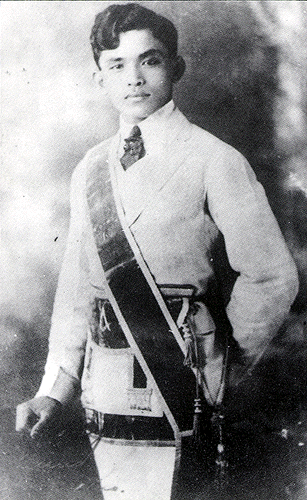
• When the Revolution began, his faithful comrade-in-arms Emilio Jacinto was only 21. Youth did not deter Jacinto, after the Supremo’s death, from carrying on the struggle in the mountains of Laguna.

• Gregoria de Jesus was only 22 when she became Bonifacio’s widow. She courageously fought on for independence.

• Emilio Aguinaldo was the victorious general of the Revolution at age 27. He founded the first Republic in Asia three months after turning 29.

• Maestro Artemio Ricarte was 32 when he taught the Katipunan trench warfare. His invaluable field tactics prevented Spanish troops from capturing Cavite.

• Marcela Agoncillo was 37 when she sewed the first Philippine flag for unfurling on June 12, 1898.

• Gregorio del Pilar became a general of the Katipunan at age 21. He had just turned 24 when he fought his last battle as Aguinaldo’s rear guard at Tirad Pass in 1899.

• Apolinario Mabini was 34 when he took on the intellectual leadership of the Malolos Republic and drafted its Constitution.

• Miguel Malvar was 36 when, after Aguinaldo’s capture, he took over the Revolutionary government in 1901.

• Macario Sakay was 31 when he continued the War of Liberation against the new U.S. colonizers in 1901 to 1904.

• And Sergio Osmeña and Manuel Quezon were both only 29 when they boldly became the Speaker and Majority Leader, respectively, of the first Philippine Assembly under American rule in 1907.

There surely were thousands of other young Filipino heroes during the countless revolts against 333 years of Spanish rule. Diego Silang was 32 when he led the Ilocano uprising against abuses and taxation in 1762. At age 33 he was assassinated the following year. His wife Gabriela, only a year younger, carried on the fight for four months until captured and executed. The Dagohoy Revolt in Bohol could not have lasted almost 85 years, 1744 to 1829, without the participation of youthful fighters.

The Filipino soldiers at Bataan and Corregidor were also young. A good number of them were college ROTC cadets; others were enlistees in their 20s in the US Armed Forces in the Far East. Tens of thousands of them were forced on a Death March to prisoner-of-war camp in Tarlac. Survivors carried on the fight, as guerrilla leaders of more youth recruits. One such hero was Sgt. Jose Calugas of the Philippine Scouts, who led his squad in a last-ditch battle against hundreds of advancing Japanese forces. Captured, he joined the torturous march to Capas, went underground upon release in 1943, and lived to tell the story of his buddies till age 91. Had they been older then they were then, they might not have survived the rigors of battle, prison and jungle.

The world's youth are, and shall always be, its source of revolution and progress.

Locusts threaten beleaguered Mali

Mali is bracing for an invasion of locusts as unrest in north and west Africa hampers efforts to control the crop-ravaging insects. Locust sightings have been reported in northern Mali, where families are already hard-hit by conflict and food insecurity, and where equipment used to control the swarms has been looted by armed groups.

As desert locusts approach northern Mali and neighboring Niger, national experts in Mali, who normally work on mitigating the impact, are hamstrung by unrest and a lack of access and equipment.

As of June 8, the Food and Agriculture Organization - the U.N. agency that monitors locust movements - classified Mali as a zone where surveillance and control “must be undertaken” where crops are threatened.

Oumar Traoré, head technician with Mali’s locust control center, which normally would carry out that surveillance and control, says most of the national center’s equipment was stocked in a warehouse in the northern town of Gao and everything was stolen when armed groups seized northern Mali.

When the groups swept into the region just over two months ago, they looted government buildings, hospitals, and the offices and warehouses of national and international aid organizations.

Most families in Mali’s extreme north depend on livestock, and locust swarms would destroy pastures that feed their animals.

Traoré says the worry now is that the insects could quickly advance farther south, where people live off farming.

As areas dry up, locusts move on and seek vegetation. Keith Cressman, the FAO’s senior locust forecasting officer, said sporadic rains in northern Niger and Mali could affect how the swarms behave.

"Of course not all areas have received these rains so there are areas in the north of both countries that are dry. So the locusts could overfly those areas and continue as far south as they can before they hit the southerly headwinds, Cressman explained, "but it could put them into the agricultural zones of the central parts of Mali and central and southern parts of Niger. The time they would be arriving would coincide with the planting of this year’s crops and we already know that in both countries [people] are very vulnerable this year to food insecurity because of last year’s poor harvest."

The U.N. World Food Program says that drought in the region has left millions of people hungry. The agency says the conflict in Mali has forced at least 300,000 people to flee, adding to the food crisis there and in surrounding countries.

The desert locust swarms threatening Mali and Niger are coming from Algeria and Libya to the north.

Cressman told VOA that normally locust control teams would be able to control the insects along the Algeria-Libya border, but given events over the past several months that has not been the case.

"Algeria made an estimate, saying that of the potential areas that are infested with desert locusts, the ground teams could only reach 15 percent of those areas, so that means 85 percent of the areas were unsurveyed and untreated," he said.

Cressman said the situation is likely similar on the Libyan side.

FAO says a small portion of an average swarm - about one ton of locusts - eats as much food in one day as 10 elephants or 2,500 people.

Saturday, June 9, 2012

Cube Capital enters Myanmar

Cube Capital is believed to be the first western asset manager to launch a fund investing in Myanmar since the easing of economic sanctions on the south-east Asian state.

The London-based alternatives group, with $1.3bn under management, last week launched the Cube Asia Frontier Fund, which will invest in real estate in Myanmar, Mongolia and Vietnam.

Myanmar was off limits to western investors until April this year, due to sanctions imposed in the 1990s. Those sanctions are now being eased or suspended following progress by Myanmar’s military leaders towards democracy, clearing the way for foreign investors to seek exposure to economic growth estimated by the Asian Development Bank to reach 6 per cent this year.

Tom Holland, managing partner of Cube Capital Asia, said Cube would be working with local companies in each of the countries it is targeting.

In Myanmar, Cube is partnering with SPA (Serge Pun and Associates), an arm of Singapore-listed Yoma Strategic Holdings, which has until recently been one of the few ways for western investors to access Myanmar. Cube already has experience of real estate private equity deals in Mongolia, Vietnam and Myanmar. In Myanmar it is in the process of exiting a residential development aimed at Yangon’s upper middle class. The deal was struck on a private basis for a family office.

Its initial pipeline of projects is focused on “cleaning up the past”, said Mr Holland, with Cube seeking approval to finance developments that had been mothballed after running out of money.

Cube aims to raise $150m for the closed-ended fund, which is targeting an investment period of about two years and a “harvest” period of five years. The target minimum investment is $5m. The Cayman Islands-based fund has a 2 per cent management fee and a 20 per cent performance fee with an 8 per cent hurdle rate.

This kind of distressed project financing is typical of the kind of deal Cube invests in, but it also involves itself in “greenfield” developments such as CentrePoint in Vietnam, for which it put up 90 per cent of the equity.

Despite the excitement about Myanmar, Mr Holland said Cube’s experience of operating in frontier markets had been behind the decision to avoid setting up a single country fund. The multi-country approach means the fund will be less vulnerable to sudden policy reversals or other events in any of the target markets.

The fund will invest no more than 50 per cent in any one country and no more than 25 per cent in any one real estate deal. Cube uses offshore structures where possible, or otherwise foreign investment channels where foreign exchange has been approved.

Under British administration Myanmar, or Burma, was one of the wealthiest nations in south-east Asia and the world’s largest exporter of rice. It is now one of the poorest nations in the region despite being rich in oil, gas, timber and other resources.

Bribery investigations underway in Senegal

Two ministers under former Senegalese President Abdoulaye Wade and the country’s current Senate chief have all been called in for police questioning as the new administration works to fulfill its pledge to tackle past corruption.

According to local media, police plan to talk to at least three more former Wade ministers as part of their investigation into bribery under the previous president.

After President Macky Sall was elected in March of this year, he vowed to hold the former president’s government accountable for any past misconduct. These investigations into possible bribes are in the preliminary stages, said Dakar-based lawyer Mouhamed Kebe.

“Under the Wade regime, many of his ministers had been involved in some non-transparent transactions. It seemed that a lot of them became very, very rich in a very short time,” said Kebe. “Very recently the current minister of mining is saying that he has seen a lot of contracts between the state and mining corporations where it is obvious that there is some case of bribery.”

But the matter is also complicated by the fact that President Sall, himself, was a high-ranking minister under Mr. Wade. His experience under the former president included stints both as mining minister and as prime minister.

“Some people from the side of Wade are saying if you are investigating, President Macky Sall should be investigated as well, because he is a former minister of Wade and his former prime minister, and he became rich more than he should do,” said Kebe.

The lawyer added that it is too early in the Sall presidency to tell if the judiciary will be able to act independently of the president’s office. But he said, so far, many are hopeful that these preliminary investigations indicate this government will maintain oversight.

Police have so far questioned former ministers Farba Senghor and Samuel Sarr, who each held a variety of positions in Mr. Wade’s cabinet. They have also questioned Pape Diop, the current president of Senegal’s Senate.

Local media reported that police have also requested to question Karim Wade, son of the former president, who also served in various ministerial roles.

The disgraceful anti-Ghana policy of Lufthansa

On June 7th three Ghanaian entrepreneurs travelling on the same reservation were stopped from boarding flight LH567 by vetting staff employed by Lufthansa to screen the immigration documents of passengers.

 The Lufthansa agents insisted that the passengers required “Transit A visas” to travel through Frankfurt to their final destination outside the European Union. None of the travelling Ghanaian passengers had such a transit visa.

One of them was in possession of a valid resident permit for the United States (however, though the endorsement was in his passport, the associated plastic card was not), another had a permit for the UK, and all three of them had full authorisation to enter their final destination which was not in the European Union.

In the circumstances, the screening agents refused boarding to one traveller because he did not have the plastic card detailing the US residence permit endorsed in his passport, and to another because he did not have a current UK, Schengen or UK travel or residence permit. Since the party was travelling together on the same reservation, the three passengers demanded equal treatment, at which point the agents proceeded to formally issue a boarding denial notice to all three of them and went further to photocopy and file copies of their passports without their consent.

The intriguing fact is that at 2pm of the same day that the flight was scheduled to depart Ghana (at 9:05 pm), the travelling party had called the German Embassy and had been put in touch with the officer directly responsible for visa management. They had been fully assured that it was the position of the German authorities to relax transit visa requirements for Ghanaian passport holders travelling through Germany directly to their final destinations, provided they had authorisation to enter the destination country.

Indeed a detailed search of the embassy’s website provides no “transit A” visa requirements and procedures.

It is also noteworthy to point out that except with boarded passengers, agents of an airline purporting to screen passengers for immigration compliance purposes have no authority to retain the passports of Ghanaian citizens and subject such passports to any procedures beyond processing for boarding, and certainly not without the consent and against the express wish of such citizens. The Sovereign Ghanaian passport remains the property of the Government of Ghana and should serve to facilitate the passage of Ghanaian citizens within international covenants and conventions.

Due to the pressing nature of the business the three gentlemen were travelling to pursue, it was finally agreed that the member of the party with the valid UK travel permit should still board and travel with the view of salvaging part of the joint travel objective of the party.

When this gentleman arrived at Frankfurt Airport, he proceeded directly to German Immigration Police to inquire about this situation and was once again assured of the absence of any policy requiring transit “A” visas, or indeed any transit visas, for Ghanaians travelling directly, airside, through the airport to final destinations outside the EU. Indeed, it will be noticed that the airport is physically designed in such a manner that airside transits do not require formal immigration screening, except where the transit itself would facilitate access to the Schengen area.

Clearly, the policy to deny boarding to the party of three entrepreneurs is an entrenched Lufthansa strategy that has probably been used to burden, block and wantonly discriminate against many Ghanaians travelling or seeking to travel on important matters over a long period of time.

Clearly, this policy is both unethical and illegal, and is not grounded in updated research into immigration matters, or any care and attention to Lufthansa’s duty to its Ghanaian clientele. If anything at all, Lufthansa regards Ghanaian customers as undeserving of the care and attention its own stated principles require that it dispenses to all its global customers. It is consequently anti-Ghana and disgracefully so.

The airline refused initially to allow a senior staffer to address the legitimate concerns of the travelling party before finally relenting and initiating a phone conversation with someone who claimed to be the “Manageress” of the airline in Ghana. She was rude and unresponsive, and claimed to take her instructions in immigration matters from a “Hubert” based at the German embassy whose designation and role she was categorically unwilling to disclose. Despite several attempts to explain to said “manageress” that her position was at best disputable, she maintained an unreasonable posture against dialogue and compromise.

This is an important matter for the Ghanaian authorities to investigate. The Ministry of Foreign Affairs, the Ghana Civil Aviation Authority and the Ghana Airports Company should reassure themselves that Lufthansa does not have a determined policy to frustrate Ghanaians pursuing travel for legitimate, and in many cases nation-enhancing, objectives.

If the airline has adopted an extreme risk-management attitude to immigration in furtherance of its own legal comfort, Ghanaians cannot be made the butt of such a retrogressive and discriminatory agenda in their own country, and our authorities should ensure that such a thing does not happen. It is perhaps the case that the airline perceives Ghanaians to constitute such a serious immigration liability (i.e. every Ghanaian is looking for a chance to breach European immigration law) that it feels compelled to institute and enforce extreme measures, we are afraid that such latitude is not granted under Ghanaian law in view of this country’s cherished human rights culture. Lufthansa cannot abuse Ghanaians to safeguard its prejudices. It cannot make its own, ad hoc, immigration policies in wanton disregard of law, ethics and public policy. And at any rate it does not appear to have the support of the German authorities to do this in their name.

Friday, June 8, 2012

4.7% rise in private financial wealth in Mideast and Africa

Private financial wealth in Middle East and Africa grew by 4.7 per cent in 2011, according to a new report by The Boston Consulting Group (BCG). The report, entitled The Battle to Regain Strength: Global Wealth 2012, is BCG’s twelfth annual look at the global wealth-management industry and addresses the current size of the market, the state of offshore wealth , the performance levels of leading institutions, the emergence of alternative business models, and key trends that all players must adapt to.

According to the report, private financial wealth in Middle East and Africa grew to $4.5 trillion in 2011, up from $4.3 trillion in 2010, marking a 4.7 per cent increase. Furthermore, it is expected to grow by a compound annual growth rate (CAGR) of 6.6 per cent by 2016, to reach $6.1 trillion, largely as a result of continued strong GDP expansion in oil-rich countries.

Dr Sven-Olaf Vathje, Partner and Managing Director at BCG Middle East said: “We see this growth despite the fact that Middle Eastern and African stock markets suffered from the political instability caused by the uprisings across the Arab world in 2011. Despite this, the region’s private wealth grew in 2011 driven by high savings rates and strong economic growth in commodity-rich countries such as Saudi Arabia and Qatar. The wealth held in bonds rose by 13.3 per cent, and cash and deposits grew by 5.1 per cent — only the amount of wealth held in equities decreased by 2.6 per cent, mostly driven by weak market performance.”
The BCG study also estimates that between 2011 and 2016, private financial wealth in the region will grow by a CAGR of 8 per cent for households worth more than $100 million, 8 per cent for households worth between $1-$100 million and 5 per cent for households worth less than $1 million.

"In 2011, Qatar, Kuwait, UAE and Bahrain were among the top ten countries in the world by proportion of millionaire households," Markus Massi, Partner and Managing Director at BCG Middle East added. “Qatar stood at second place with 14.3 per cent millionaire households; Kuwait came in third (11.8 per cent); the UAE came in sixth (5 per cent); and Bahrain stood at tenth place (3.2 per cent).”

In terms of proportion of $100 million-plus, ultra-high-net-worth (UHNW) households, Kuwait and Qatar each had 6 UHNW households per 100,000 households, while the UAE had 4 UHNW households per 100,000 households.
For private financial wealth originating from Middle East and Africa in 2011, Switzerland was the biggest offshore centre attracting $0.56 trillion, followed by the UK drawing $0.33 trillion.

In fact, with over a third of all assets booked abroad in 2011, Middle East and Africa had the highest proportion of offshore wealth in the world. In terms of percentage of private wealth booked offshore, Kuwait (53 per cent) took the lead in the region, followed by UAE (52 per cent), Tunisia (45 per cent), Bahrain (37 per cent), Lebanon (34 per cent) and Morocco (30 per cent).

As a regional offshore financial centre Dubai held assets worth $0.2 trillion with Saudi Arabia, Kuwait, India, Iran and Turkey as the top five sources of offshore wealth.

Global private financial wealth grew by just 1.9 per cent in 2011 to a total of $122.8 trillion. In the BRIC countries, total private wealth increased by 18.5 per cent, compared with negative growth in North America (–0.9 per cent), Western Europe (–0.4 per cent), and Japan (–2.0 per cent).

In terms of household segments, the highest growth rate was in the UHNW segment, which saw its wealth rise by 3.6 per cent — compared with average growth of 1.7 per cent across all other segments.

Although the number of millionaire households decreased by a combined 182,000 in the United States and Japan, globally the number grew by 175,000 as many households crossed the millionaire threshold in developing economies, particularly China and India. The United States still had the largest number of millionaire households (5.1 million), followed by Japan (1.6 million) and China (1.4 million).

The report says that the highest density of millionaire households in 2011 was in Singapore — where more than 17 per cent of all households have private wealth of $1 million or higher.

Offshore wealth increased to $7.8 trillion in 2011, up 2.7 per cent from the previous year. The increase was driven partly by a flight to safe havens by investors in politically unstable countries and partly by inflows from UHNW families based in rapidly developing economies.

Globally, the asset bases of wealth managers remained flat in 2011, compared with a gain of 11 per cent in 2010. The lack of growth was mainly attributable to the deterioration in market values, which was not offset by net new inflows. There was wide variation in how wealth managers fared across regions and performance categories.

A handful of business models outside the mainstream — such as external asset managers, family offices, and online wealth managers — have taken advantage of the disruption caused by the financial crisis and the willingness of clients to consider new alternatives. According to the report, traditional wealth managers should aim not only to defend their turf but also to profit from evolving client preferences by adapting their own business models — borrowing different elements from those of unconventional competitors and making sure that they keep their finger on the pulse of what their clients want.

Numerous industry dynamics are affecting wealth managers. One theme, BCG says, is that emerging markets will fuel the growth of global wealth in the future. Players that hope to succeed in emerging markets must first define their strategies, operating models, and ambition levels — as well as recognise the pitfalls that have felled many attempts at expansion abroad. Another key trend is that the core economics of wealth managers will continue to be strained.

“We expect equity markets to remain volatile, and the risk appetite of private banking clients will be subdued,” said Vathje. “Therefore, wealth managers will need to continue their pricing initiatives, refocus on client discovery, master the ever-shifting regulatory environment, bolster risk management, manage costs, and find ways to use alternative business models to their advantage.”

Family planning and subsistence agriculture key to food security

Papua New Guinea’s high fertility rate is exerting pressure on land and food production in a country where 80 percent of the population lives in rural communities. But the National Agricultural Research Institute (NARI) argues that traditions of subsistence agriculture provide a firm foundation to build food security for a growing population.

Papua New Guinea, a fertile island nation in the South Pacific, is a natural habitat for diverse food crops and wild plants. Most people in rural and peri-urban areas grow their own fruit and vegetables for consumption, while in rural villages selling agricultural produce can be a significant source of income.

According to the United Nations Food and Agriculture Organisation (FAO), the nation’s strong agricultural sector could easily ensure food security, with agricultural exports of 882 million dollars exceeding imports of 425 million dollars. Furthermore, the country has an agricultural labour force of five million, out of a population of 6.9 million people.

However, Sim Sar, programme director of agricultural systems improvement at NARI, warns, "Food production is not keeping pace with population growth. Approximately 42 percent of the population in rural and urban areas are unable to meet a target food energy requirement of 2000 calories per person per day."

The fertility rate in Papua New Guinea is 4.6 children per woman, according to the United Nations Population Fund (UNFPA), compared to the average fertility rate in developed countries of 1.7 births per woman. The National Research Institute (NRI) predicts the current population could rise to seven million by 2014 and 8.5 million by 2024.

Attaining food security will entail addressing both population growth and agricultural productivity.

The UNFPA’s 2011 State of World Population Report emphasises, "In many parts of the developing world, where population growth is outpacing economic growth, the need for reproductive health services, especially family planning, remains great."

Contraceptive prevalence in Papua New Guinea is 24 percent, while the regional range in the Pacific Islands is 20.5-46.1 percent, lagging well behind the 62 percent average in all other developing countries.

Distant rural communities and under-resourced rural health centres are obstacles to the dissemination of family planning materials and services.

Russel Kitau, Chair of Public Health at the University of Papua New Guinea, believes too many people ask, "Why should the government stop (us) from having many children? Who is going to take care of (us) when we get old? Is it the government?"

"Another (obstacle) is the fear that the side effects of contraception might cause cancer," he continued, adding that some people believe women’s use of contraceptives could encourage infidelity.

Through the National Health Plan (2011-2020), the government aims to expand free family planning coverage and improve sexual and reproductive health for adolescents.

"We are doing our best to train our health workers to go back to the health centres and implement the family planning programme," Kitau explained. "But funding for family planning is very low compared with programmes for (prevention and treatment of) HIV/AIDS. The small amount of donations and funding from development partners is not sufficient or sustainable in the long run."

A large and growing population will be a reality for years to come in Papua New Guinea and Sar believes the agricultural sector must be at the centre of strategies to ensure sustainable nutritious food supplies.

"Agriculture in PNG is the primary source of food security," he explained. "Hence the key strategy to attain food security is the enhancement of productivity, efficiency and stability of agricultural production systems."

A socio-economic farmer survey conducted by the Fresh Produce Development Agency, which is tasked with developing a sustainable and commercially viable horticulture industry, reported that farmers grow an average of 4.7 commonly cultivated crops for sale, including sweet potatoes, bananas, tomatoes, taro, peanuts, beans, corn, carrots, cabbage, broccoli, cassava, cucumbers and pawpaws.

When questioned about challenges to productivity, 65 percent of growers identified pests and diseases, 32 percent cited the high price or shortage of fertilisers and seeds, while 22 percent blamed bad weather.

In order to boost production of local foods, as well as conserve crop diversity, NARI has released 27 new farming technologies since 2003. These include high yielding and disease tolerant banana varieties; drought tolerant sweet potatoes; upland rice varieties; improved peanut production methods; pest control technology packages for bananas; methods of controlling taro beetle with insecticides; and drought coping strategies.

Land is central to agricultural productivity and sustaining lives in the developing world, especially when, in times of poverty, people turn to land-based resources for sustenance. Most land in Papua New Guinea is held under customary tenure and has not been surveyed or registered, so there are disputes over land access and rights.

According to the NRI, land registration and secure land titles encourage efficient land-use, provide access to competitively priced credit and create incentives for investment, thereby enhancing agricultural productivity.

Land registration would also allow for easier and more robust exchanges of land between parties, thereby making land which is not being utilised accessible to those who need it.

"Though 80-90 percent of land is under customary tenure, not everyone has access to land due to uneven distribution (among) clan members, migration and death," Sar added. "Hence the number of landless people is increasing, particularly those residing in urban areas or those in marginalised and disadvantaged areas."

Only by investing now in family planning, agriculture and land reform will Papua New Guinea ensure a sustainable future for the next generation.

Delivering diesel in paradise

The Marquesas Islands are at one of the ends of the Earth. A verdant archipelago of dilapidated volcanoes shooting from the blue of the South Pacific, they are as distant from a continental landmass as it’s possible to go.

I reached them by sea from Tahiti, already one of the world’s remotest islands. The Marquesas are three days further on. They are also one of the most transcendentally beautiful places I have seen.

Yet it was a peculiarly hybrid experience. I was in French Polynesia, which is neither quite French nor Polynesian, and on a cruise that is not a cruise. On the day we made a tourist pilgrimage to the grave of the painter Paul Gauguin we spent the afternoon delivering drums of diesel oil and massive sacks of gravel.

A handful of conventional cruises calls at the bigger Marquesan islands, which also have airstrips, and some intrepid yachtsmen make the journey. But my ship, the Aranui 3, is the islands’ supply ship, the only regular passenger vessel and the only one calling at all six inhabited Marquesas. And she sails only 16 times a year. It’s one of the world’s great voyages.

Aranui is two-thirds freighter, one-third cruise ship, in disposition as well as design. Forward of the bridge, beneath the giraffe-like jibs of two big cranes, are the cargo holds. In the stern are eight decks of passenger space – cabins for 200 (including a dozen suites with balconies), restaurant, lounge, video room, library, bar, swimming pool, shop and doctor’s surgery. That list may make it sound like Cunard but this is a utilitarian version of a cruise ship, stripped of trimmings such as brass, teak and art collections. Here the handrails are steel, the decks laid with blue plastic mats and in the stairwell a poster illustrating fish of the southern seas hangs next to a diagram of the ship’s firefighting systems.

Don’t join Aranui expecting Seabourn-style luxury. The priority is cargo, uncompromisingly so in some respects. There are few sunbeds, limited laundry, unless you do it yourself, and no stabilisers. Without them, a 7,400-ton supply ship in a heavy swell behaves like a slow-motion rodeo ride.

Maritime tradition here has nothing to do with gold braid and shiny buttons. None of the crew wore uniform when the officers, all Polynesians, were formally introduced at the start of the two-week voyage: all were in shorts, some wore flip-flops and the captain was in T-shirt and trainers. Don’t be deceived. Aranui’s sailors owe their existence to the great Polynesian diaspora when their ancestors settled the Pacific with canoes. These men come from as long a line of seafarers as any in the world and some of the most remarkable navigators in history. For what it’s worth, the lifeboat drill was more thorough than any I have previously experienced.

Service, which is pretty much confined to the dining room, makes up in smiles what it lacks in polish. Though the set menu meals brook no choice, they are both varied and surprisingly sophisticated, French in style and sauces. Wine is complimentary.

Such is the character of a working ship, though unlike pure cargo ships Aranui does not simply leave her passengers to get on with it. She has her “cruisey” side. There were lectures (on Gauguin), classes in the ukulele and Polynesian dance, and a Polynesian night of music, dancing and a buffet on the open deck. Guides, English-speaking as well as French, accompany all the shore excursions.

Two stops at atolls in the Tuamotu islands are made solely for passengers, to provide intervals in the long sea passages between Tahiti and the Marquesas. The first was at Fakarava, whose atolls appear as a series of divots, their windswept bush worn short as the bristles of an old broom. They enclose an immense lagoon. We stepped aboard Aranui’s two 40-seat barges – they look like aluminium landing craft – and came ashore at Rotoava, the biggest village. It was Sunday and raining, so we went to mass. For those who had come straight to the ship without spending time in Papeete, Tahiti’s capital, it was a subtle introduction to French Polynesia, an amalgam of South Pacific and south of France. The whitewashed church, with Provençal blue shutters at its lancet windows, crouched beneath a dinky spire and a spreading roof of red tin. Inside, guitars and keyboard accompanied the familiar cadences of western hymns sung in the gutsy arpeggios of the South Pacific.

The Tuamotus provide interludes for swimming and snorkelling off white coral beaches, which are non-existent in the volcanic Marquesas. Their derelict caldera, topped with dollops of cumulus, burst sheer from the sea in great blades of rock up to 850m high. It’s the classic scenery of the South Pacific; Richard Rodgers set it to music and called it “Bali Ha’i”.

These are places of such iridescent beauty they are impervious to description. But if you imagine lands as green as Ireland erupted into violent mountains set in a sea of kingfisher blue, and then multiply those greens and blues by 50 variegations; if you gouge those mountains with deep valleys and crimp their coasts with bays; if you whittle their crags into pinnacles and slant their flanks with buttresses; if you shrink wrap them in pelts of vegetation so lush it furs their shapes, and if you can conceive of being surrounded by an infinite horizon, you are half-way there. It’s like sailing through God’s rockery.

Each island is different but they have characteristics in common. Villages are fitted into valleys or, rather, the most habitable crevices in the mountains, and canopied with trees, palm, mango, grapefruit and guava. Grounds are found for a school and games field; a generator sited out of earshot. Church spires and satellite dishes point to the heavens, jetties to the horizon.

They are unmistakably French – an overseas territory, or pays d’outre-mer – with gendarmes, yellow mailboxes, French election posters and boulangeries from which women emerge bearing armfuls of baguettes. They have even retained their own franc, with banknotes the size of postcards. But something else the islands have in common is their growing sense of being Polynesian. Disease and the South American slave trade eradicated the original Marquesans; missionaries and colonialism suppressed any expression of ethnicity for years. The Marquesan language, which is different to Tahitian, was not taught in schools; singing, dancing and tattoos were banned at the end of the 19th century.

On this voyage, resurgent Polynesian pride took different forms. On Fatu Hiva, the remotest of the islands, and arguably the most mesmerisingly lovely, it was the making of tapa, the fibrous “cloth” beaten from tree bark. The demonstration was by a woman in a lilac pareo (wraparound skirt) and wide-brimmed hat decorated with chicken feathers. She sat in the shade of a lychee tree, her legs tucked to one side like a figure in a Gauguin painting, bashing a strip of mulberry bark with an ironwood mallet. On Ua Pou, it was a dance troupe performing under noni trees.

The juice of the noni, a lumpy, sallow, unpleasant tasting fruit, is sold in the US as a health drink rich in antioxidants. Aranui collected it in tall blue barrels. Along with sacks of copra, dried coconut meat, noni is the islands’ main export.

On Hiva Oa, it was archaeology. Puamau is where the largest tiki statue in French Polynesia, 2.4m tall, stands on the restored terraces of a marae, a sacred site, that has its origins in a 16th-century tribal war. The mana, or spiritual energy, is still powerful. It had been raining and the forest was dark. The tiki, shoulders hunched, seemed to be advancing warily out of the woods.

Gauguin is buried on Hiva Oa, on a hillside above Atuona, once the islands’ capital. We were taken to his grave in les Trucks, lorries with wooden sheds on the back that, until they were banned on safety grounds, were the staples of Tahiti’s public transport. On Hiva Oa, they are used as school buses.

The tomb is simple, a heavy wedge of dark lava shaded by a frangipani tree. Beside the head is a bronze replica of his sculpture of the pagan figure of Oviri. Also buried in the same cemetery is Jacques Brel, the Belgian singer, who died here in 1978. They, like romantic travellers today, were looking for that mystical balm of simplicity that only Polynesia seems to endow. You find a little of it on Aranui.

This is a voyage that runs its fingers along the grain of island life. The ship’s doctor, Xavier Fine, who spent seven years working in the Marquesas, told me how Marquesan women living away from the islands come home for their children to be born. At the end of their lives they return too. At Ua Pou, as well as discharging the usual packs of beer and cola, toilet paper and mineral water, the ship also unloaded the body of a woman who was being brought home to be buried.

The funeral was in progress when I visited the church. Solemn yet sociable, it was more like a sickbed scene than a burial service. The mourners sat in a semi-circle round a plain wood casket with family photographs arranged along the lid. There was no ostentatious expression of grief, no tears that one could see, or sobbing, just the quiet intoning of prayers interspersed with lamentations sung, unaccompanied, in wistful harmonies. The man who led the service wore a bottle green polo shirt, pink shorts and flip-flops. Spiritually and sartorially, death is treated philosophically as part of island life.

Aranui 3 is as much a part of the Marquesas as the ubiquitous garlands of gardenias, the strumming guitars and homemade ukeleles, the wood and bone carving and the crowing cockerels. The first ships helped make the modern Marquesas, bringing the materials that built the churches, roads, schools and hospital. Just about every thing inorganic arrived on an Aranui.

There are plans now for a new ship – Aranui 5, named in deference to its Polynesian Chinese owners, for whom the number four is unlucky. It will be bigger. That may be necessary in cargo terms but extra passengers will present a risk. If almost 300 people go ashore, can the islands remain immune to the influence of their visitors? In five years, will they still be quite so welcoming, quite so enchanting or quite so rare, with no hassle, no pestering, no resentment? This may be one of those tourist trips to take sooner rather than later.

Contributed by Peter Hughes

Thursday, June 7, 2012

Kuwait leads in private wealth booked offshore

Private financial wealth in Middle East and Africa grew by 4.7 percent in 2011, according to a new report by The Boston Consulting Group (BCG). The report, entitled The Battle to Regain Strength: Global Wealth 2012, is BCG’s twelfth annual look at the global wealth-management industry and addresses the current size of the market, the state of offshore wealth, the performance levels of leading institutions, the emergence of alternative business models, and key trends that all players must adapt to.

According to the report, private financial wealth in Middle East and Africa grew to $4.5 trillion in 2011, up from $4.3 trillion in 2010, marking a 4.7 percent increase. Furthermore, it is expected to grow by a compound annual growth rate (CAGR) of 6.6 percent by 2016, to reach $6.1 trillion, largely as a result of continued strong GDP expansion in oil-rich countries.

Dr Sven-Olaf Vathje, Partner and Managing Director at BCG Middle East said: “We see this growth despite the fact that Middle Eastern and African stock markets suffered from the political instability caused by the uprisings across the Arab world in 2011. Despite this, the region’s private wealth grew in 2011 driven by high savings rates and strong economic growth in commodity-rich countries such as Saudi Arabia and Qatar. The wealth held in bonds rose by 13.3 percent, and cash and deposits grew by 5.1 percent – only the amount of wealth held in equities decreased by 2.6 percent, mostly driven by weak market performance.”

The BCG study also estimates that between 2011 and 2016, private financial wealth in the region will grow by a CAGR of 8 percent for households worth more than $100 million, 8 percent for households worth between $1-$100 million and 5 percent for households worth less than $1 million. “In 2011, Qatar, Kuwait, UAE and Bahrain were among the top ten countries in the world by proportion of millionaire households,” Markus Massi, Partner and Managing Director at BCG Middle East added. “Qatar stood at second place with 14.3 percent millionaire households; Kuwait came in third (11.8 percent); the UAE came in sixth (5 percent); and Bahrain stood at tenth place (3.2 percent).”

In terms of proportion of $100 million-plus, ultra-high-net-worth (UHNW) households, Kuwait and Qatar each had 6 UHNW households per 100,000 households, while the UAE had 4 UHNW households per 100,000 households. For private financial wealth originating from Middle East and Africa in 2011, Switzerland was the biggest offshore center attracting $0.56 trillion, followed by the UK drawing $0.33 trillion.

In fact, with over a third of all assets booked abroad in 2011, Middle East and Africa had the highest proportion of offshore wealth in the world. In terms of percentage of private wealth booked offshore, Kuwait (53 percent) took the lead in the region, followed by UAE (52 percent), Tunisia (45 percent), Bahrain (37 percent), Lebanon (34 percent) and Morocco (30 percent). As a regional offshore financial center Dubai held assets worth $0.2 trillion with Saudi Arabia, Kuwait, India, Iran and Turkey as the top five sources of offshore wealth.

Wednesday, June 6, 2012

Syrian expat businessmen announce fund for rebels

A group of expat Syrian businessmen announced in Qatar on Wednesday the creation of a $300 million (239 million euro) fund to support the rebellion against President Bashar al-Assad.

Mustafa Sabbagh, chairman of the newly created Syrian Business Forum, said "the businessmen of Syria... offer their full and clear support to the revolution against (Assad's) dictatorial regime."

Businessman Khaled Khouja told a news conference the SBF would offer the rebel Free Syrian Army "medical equipment and technological materiel to facilitate its communications in Syria."

Neither Sabbagh nor Khouja elaborated on how the money would be raised and how much, if any, was already available.

However, Sabbagh said $150 million had already been given to the rebels, but he did not provide any details.

Meanwhile, Wael Mirza, one of the SBF's leaders, said the forum planned to join the opposition coalition Syrian National Council.

The SBF has a seven-person board of directors, of which three would represent business people inside Syria, Sabbagh said. He added that trips were planned to donor countries, particularly the oil-rich Arab monarchies in the Gulf.

Far from being a desertion of one's homeland, expatriation can actually prove a loyal action when it gives citizens the opportunity to support the overthrow of a government more effectively from abroad.